Cheshmazar Elhameh, Hosseini Agha Fatemeh, Yazdani Bahareh, Razmpoosh Elham, Zarrati Mitra
Department of Nutrition, School of Public Health, Iran University of Medical Sciences, Tehran, Iran.
Department of Biostatistics, School of Public Health, Iran University of Medical Sciences, Tehran, Iran.
Evid Based Complement Alternat Med. 2020 Nov 10;2020:3826237. doi: 10.1155/2020/3826237. eCollection 2020.
Improved vitamin D levels can have a favorable effect on some metabolic variables. The objective of the current study was to determine the effects of vitamin D supplementation during a weight-loss intervention on the levels of omentin-1, spexin, lipid profiles, and inflammatory factors in obese and overweight participants.
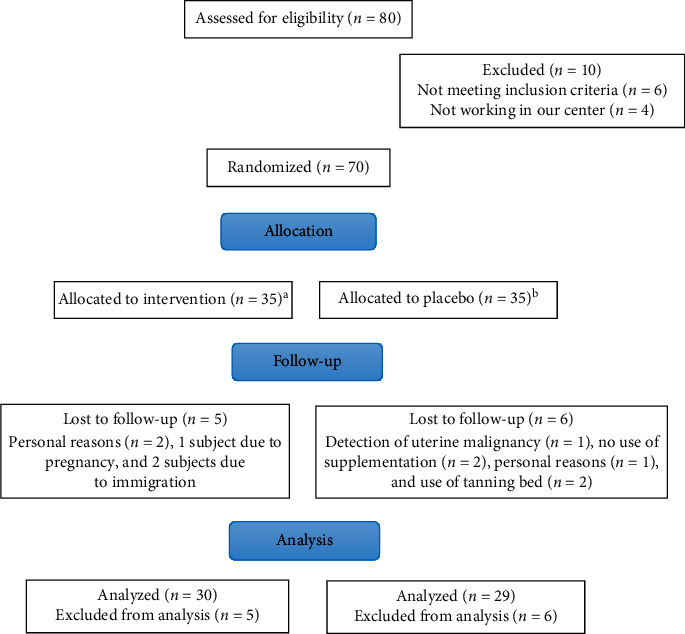
In this double-blind placebo-controlled randomized clinical trial, 70 overweight and obese participants with vitamin D deficiency (25(OH)D ≤ 20 nmol/L) were assigned into the intervention (a daily dose of 2,000 IU vitamin D + low-calorie diet) and placebo (placebo + low-calorie diet) groups for 8 weeks. Anthropometric parameters, serum levels of 25-hydroxy vitamin D (25(OH)D), lipid profiles, omentin-1 and spexin levels, high-sensitivity C-reactive protein (hs-CRP), and soluble intercellular adhesion molecule-1 (sICAM-1) concentrations were assessed before and after the intervention.
Vitamin D supplementation after the intervention led to a significant decrease in triglycerides (TG) ( = 0.02), very-low-density lipoprotein-cholesterol (VLDL-C) ( = 0.02), and hs-CRP ( = 0.03) concentrations and a significant increase in the serum vitamin D level ( < 0.001). Furthermore, after adjusting for baseline values, age, and baseline BMI, the levels of serum high-density lipoprotein-cholesterol (HDL-C) ( = 0.01) increased significantly, and a significant reduction was observed in the concentration of sICAM-1 ( = 0.01) in the intervention group. However, we did not find any significant difference in serum omentin-1 and spexin concentrations between the groups after intervention.
Vitamin D supplementation along with a low-calorie diet (LCD) program for 8 weeks significantly decreased the inflammatory markers in obese individuals, while it did not alter serum omentin-1 and spexin concentrations.
改善维生素D水平可能对某些代谢变量产生有利影响。本研究的目的是确定在减肥干预期间补充维生素D对肥胖和超重参与者的网膜素-1、信号肽、血脂谱和炎症因子水平的影响。
在这项双盲安慰剂对照随机临床试验中,70名维生素D缺乏(25(OH)D≤20 nmol/L)的超重和肥胖参与者被分为干预组(每日剂量2000 IU维生素D + 低热量饮食)和安慰剂组(安慰剂 + 低热量饮食),为期8周。在干预前后评估人体测量参数、血清25-羟基维生素D(25(OH)D)水平、血脂谱、网膜素-1和信号肽水平、高敏C反应蛋白(hs-CRP)以及可溶性细胞间黏附分子-1(sICAM-1)浓度。
干预后补充维生素D导致甘油三酯(TG)(P = 0.02)、极低密度脂蛋白胆固醇(VLDL-C)(P = 0.02)和hs-CRP(P = 0.03)浓度显著降低,血清维生素D水平显著升高(P < 0.001)。此外,在调整基线值、年龄和基线BMI后,干预组血清高密度脂蛋白胆固醇(HDL-C)水平(P = 0.01)显著升高,sICAM-1浓度(P = 0.