Gianchandani Neha, Jaiswal Aayush, Singh Dilbag, Kumar Vijay, Kaur Manjit
Department of Computer Science and Engineering, School of Computing and Information Technology, Manipal University Jaipur, Jaipur, Rajasthan 303007 India.
Computer Science Engineering, School of Engineering and Applied Sciences, Bennett University, Greater Noida, 201310 India.
J Ambient Intell Humaniz Comput. 2023;14(5):5541-5553. doi: 10.1007/s12652-020-02669-6. Epub 2020 Nov 16.
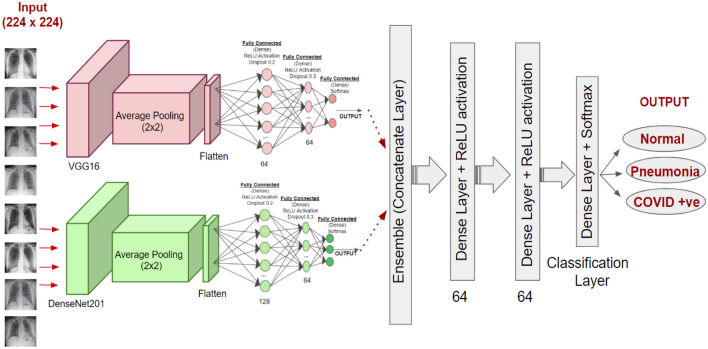
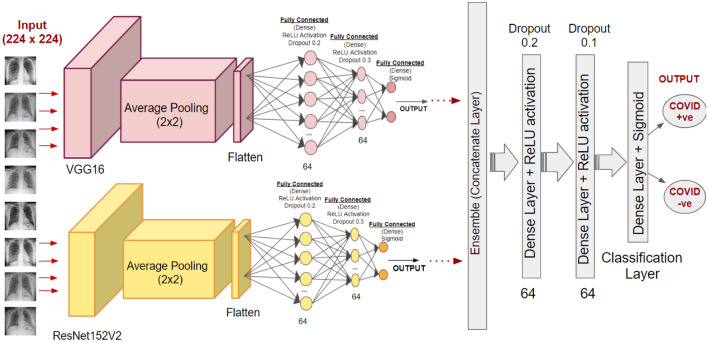
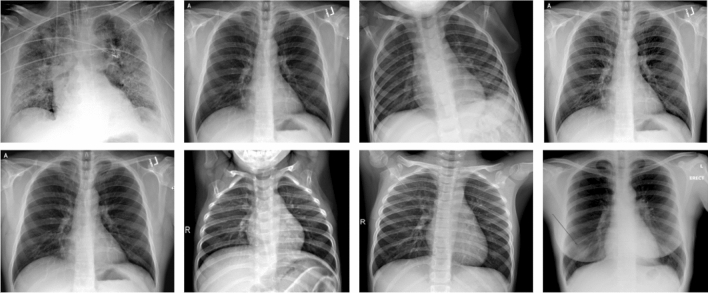
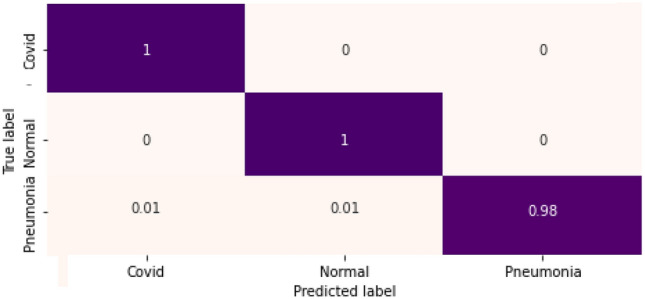
The severe acute respiratory syndrome coronavirus 2 (SARS-CoV-2) causes novel coronavirus disease (COVID-19) outbreak in more than 200 countries around the world. The early diagnosis of infected patients is needed to discontinue this outbreak. The diagnosis of coronavirus infection from radiography images is the fastest method. In this paper, two different ensemble deep transfer learning models have been designed for COVID-19 diagnosis utilizing the chest X-rays. Both models have utilized pre-trained models for better performance. They are able to differentiate COVID-19, viral pneumonia, and bacterial pneumonia. Both models have been developed to improve the generalization capability of the classifier for binary and multi-class problems. The proposed models have been tested on two well-known datasets. Experimental results reveal that the proposed framework outperforms the existing techniques in terms of sensitivity, specificity, and accuracy.
严重急性呼吸综合征冠状病毒2(SARS-CoV-2)在全球200多个国家引发了新型冠状病毒病(COVID-19)疫情。需要对感染患者进行早期诊断以终止此次疫情。通过放射影像诊断冠状病毒感染是最快的方法。在本文中,设计了两种不同的集成深度迁移学习模型,利用胸部X光片进行COVID-19诊断。两种模型都使用了预训练模型以获得更好的性能。它们能够区分COVID-19、病毒性肺炎和细菌性肺炎。开发这两种模型是为了提高分类器在二分类和多分类问题上的泛化能力。所提出的模型在两个知名数据集上进行了测试。实验结果表明,所提出的框架在敏感性、特异性和准确性方面优于现有技术。