Shelke Ankita, Inamdar Madhura, Shah Vruddhi, Tiwari Amanshu, Hussain Aafiya, Chafekar Talha, Mehendale Ninad
K. J. Somaiya College of Engineering, Vidyavihar, Mumbai, India Maharshtra 400077.
SN Comput Sci. 2021;2(4):300. doi: 10.1007/s42979-021-00695-5. Epub 2021 May 26.
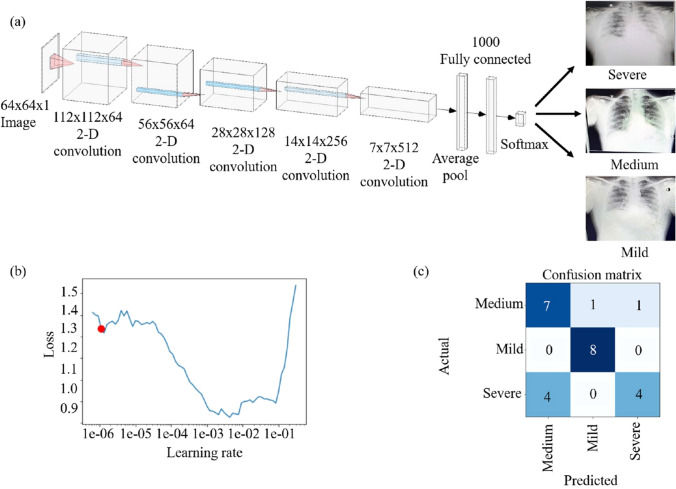
In today's world, we find ourselves struggling to fight one of the worst pandemics in the history of humanity known as COVID-2019 caused by a coronavirus. When the virus reaches the lungs, we observe ground-glass opacity in the chest X-ray due to fibrosis in the lungs. Due to the significant differences between X-ray images of an infected and non-infected person, artificial intelligence techniques can be used to identify the presence and severity of the infection. We propose a classification model that can analyze the chest X-rays and help in the accurate diagnosis of COVID-19. Our methodology classifies the chest X-rays into four classes viz. normal, pneumonia, tuberculosis (TB), and COVID-19. Further, the X-rays indicating COVID-19 are classified on a severity-basis into mild, medium, and severe. The deep learning model used for the classification of pneumonia, TB, and normal is VGG-16 with a test accuracy of 95.9 %. For the segregation of normal pneumonia and COVID-19, the DenseNet-161 was used with a test accuracy of 98.9 %, whereas the ResNet-18 worked best for severity classification achieving a test accuracy up to 76 %. Our approach allows mass screening of the people using X-rays as a primary validation for COVID-19.
The online version contains supplementary material available at 10.1007/s42979-021-00695-5.
在当今世界,我们发现自己正在努力对抗人类历史上最严重的大流行病之一,即由冠状病毒引起的COVID-2019。当病毒到达肺部时,由于肺部纤维化,我们在胸部X光片中观察到磨玻璃影。由于感染者和未感染者的X光图像存在显著差异,人工智能技术可用于识别感染的存在和严重程度。我们提出了一种分类模型,该模型可以分析胸部X光片并有助于COVID-19的准确诊断。我们的方法将胸部X光片分为四类,即正常、肺炎、肺结核(TB)和COVID-19。此外,显示COVID-19的X光片根据严重程度分为轻度、中度和重度。用于肺炎、肺结核和正常分类的深度学习模型是VGG-16,测试准确率为95.9%。对于正常肺炎和COVID-19的区分,使用了DenseNet-161,测试准确率为98.9%,而ResNet-18在严重程度分类方面效果最佳,测试准确率高达76%。我们的方法允许使用X光片对人群进行大规模筛查,作为COVID-19的主要验证手段。
在线版本包含可在10.1007/s42979-021-00695-5获取的补充材料。