Department of Biotechnology, University of Turku, 20014, Turku, Finland.
Translational Health Science and Technology Institute, NCR Biotech Science Cluster, Faridabad, 121001, India.
Anal Bioanal Chem. 2021 Feb;413(4):967-978. doi: 10.1007/s00216-020-03055-z. Epub 2020 Nov 23.
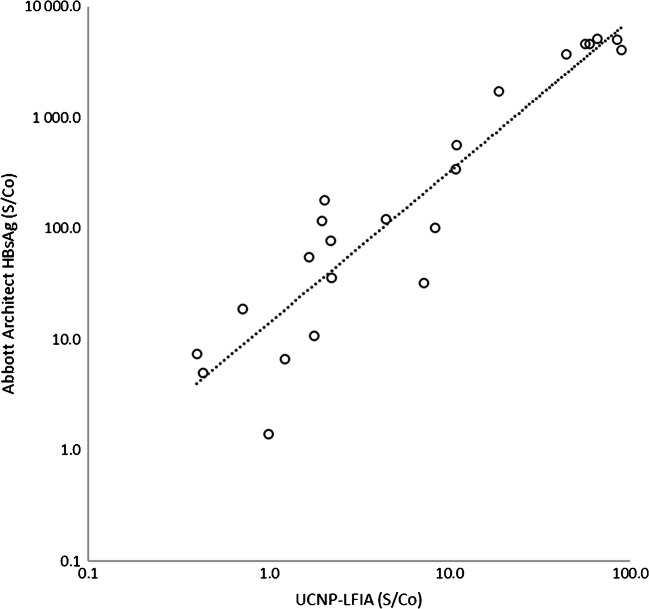
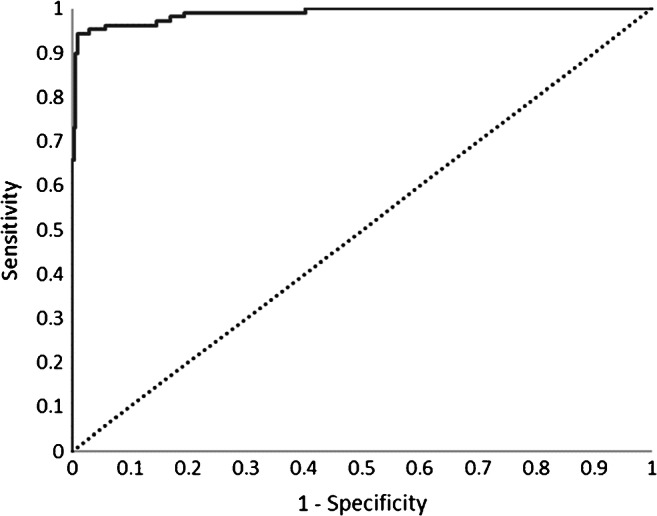
Detection of hepatitis B Virus surface antigen (HBsAg) is an established method for diagnosing both acute and chronic hepatitis B virus (HBV) infection. In addition to enzyme immunoassays (EIAs), rapid diagnostic tests (RDTs) are available for the detection of HBsAg in resource-poor settings. However, the available RDTs have inadequate sensitivity and therefore are not suitable for diagnosis of patients with low levels of HBsAg and for blood screening. To provide a high-sensitivity RDT, we developed a lateral flow immunoassay (LFIA) for HBsAg utilizing upconverting nanoparticle (UCNP) reporter. The UCNP-LFIA can use whole blood, serum, or plasma and the results can be read in 30 min using a reader device. When compared with a commercial conventional visually read LFIA, the developed UCNP-LFIA had a Limit of Detection (LoD) of 0.1 IU HBsAg/ml in spiked serum, whereas the LoD of the conventional LFIA was 3.2 IU HBsAg/ml. The developed UCNP-LFIA fulfills the WHO criterion for blood screening (LoD ≤ 0.13 IU HBsAg/ml) in terms of LoD. The UCNP-LFIA and conventional LFIA were evaluated with well-characterized sample panels. The UCNP-LFIA detected 20/24 HBsAg-positive samples within the HBsAg Performance Panel and 8/10 samples within the Mixed Titer Performance Panel, whereas the conventional LFIA detected 8/24 and 4/10 samples in these panels, respectively. The performance of the assays was further evaluated with HBsAg-positive (n = 108) and HBsAg-negative (n = 315) patient samples. In comparison with a central laboratory test, UCNP-LFIA showed 95.4% (95% CI: 89.5-98.5%) sensitivity whereas sensitivity of the conventional LFIA was 87.7% (95%CI: 79.9-93.3%).
乙型肝炎病毒表面抗原 (HBsAg) 的检测是诊断急性和慢性乙型肝炎病毒 (HBV) 感染的一种既定方法。除了酶免疫测定 (EIA) 外,还可在资源匮乏的环境中使用快速诊断检测 (RDT) 来检测 HBsAg。然而,现有的 RDT 灵敏度不足,因此不适合用于诊断 HBsAg 水平较低的患者和血液筛查。为了提供高灵敏度的 RDT,我们开发了一种利用上转换纳米粒子 (UCNP) 报告物的乙型肝炎表面抗原侧向流动免疫测定 (LFIA)。UCNP-LFIA 可使用全血、血清或血浆,使用阅读器设备在 30 分钟内读取结果。与商业常规视觉读取 LFIA 相比,开发的 UCNP-LFIA 在加标血清中的检测限 (LoD) 为 0.1 IU HBsAg/ml,而常规 LFIA 的 LoD 为 3.2 IU HBsAg/ml。就 LoD 而言,开发的 UCNP-LFIA 满足了世界卫生组织血液筛查标准 (LoD≤0.13 IU HBsAg/ml)。UCNP-LFIA 和常规 LFIA 均使用经过良好特征描述的样本进行了评估。UCNP-LFIA 在 HBsAg 性能面板中检测到 24 个 HBsAg 阳性样本中的 20 个,在混合滴度性能面板中检测到 10 个样本中的 8 个,而常规 LFIA 分别在这些面板中检测到 24 个样本中的 8 个和 10 个样本中的 4 个。使用 HBsAg 阳性 (n=108) 和 HBsAg 阴性 (n=315) 患者样本进一步评估了这些检测方法的性能。与中心实验室检测相比,UCNP-LFIA 的敏感性为 95.4% (95%CI: 89.5-98.5%),而常规 LFIA 的敏感性为 87.7% (95%CI: 79.9-93.3%)。