Section of Gastroenterology, Hepatology, and Nutrition, University of Chicago Medicine, Chicago, IL 60637, USA.
Department of Organoid Medicine, Keio University School of Medicine, Tokyo 160-8582, Japan.
Viruses. 2020 Nov 20;12(11):1333. doi: 10.3390/v12111333.
coronavirus disease 2019 (COVID-19) causes severe illness including cytokine storms, but mortality among countries differs largely. In the present study, we investigated the association between human leukocyte antigen (HLA) class I, which plays a major role in susceptibility to viral infections, and the mortality of COVID-19.
data of allele frequencies of HLA-A, -B and -C and COVID-19 mortality were obtained for 74 countries from the Allele Frequency Net Database and worldometer.info. Association between allele frequency of each HLA and mortality was assessed by linear regression followed by multivariable regression. Subsequently, association of HLA-C*05 to its receptor , expressed on natural killer (NK) cells, and differential mortality to historic pandemics were analyzed.
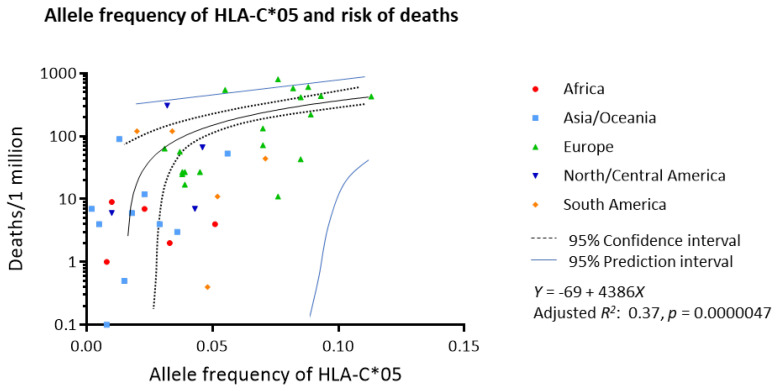
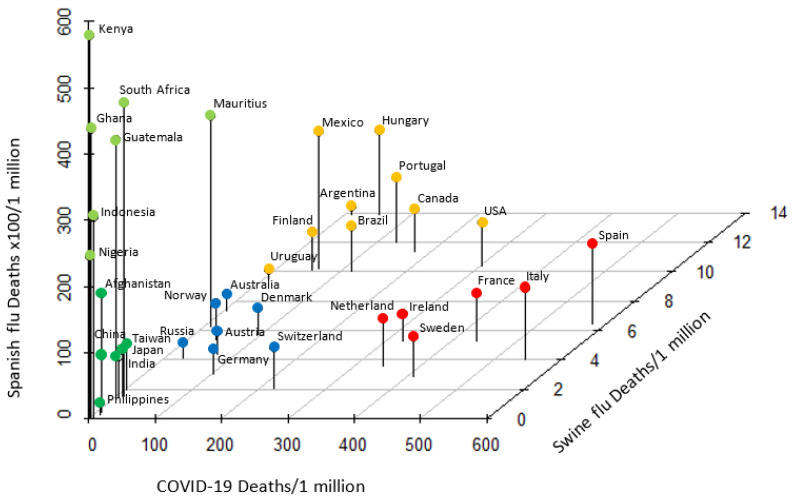
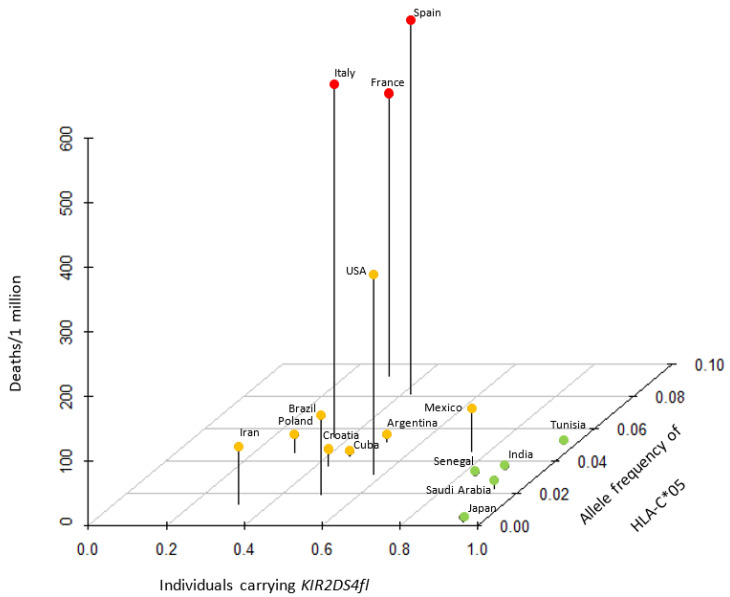
HLA-A01, -B07, -B08, -B44 and -C05 were significantly associated with the risk of deaths (adjusted = 0.040, 0.00081, 0.047, 0.0022, 0.00032, respectively), but only HLA-C05 remained statistically significant ( = 0.000027) after multivariable regression. A 1% increase in the allele frequency of HLA-C05 was associated with an increase of 44 deaths/million. Countries with different mortality could be categorized by the distribution of HLA-C05 and its receptor , which in combination cause NK cell-induced hyperactive immune response. Countries with similar ethnic and/or geographic background responded in a similar pattern to each pandemic.
we demonstrated that allele frequency of HLA-C*05 and the distribution pattern with its receptor strongly correlated with COVID-19 mortality. Host genetic variance of innate immunity may contribute to the difference in mortality among various countries and further investigation using patient samples is warranted.
2019 年冠状病毒病(COVID-19)可引起严重疾病,包括细胞因子风暴,但各国的死亡率差异很大。在本研究中,我们研究了在病毒感染易感性中起主要作用的人类白细胞抗原(HLA)I 类与 COVID-19 死亡率之间的关系。
从 Allele Frequency Net Database 和 worldometer.info 获得了 74 个国家的 HLA-A、-B 和 -C 等位基因频率数据以及 COVID-19 死亡率数据。通过线性回归和多变量回归评估每个 HLA 等位基因频率与死亡率之间的关系。随后,分析了 HLA-C*05 与其在自然杀伤(NK)细胞上的受体的关系以及对历史大流行的死亡率差异。
HLA-A01、-B07、-B08、-B44 和 -C05 与死亡风险显著相关(调整后 = 0.040、0.00081、0.047、0.0022、0.00032),但多变量回归后仅 HLA-C05 仍具有统计学意义( = 0.000027)。HLA-C05 等位基因频率增加 1%,与每百万增加 44 例死亡相关。死亡率不同的国家可以根据 HLA-C05 及其受体的分布进行分类,这两者共同导致 NK 细胞诱导的过度活跃免疫反应。具有相似种族和/或地理背景的国家对每种大流行的反应模式相似。
我们证明了 HLA-C*05 的等位基因频率及其与受体的分布模式与 COVID-19 死亡率密切相关。固有免疫的宿主遗传变异可能导致各国死亡率的差异,需要进一步使用患者样本进行研究。