Centre for Veterinary Epidemiology and Risk Analysis, University College Dublin, Dublin, Ireland
Centre for Veterinary Epidemiology and Risk Analysis, University College Dublin, Dublin, Ireland.
BMJ Open. 2020 Nov 23;10(11):e040263. doi: 10.1136/bmjopen-2020-040263.
The serial interval is the time between symptom onsets in an infector-infectee pair. The generation time, also known as the generation interval, is the time between infection events in an infector-infectee pair. The serial interval and the generation time are key parameters for assessing the dynamics of a disease. A number of scientific papers reported information pertaining to the serial interval and/or generation time for COVID-19.
Conduct a review of available evidence to advise on appropriate parameter values for serial interval and generation time in national COVID-19 transmission models for Ireland and on methodological issues relating to those parameters.
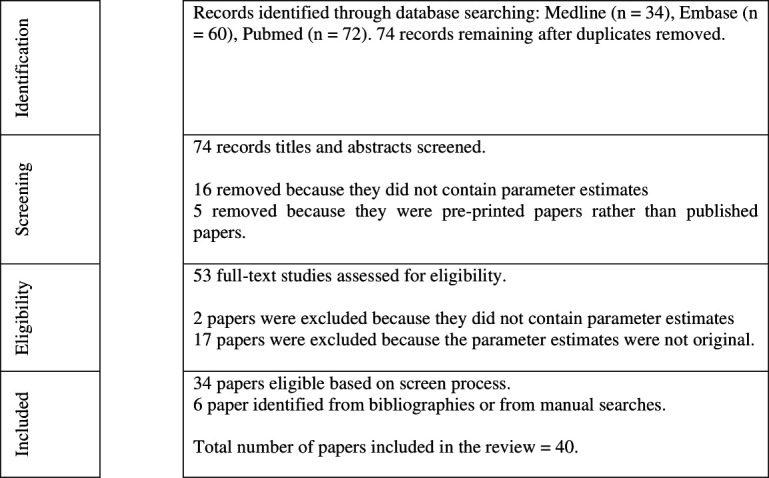
We conducted a rapid review of the literature covering the period 1 January 2020 and 21 August 2020, following predefined eligibility criteria. Forty scientific papers met our inclusion criteria and were included in the review.
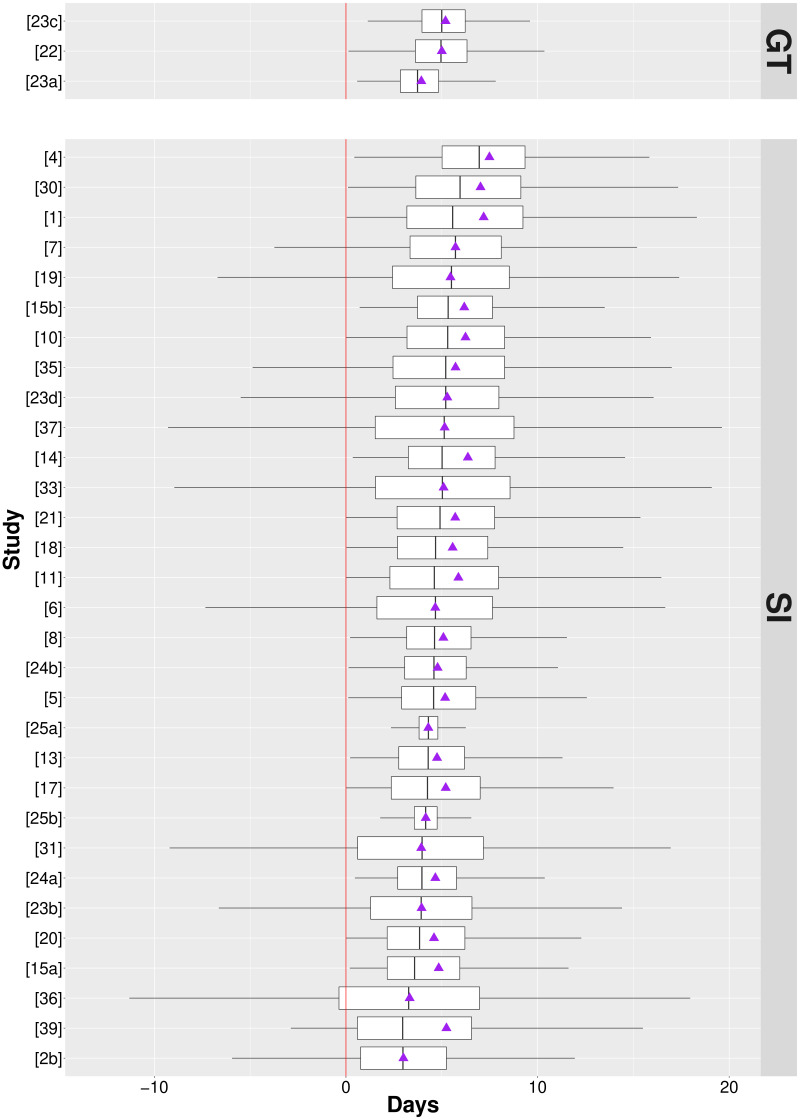
The mean of the serial interval ranged from 3.03 to 7.6 days, based on 38 estimates, and the median from 1.0 to 6.0 days (based on 15 estimates). Only three estimates were provided for the mean of the generation time. These ranged from 3.95 to 5.20 days. One estimate of 5.0 days was provided for the median of the generation time.
Estimates of the serial interval and the generation time are very dependent on the specific factors that apply at the time that the data are collected, including the level of social contact. Consequently, the estimates may not be entirely relevant to other environments. Therefore, local estimates should be obtained as soon as possible. Careful consideration should be given to the methodology that is used. Real-time estimations of the serial interval/generation time, allowing for variations over time, may provide more accurate estimates of reproduction numbers than using conventionally fixed serial interval/generation time distributions.
序列间隔是感染者-感染者对之间症状发作的时间间隔。代间隔,也称为生成间隔,是感染者-感染者对之间感染事件的时间间隔。序列间隔和代间隔是评估疾病动态的关键参数。许多科学论文报告了与 COVID-19 的序列间隔和/或代间隔有关的信息。
审查现有证据,为爱尔兰国家 COVID-19 传播模型中的序列间隔和代间隔提供适当的参数值,并就这些参数的方法学问题提供建议。
我们根据预先确定的纳入标准,对涵盖 2020 年 1 月 1 日至 2020 年 8 月 21 日期间的文献进行了快速审查。有 40 篇科学论文符合我们的纳入标准,并包含在审查中。
基于 38 项估计,序列间隔的平均值范围为 3.03 至 7.6 天,中位数为 1.0 至 6.0 天(基于 15 项估计)。仅提供了三个代间隔平均值的估计。这些范围从 3.95 到 5.20 天。一个代间隔中位数的估计值为 5.0 天。
序列间隔和代间隔的估计值非常依赖于收集数据时适用的特定因素,包括社会接触水平。因此,这些估计值可能与其他环境不完全相关。因此,应尽快获得当地的估计值。应仔细考虑所使用的方法。实时估计序列间隔/代间隔,允许随时间变化,可能比使用传统的固定序列间隔/代间隔分布提供更准确的繁殖数估计。