Fanzo Jessica, Bellows Alexandra L, Spiker Marie L, Thorne-Lyman Andrew L, Bloem Martin W
Berman Institute of Bioethics, Nitze School of Advanced International Studies, Bloomberg School of Public Health, Johns Hopkins University, Washington, DC, USA.
Department of International Health, Bloomberg School of Public Health, Johns Hopkins University, Baltimore, MD, USA.
Am J Clin Nutr. 2021 Jan 4;113(1):7-16. doi: 10.1093/ajcn/nqaa313.
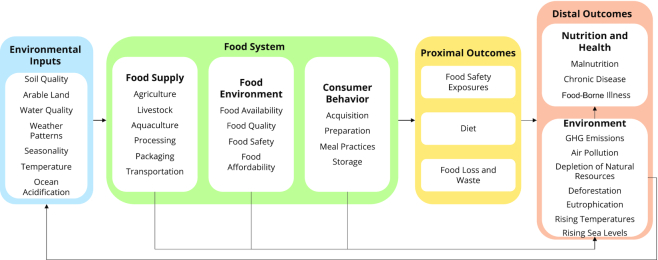
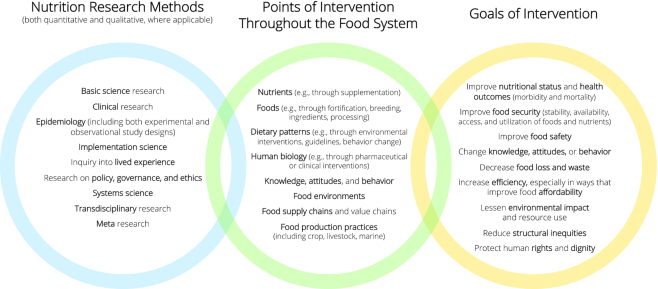
Global and local food system transformation is necessary in order to ensure the delivery of healthy, safe, and nutritious foods in both sustainable and equitable ways. Food systems are complex entities that affect diets, human health, and a range of other outcomes including economic growth, natural resource and environmental resiliency, and sociocultural factors. However, food systems contribute to and are vulnerable to ongoing climate and environmental changes that threaten their sustainability. Although there has been increased focus on this topic in recent years, many gaps in our knowledge persist on the relation between environmental factors, food systems, and nutritional outcomes. In this article, we summarize this emerging field and describe what innovative nutrition research is needed in order to bring about food policy changes in the era of climate disruption and environmental degradation.
为了以可持续和公平的方式确保提供健康、安全和营养的食物,全球和地方粮食系统转型是必要的。粮食系统是复杂的实体,会影响饮食、人类健康以及一系列其他结果,包括经济增长、自然资源和环境适应力以及社会文化因素。然而,粮食系统既对持续的气候和环境变化有所贡献,又易受其影响,而这些变化正威胁着它们的可持续性。尽管近年来对这一主题的关注有所增加,但在环境因素、粮食系统和营养结果之间的关系方面,我们的知识仍存在许多空白。在本文中,我们总结了这一新兴领域,并描述了为在气候破坏和环境退化时代带来粮食政策变化需要开展哪些创新性营养研究。