Department of Molecular Cell Biology, Weizmann Institute of Science, 76100, Rehovot, Israel.
Geroscience. 2021 Feb;43(1):329-341. doi: 10.1007/s11357-020-00286-x. Epub 2020 Nov 25.
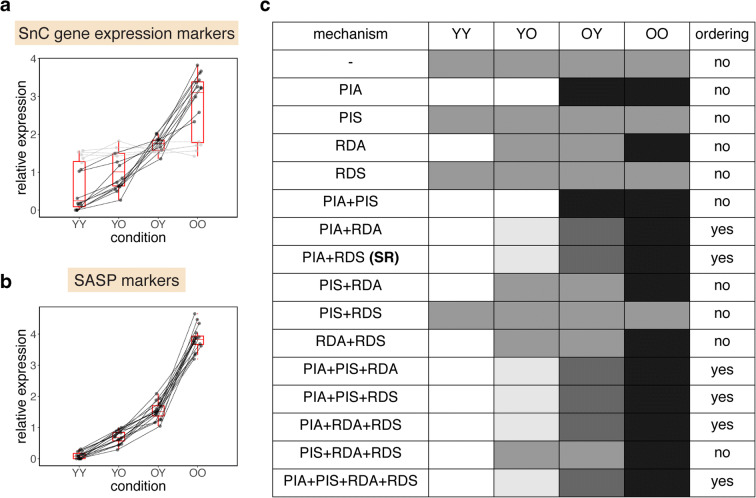
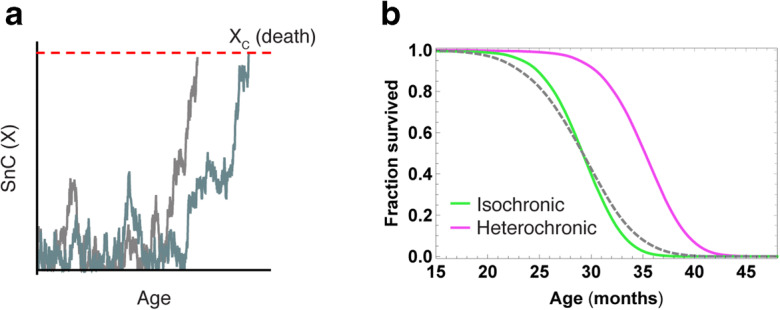
Senescent cells are growth-arrested cells that cause inflammation and play a causal role in aging. They accumulate with age, and preventing this accumulation delays age-related diseases. However, the mechanism for senescent cell accumulation is not fully understood. Accumulation can result from increasing production or decreasing removal of senescent cells with age, or both. To distinguish between these possibilities, we analyze data from parabiosis, the surgical conjoining of two mice so that they share circulation. Parabiosis between a young and old mouse, called heterochronic parabiosis, reduces senescent cell levels in the old mouse, while raising senescent cell levels in the young mouse. We show that parabiosis data can reject mechanisms for senescent cell accumulation in which only production rises with age or only removal decreases with age; both must vary with age. Since removal drops with age, senescent cell half-life rises with age. This matches a recent model for senescent cell accumulation developed from independent data on senescent cell dynamics, called the SR model, in which production rises linearly with age and senescent cells inhibit their own removal. The SR model further explains the timescales and mechanism of rejuvenation in parabiosis, based on transfer of spare removal capacity from the young mouse to the old. The present quantitative understanding can help design optimal treatments that remove senescent cells, by matching the time between treatments to the time it takes senescent cells to re-accumulate.
衰老细胞是生长停滞的细胞,会引起炎症,并在衰老过程中起因果作用。它们随着年龄的增长而积累,预防这种积累可以延缓与年龄相关的疾病。然而,衰老细胞积累的机制尚未完全了解。随着年龄的增长,衰老细胞的积累可能是由于产生的增加或去除的减少,或者两者兼而有之。为了区分这些可能性,我们分析了来自联体动物的数据分析,联体动物是将两只老鼠进行手术连接,使它们共享循环。年轻和老年老鼠之间的联体动物,称为异时联体动物,会降低老年老鼠中衰老细胞的水平,同时提高年轻老鼠中衰老细胞的水平。我们表明,联体动物数据可以排除衰老细胞积累的机制,即只有随着年龄的增长而增加生产或只有随着年龄的增长而减少去除;两者都必须随年龄而变化。由于去除随年龄下降,衰老细胞半衰期随年龄上升。这与最近基于对衰老细胞动力学的独立数据开发的衰老细胞积累的 SR 模型相匹配,该模型表明生产随年龄呈线性上升,衰老细胞抑制其自身的去除。基于从年轻老鼠向老年老鼠转移备用去除能力,SR 模型进一步解释了联体动物中的恢复时间尺度和机制。目前的定量理解可以通过将治疗时间与衰老细胞重新积累的时间相匹配,帮助设计出最佳的去除衰老细胞的治疗方法。