Altundag Aytug, Saatci Ozlem, Sanli Deniz Esin Tekcan, Duz Ozge Arici, Sanli Ahmet Necati, Olmuscelik Oktay, Temirbekov Dastan, Kandemirli Sedat Giray, Karaaltin Aysegul Batioglu
Department of Otorhinolaryngology, Biruni University, Istanbul, Turkey.
Department of Otorhinolaryngology, Istanbul Sancaktepe, Education and Research Hospital, Istanbul, Turkey.
Eur Arch Otorhinolaryngol. 2021 Jun;278(6):1891-1897. doi: 10.1007/s00405-020-06496-5. Epub 2020 Nov 25.
This study aimed to define the clinical course of anosmia in relation to other clinical symptoms.
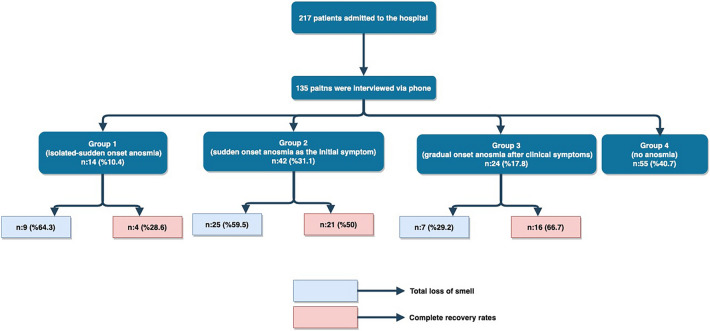
135 patients with COVID-19 were reached by phone and subsequently included in the study. Olfactory functions were evaluated using a questionnaire for assessment of self-reported olfactory function. Patients were divided into four subgroups according to the presence of olfactory symptoms and temporal relationship with the other symptoms: group1 had only olfactory complaints (isolated, sudden-onset loss of smell); group2 had sudden-onset loss of smell, followed by COVID-19 related complaints; group3 initially had COVID-19 related complaints, then gradually developed olfactory complaints; and group4 had no olfactory complaints.
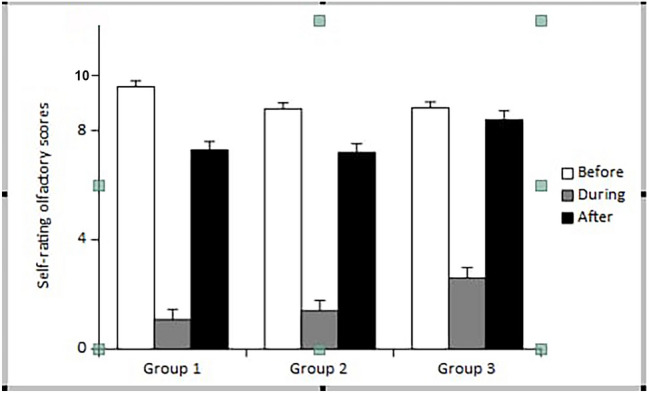
In total, 59.3% of the patients interviewed had olfactory complaints during the disease course. The olfactory dysfunction severity during COVID-19 infection was significantly higher in group1 compared to groups 2 and 3. In groups1-3, the odor scores after recovery from COVID-19 disease were significantly lower compared to the status prior to disease onset. The residual olfactory dysfunction was similar between groups1 and 2, but was more evident than group3. Mean duration for loss of smell was 7.8 ± 3.1 (2-15) days. Duration of loss of smell was longer in groups1 and 2 than in group3. Odor scores completely returned back to the pre-disease values in 41 (51.2%) patients with olfactory dysfunction. Rate of complete olfactory dysfunction recovery was higher in group3 compared to groups1 and 2.
In isolated anosmia cases, anosmia is more severe, and complete recovery rates are lower compared to the patients who have other clinical symptoms.
Level 4.
本研究旨在确定嗅觉丧失与其他临床症状相关的临床病程。
通过电话联系了135例新冠肺炎患者,随后将其纳入研究。使用一份自我报告嗅觉功能评估问卷对嗅觉功能进行评估。根据嗅觉症状的存在情况以及与其他症状的时间关系,将患者分为四个亚组:第1组仅有嗅觉主诉(孤立性、突发性嗅觉丧失);第2组突发性嗅觉丧失,随后出现与新冠肺炎相关的主诉;第3组最初有与新冠肺炎相关的主诉,随后逐渐出现嗅觉主诉;第4组无嗅觉主诉。
总共,59.3%的受访患者在病程中出现嗅觉主诉。与第2组和第3组相比,第1组在新冠肺炎感染期间嗅觉功能障碍的严重程度显著更高。在第1 - 3组中,新冠肺炎康复后的气味评分显著低于疾病发作前的状态。第1组和第2组的残余嗅觉功能障碍相似,但比第3组更明显。嗅觉丧失的平均持续时间为7.8±3.1(2 - )天。第1组和第2组嗅觉丧失的持续时间比第3组长。41例(51.2%)嗅觉功能障碍患者的气味评分完全恢复到病前值。第3组完全嗅觉功能障碍恢复率高于第1组和第2组。
在孤立性嗅觉丧失病例中,与有其他临床症状患者相比,嗅觉丧失更严重,完全恢复率更低。
4级。