Zucca Paolo, Rossmann Marie-Christin, Osorio Jorge E, Karem Kevin, De Benedictis Paola, Haißl Josef, De Franceschi Paola, Calligaris Elisa, Kohlweiß Michaela, Meddi Giulio, Gabrutsch Wolfgang, Mairitsch Horst, Greco Oronzo, Furlani Roberto, Maggio Marcello, Tolomei Massimiliano, Bremini Alessandro, Fischinger Ingrid, Zambotto Paolo, Wagner Peter, Millard Yvonne, Palei Manlio, Zamaro Gianna
Central Directorate for Health, Social Policies, and Disabilities, Trieste, Italy.
Bio-crime Veterinary Medical Intelligence Centre - c/o International Police and Custom Cooperation Centre, Thörl-Maglern, Austria.
Front Vet Sci. 2020 Nov 3;7:593683. doi: 10.3389/fvets.2020.593683. eCollection 2020.
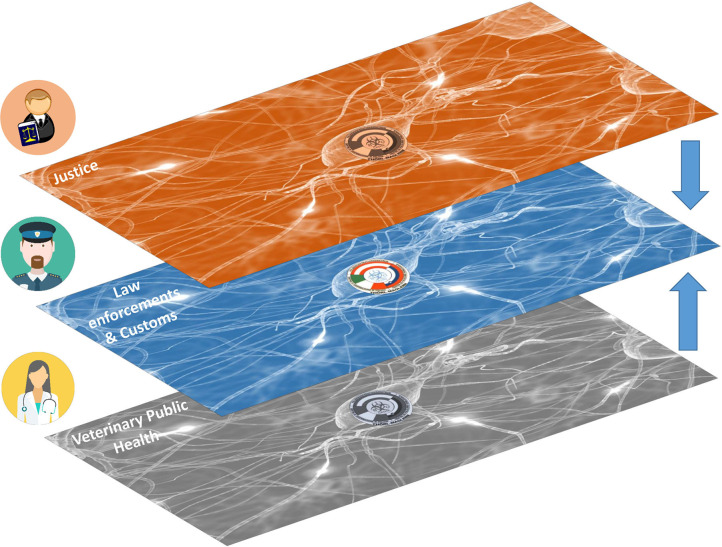
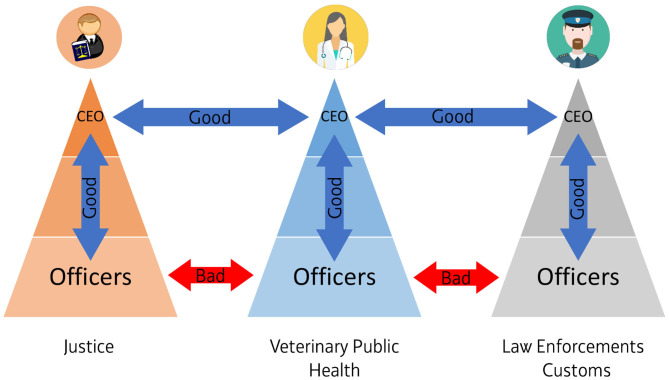
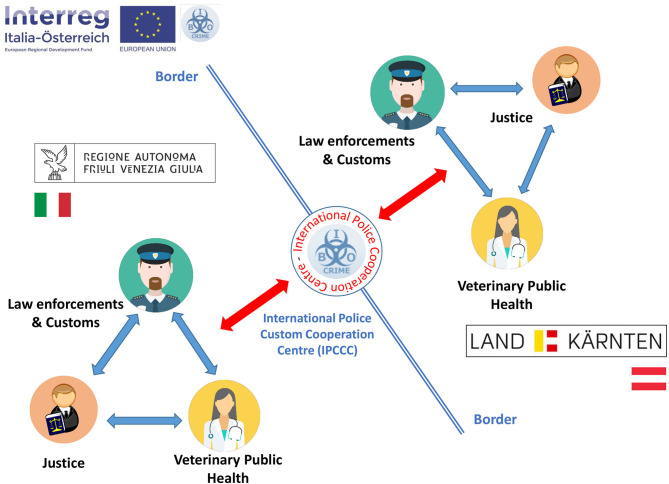
Illegal animal trade (pet, wildlife, animal products, etc.) is an example of transnational organized crime (T.O.C.) that generates a large business with huge profit margins. This criminal activity causes several negative effects on human health (zoonoses), animal health and welfare, market protection, consumer fraud and may be used as tool of agro/bio-terrorism. Illegal animal trade can facilitate the spread of zoonoses that are defined as diseases and infections that are transmitted by vertebrate animals to man. Humans are affected by more than 1,700 known pathogens: 60% of existing human infectious diseases are zoonotic and at least 75% of emerging infectious diseases of humans have an animal origin and 72% of zoonoses originate from wildlife or exotic animals. The Bio-Crime Project was developed in 2017 by Friuli Venezia Giulia Region (Italy) and Land Carinthia (Austria) together with other public institutions to combat illegal animal trade and to reduce the risk of disease transmission from animals to humans. Project partners agreed that a multi-agency approach was required to tackle the illegal animal trade that was high value, easy to undertake and transnational crime. The Bio-crime model of cross-border cooperation introduces the novel approach of replicating the cooperative framework given by the triad of Veterinary Public Health, Justice and Law Enforcements/Customs across borders using the International Police and Custom Cooperation Centres (IPCCCs) as a connection link among public entities of the neighbor countries. This model has been recognized as a best practice at European level because it can be easily replicated and scaled up without any supplementary cost for Member States.
非法动物贸易(宠物、野生动物、动物制品等)是跨国有组织犯罪的一个例子,它形成了一个利润丰厚的庞大产业。这种犯罪活动对人类健康(人畜共患病)、动物健康和福利、市场保护、消费者欺诈产生了若干负面影响,并且可能被用作农业/生物恐怖主义的工具。非法动物贸易会促使被定义为由脊椎动物传播给人类的疾病和感染的人畜共患病的传播。人类受到1700多种已知病原体的影响:现有的人类传染病中有60%是人畜共患的,至少75%的人类新发传染病源自动物,72%的人畜共患病源自野生动物或外来动物。生物犯罪项目于2017年由弗留利-威尼斯朱利亚大区(意大利)和卡林西亚州(奥地利)与其他公共机构共同发起,以打击非法动物贸易,并降低疾病从动物传播给人类的风险。项目合作伙伴一致认为,需要采取多机构方法来应对非法动物贸易,因为这是一种高价值、易于实施的跨国犯罪。跨境合作的生物犯罪模式引入了一种新颖的方法,即利用国际警察和海关合作中心(IPCCCs)作为邻国公共实体之间的连接纽带,复制由兽医公共卫生、司法和执法/海关三方组成的合作框架并跨越国界应用。这种模式在欧洲层面已被视为最佳实践,因为它可以轻松复制和扩大规模,而无需成员国承担任何额外成本。