• 文献检索
  • 文档翻译
  • 深度研究
  • 学术资讯
  • Suppr Zotero 插件Zotero 插件
  • 邀请有礼
  • 套餐&价格
  • 历史记录
应用&插件
Suppr Zotero 插件Zotero 插件浏览器插件Mac 客户端Windows 客户端微信小程序
定价
高级版会员购买积分包购买API积分包
服务
文献检索文档翻译深度研究API 文档MCP 服务
关于我们
关于 Suppr公司介绍联系我们用户协议隐私条款
关注我们

Suppr 超能文献

核心技术专利:CN118964589B侵权必究
粤ICP备2023148730 号-1Suppr @ 2026

文献检索

告别复杂PubMed语法,用中文像聊天一样搜索,搜遍4000万医学文献。AI智能推荐,让科研检索更轻松。

立即免费搜索

文件翻译

保留排版,准确专业,支持PDF/Word/PPT等文件格式,支持 12+语言互译。

免费翻译文档

深度研究

AI帮你快速写综述,25分钟生成高质量综述,智能提取关键信息,辅助科研写作。

立即免费体验

预测髋关节或膝关节置换术后的非计划再入院:回顾性观察研究。

Predicting Unplanned Readmissions Following a Hip or Knee Arthroplasty: Retrospective Observational Study.

作者信息

Mohammadi Ramin, Jain Sarthak, Namin Amir T, Scholem Heller Melissa, Palacholla Ramya, Kamarthi Sagar, Wallace Byron

机构信息

Northeastern University, Boston, MA, United States.

Tufts University School of Medicine, Boston, MA, United States.

出版信息

JMIR Med Inform. 2020 Nov 27;8(11):e19761. doi: 10.2196/19761.

DOI:10.2196/19761
PMID:33245283
原文链接:https://pmc.ncbi.nlm.nih.gov/articles/PMC7732713/
Abstract

BACKGROUND

Total joint replacements are high-volume and high-cost procedures that should be monitored for cost and quality control. Models that can identify patients at high risk of readmission might help reduce costs by suggesting who should be enrolled in preventive care programs. Previous models for risk prediction have relied on structured data of patients rather than clinical notes in electronic health records (EHRs). The former approach requires manual feature extraction by domain experts, which may limit the applicability of these models.

OBJECTIVE

This study aims to develop and evaluate a machine learning model for predicting the risk of 30-day readmission following knee and hip arthroplasty procedures. The input data for these models come from raw EHRs. We empirically demonstrate that unstructured free-text notes contain a reasonably predictive signal for this task.

METHODS

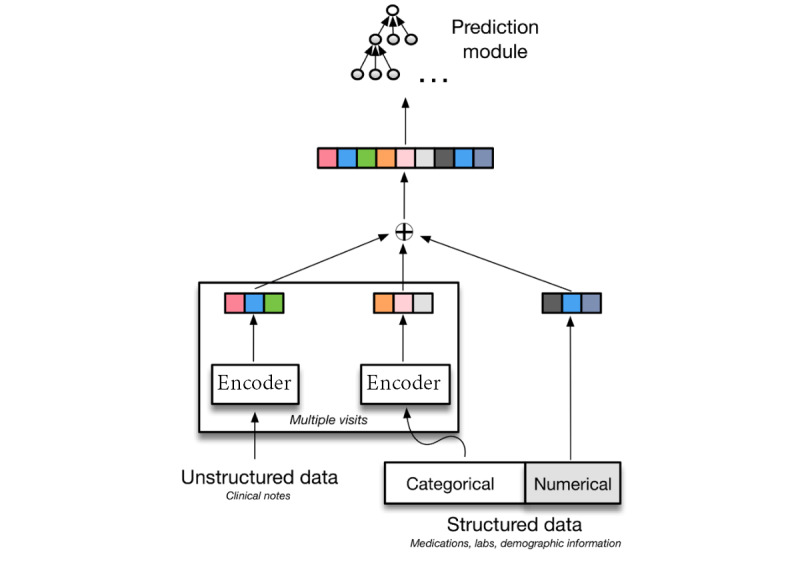
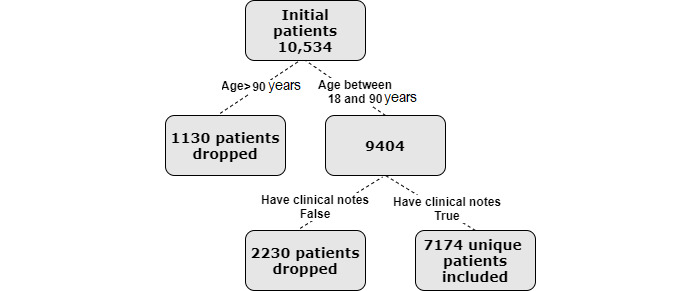
We performed a retrospective analysis of data from 7174 patients at Partners Healthcare collected between 2006 and 2016. These data were split into train, validation, and test sets. These data sets were used to build, validate, and test models to predict unplanned readmission within 30 days of hospital discharge. The proposed models made predictions on the basis of clinical notes, obviating the need for performing manual feature extraction by domain and machine learning experts. The notes that served as model inputs were written by physicians, nurses, pathologists, and others who diagnose and treat patients and may have their own predictions, even if these are not recorded.

RESULTS

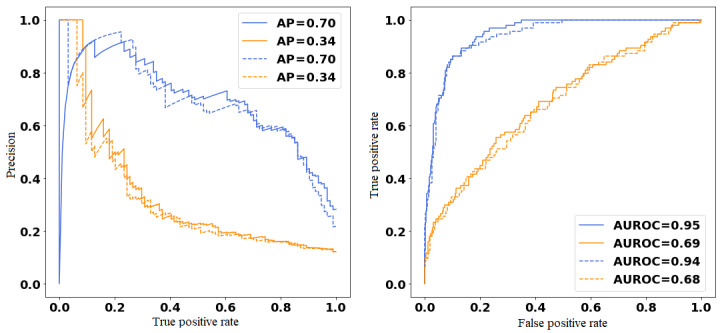
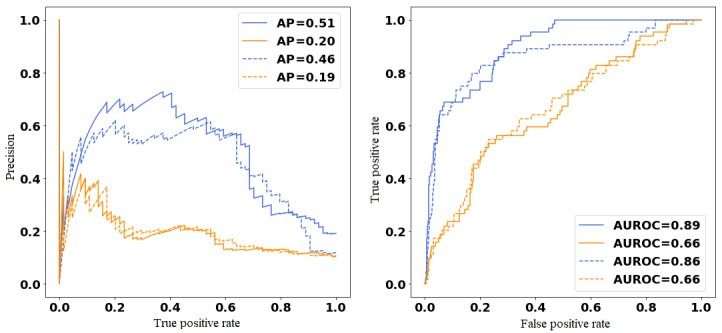
The proposed models output readmission risk scores (propensities) for each patient. The best models (as selected on a development set) yielded an area under the receiver operating characteristic curve of 0.846 (95% CI 82.75-87.11) for hip and 0.822 (95% CI 80.94-86.22) for knee surgery, indicating reasonable discriminative ability.

CONCLUSIONS

Machine learning models can predict which patients are at a high risk of readmission within 30 days following hip and knee arthroplasty procedures on the basis of notes in EHRs with reasonable discriminative power. Following further validation and empirical demonstration that the models realize predictive performance above that which clinical judgment may provide, such models may be used to build an automated decision support tool to help caretakers identify at-risk patients.

摘要

背景

全关节置换手术数量多、成本高,应进行成本和质量控制监测。能够识别再入院高风险患者的模型,或许可通过建议哪些患者应纳入预防保健计划来帮助降低成本。以往的风险预测模型依赖于患者的结构化数据,而非电子健康记录(EHR)中的临床记录。前一种方法需要领域专家手动提取特征,这可能会限制这些模型的适用性。

目的

本研究旨在开发并评估一种用于预测膝关节和髋关节置换手术后30天再入院风险的机器学习模型。这些模型的输入数据来自原始EHR。我们通过实证证明,非结构化的自由文本记录包含了针对此任务的合理预测信号。

方法

我们对2006年至2016年期间在合作伙伴医疗保健公司收集的7174例患者的数据进行了回顾性分析。这些数据被分为训练集、验证集和测试集。这些数据集用于构建、验证和测试模型,以预测出院后30天内的非计划再入院情况。所提出的模型基于临床记录进行预测,无需领域专家和机器学习专家进行手动特征提取。作为模型输入的记录由诊断和治疗患者的医生、护士、病理学家及其他人员撰写,他们可能有自己的预测,即便这些预测未被记录。

结果

所提出的模型为每位患者输出再入院风险评分(倾向)。最佳模型(在开发集上选择)对髋关节手术的受试者工作特征曲线下面积为0.846(95%CI 82.75 - 87.11),对膝关节手术为0.822(95%CI 80.94 - 86.22),表明具有合理的区分能力。

结论

机器学习模型可根据EHR中的记录,以合理的区分能力预测哪些患者在髋关节和膝关节置换手术后30天内有再入院的高风险。在进一步验证并通过实证证明这些模型实现了高于临床判断可能提供的预测性能后,此类模型可用于构建自动化决策支持工具,以帮助护理人员识别高危患者。
https://cdn.ncbi.nlm.nih.gov/pmc/blobs/208b/7732713/479f2b3e4ab4/medinform_v8i11e19761_fig4.jpg
https://cdn.ncbi.nlm.nih.gov/pmc/blobs/208b/7732713/3b99ec9f985f/medinform_v8i11e19761_fig1.jpg
https://cdn.ncbi.nlm.nih.gov/pmc/blobs/208b/7732713/2b6474c69fa8/medinform_v8i11e19761_fig2.jpg
https://cdn.ncbi.nlm.nih.gov/pmc/blobs/208b/7732713/a87e0f9833e8/medinform_v8i11e19761_fig3.jpg
https://cdn.ncbi.nlm.nih.gov/pmc/blobs/208b/7732713/479f2b3e4ab4/medinform_v8i11e19761_fig4.jpg
https://cdn.ncbi.nlm.nih.gov/pmc/blobs/208b/7732713/3b99ec9f985f/medinform_v8i11e19761_fig1.jpg
https://cdn.ncbi.nlm.nih.gov/pmc/blobs/208b/7732713/2b6474c69fa8/medinform_v8i11e19761_fig2.jpg
https://cdn.ncbi.nlm.nih.gov/pmc/blobs/208b/7732713/a87e0f9833e8/medinform_v8i11e19761_fig3.jpg
https://cdn.ncbi.nlm.nih.gov/pmc/blobs/208b/7732713/479f2b3e4ab4/medinform_v8i11e19761_fig4.jpg

相似文献

1
Predicting Unplanned Readmissions Following a Hip or Knee Arthroplasty: Retrospective Observational Study.预测髋关节或膝关节置换术后的非计划再入院:回顾性观察研究。
JMIR Med Inform. 2020 Nov 27;8(11):e19761. doi: 10.2196/19761.
2
Preoperative prediction model for risk of readmission after total joint replacement surgery: a random forest approach leveraging NLP and unfairness mitigation for improved patient care and cost-effectiveness.全关节置换术后再入院风险的术前预测模型:一种利用 NLP 和不公平性缓解的随机森林方法,以改善患者护理和成本效益。
J Orthop Surg Res. 2024 May 10;19(1):287. doi: 10.1186/s13018-024-04774-0.
3
The utilization of artificial neural networks for the prediction of 90-day unplanned readmissions following total knee arthroplasty.利用人工神经网络预测全膝关节置换术后 90 天内的非计划性再入院。
Arch Orthop Trauma Surg. 2023 Jun;143(6):3279-3289. doi: 10.1007/s00402-022-04566-3. Epub 2022 Aug 7.
4
Enhancing readmission prediction models by integrating insights from home healthcare notes: Retrospective cohort study.通过整合家庭医疗护理记录中的见解来增强再入院预测模型:回顾性队列研究。
Int J Nurs Stud. 2024 Oct;158:104850. doi: 10.1016/j.ijnurstu.2024.104850. Epub 2024 Jul 3.
5
Deep Learning Approaches for Predicting Glaucoma Progression Using Electronic Health Records and Natural Language Processing.使用电子健康记录和自然语言处理的深度学习方法预测青光眼进展
Ophthalmol Sci. 2022 Feb 12;2(2):100127. doi: 10.1016/j.xops.2022.100127. eCollection 2022 Jun.
6
Can Machine Learning Algorithms Predict Which Patients Will Achieve Minimally Clinically Important Differences From Total Joint Arthroplasty?机器学习算法能否预测哪些患者将从全关节置换术中获得最小临床重要差异?
Clin Orthop Relat Res. 2019 Jun;477(6):1267-1279. doi: 10.1097/CORR.0000000000000687.
7
Predicting 30-day readmission following total knee arthroplasty using machine learning and clinical expertise applied to clinical administrative and research registry data in an Australian cohort.利用机器学习和临床专业知识,对澳大利亚队列中临床管理和研究登记数据进行分析,以预测全膝关节置换术后30天再入院情况。
Arthroplasty. 2023 Jun 1;5(1):30. doi: 10.1186/s42836-023-00186-3.
8
Predictive modeling for 14-day unplanned hospital readmission risk by using machine learning algorithms.基于机器学习算法的 14 天内非计划性住院再入院风险预测模型。
BMC Med Inform Decis Mak. 2021 Oct 20;21(1):288. doi: 10.1186/s12911-021-01639-y.
9
Higher Hospital Costs Do Not Result in Lower Readmission Rates Following Total Joint Arthroplasty.全关节置换术后较高的医院成本并不会导致较低的再入院率。
Bull Hosp Jt Dis (2013). 2019 Mar;77(2):136-139.
10
Incidence, Risk Factors, and Costs for Hospital Returns After Total Joint Arthroplasties.全关节置换术后再入院的发生率、危险因素及费用
J Arthroplasty. 2017 Feb;32(2):381-385. doi: 10.1016/j.arth.2016.08.003. Epub 2016 Aug 12.

引用本文的文献

1
Preoperatively predicting failure to achieve the minimum clinically important difference and substantial clinical benefit for total knee arthroplasty patients using machine learning.使用机器学习对全膝关节置换术患者术前预测未能达到最小临床重要差异和实质性临床获益的情况。
Knee Surg Relat Res. 2025 Sep 10;37(1):37. doi: 10.1186/s43019-025-00289-y.
2
A systematic review of natural language processing applications in Trauma & Orthopaedics.创伤与矫形外科学中自然语言处理应用的系统评价。
Bone Jt Open. 2025 Mar 5;6(3):264-274. doi: 10.1302/2633-1462.63.BJO-2024-0081.R1.
3
Artificial intelligence in planned orthopaedic care.

本文引用的文献

1
Scalable and accurate deep learning with electronic health records.借助电子健康记录实现可扩展且准确的深度学习。
NPJ Digit Med. 2018 May 8;1:18. doi: 10.1038/s41746-018-0029-1. eCollection 2018.
2
Adoption of New Medical Technologies: The Case of Customized Individually Made Knee Implants.采用新医疗技术:定制个体化膝关节植入物案例。
Value Health. 2019 Apr;22(4):423-430. doi: 10.1016/j.jval.2019.01.008. Epub 2019 Mar 6.
3
Deep EHR: A Survey of Recent Advances in Deep Learning Techniques for Electronic Health Record (EHR) Analysis.
计划中的骨科护理中的人工智能
SICOT J. 2024;10:49. doi: 10.1051/sicotj/2024044. Epub 2024 Nov 21.
4
Deep Learning Transformer Models for Building a Comprehensive and Real-time Trauma Observatory: Development and Validation Study.用于构建全面实时创伤观测站的深度学习Transformer模型:开发与验证研究
JMIR AI. 2023 Jan 12;2:e40843. doi: 10.2196/40843.
5
Predicting 30-day unplanned hospital readmission after revision total knee arthroplasty: machine learning model analysis of a national patient cohort.预测全膝关节翻修术后 30 天内非计划性再入院:全国患者队列的机器学习模型分析。
Med Biol Eng Comput. 2024 Jul;62(7):2073-2086. doi: 10.1007/s11517-024-03054-7. Epub 2024 Mar 7.
6
Machine-learning vs. logistic regression for preoperative prediction of medical morbidity after fast-track hip and knee arthroplasty-a comparative study.机器学习与逻辑回归在快通道髋关节和膝关节置换术后医疗发病率术前预测中的比较研究。
BMC Anesthesiol. 2023 Nov 29;23(1):391. doi: 10.1186/s12871-023-02354-z.
7
Comparison of Machine Learning Algorithms for Predicting Hospital Readmissions and Worsening Heart Failure Events in Patients With Heart Failure With Reduced Ejection Fraction: Modeling Study.射血分数降低的心力衰竭患者再入院及心力衰竭恶化事件预测的机器学习算法比较:建模研究
JMIR Form Res. 2023 Apr 17;7:e41775. doi: 10.2196/41775.
8
Predicting Glaucoma Progression Requiring Surgery Using Clinical Free-Text Notes and Transfer Learning With Transformers.使用临床自由文本记录和基于转换器的迁移学习预测需要手术的青光眼进展。
Transl Vis Sci Technol. 2022 Mar 2;11(3):37. doi: 10.1167/tvst.11.3.37.
9
Predicting the 14-Day Hospital Readmission of Patients with Pneumonia Using Artificial Neural Networks (ANN).利用人工神经网络(ANN)预测肺炎患者的 14 天住院再入院率。
Int J Environ Res Public Health. 2021 May 12;18(10):5110. doi: 10.3390/ijerph18105110.
10
Predicting Active NBA Players Most Likely to Be Inducted into the Basketball Hall of Famers Using Artificial Neural Networks in Microsoft Excel: Development and Usability Study.使用Microsoft Excel中的人工神经网络预测最有可能入选篮球名人堂的现役NBA球员:开发与可用性研究
Int J Environ Res Public Health. 2021 Apr 16;18(8):4256. doi: 10.3390/ijerph18084256.
深度电子健康记录(EHR):深度学习技术在电子健康记录(EHR)分析中的最新进展综述。
IEEE J Biomed Health Inform. 2018 Sep;22(5):1589-1604. doi: 10.1109/JBHI.2017.2767063. Epub 2017 Oct 27.
4
Predictors and Cost of Readmission in Total Knee Arthroplasty.全膝关节置换术后再入院的预测因素和费用。
J Arthroplasty. 2018 Sep;33(9):2759-2763. doi: 10.1016/j.arth.2018.04.008. Epub 2018 Apr 17.
5
Readmission due to infection following total hip and total knee procedures: A retrospective study.全髋关节和全膝关节置换术后因感染导致的再入院:一项回顾性研究。
Medicine (Baltimore). 2017 Sep;96(38):e7961. doi: 10.1097/MD.0000000000007961.
6
Association Between Hospital Penalty Status Under the Hospital Readmission Reduction Program and Readmission Rates for Target and Nontarget Conditions.医院再入院率降低计划下的医院处罚状态与目标及非目标病症再入院率之间的关联
JAMA. 2016 Dec 27;316(24):2647-2656. doi: 10.1001/jama.2016.18533.
7
MIMIC-III, a freely accessible critical care database.MIMIC-III,一个免费获取的重症监护数据库。
Sci Data. 2016 May 24;3:160035. doi: 10.1038/sdata.2016.35.
8
Cost Analysis of Total Joint Arthroplasty Readmissions in a Bundled Payment Care Improvement Initiative.捆绑支付护理改善计划中全关节置换再入院的成本分析
J Arthroplasty. 2016 Sep;31(9):1862-5. doi: 10.1016/j.arth.2016.02.029. Epub 2016 Feb 24.
9
How to Decrease Length of Hospital Stay After Total Knee Replacement.全膝关节置换术后如何缩短住院时间
J Surg Orthop Adv. 2016 Spring;25(1):2-7.
10
Data-driven Temporal Prediction of Surgical Site Infection.手术部位感染的数据驱动时间预测
AMIA Annu Symp Proc. 2015 Nov 5;2015:1164-73. eCollection 2015.