Manani Duke M, Ateka Elijah M, Nyanjom Steven R G, Boykin Laura M
Department of Biochemistry, Jomo Kenyatta University of Agriculture and Technology, Nairobi P.O. Box 62000-00200, Kenya.
Department of Horticulture, Jomo Kenyatta University of Agriculture and Technology, Nairobi P.O. Box 62000-00200, Kenya.
Insects. 2017 Feb 28;8(1):25. doi: 10.3390/insects8010025.
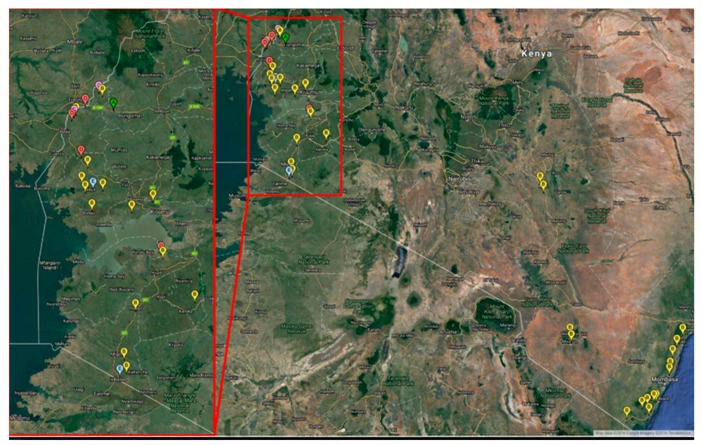
Whiteflies, (Gennadius) are major insect pests that affect many crops such as cassava, tomato, beans, cotton, cucurbits, potato, sweet potato, and ornamental crops. transmits viral diseases, namely cassava mosaic and cassava brown streak diseases, which are the main constraints to cassava production, causing huge losses to many small-scale farmers. The aim of this work was to determine the phylogenetic relationships among species in major cassava growing areas of Kenya. Surveys were carried out between 2013 and 2015 in major cassava growing areas (Western, Nyanza, Eastern, and Coast regions), for cassava mosaic disease (CMD) and cassava brown streak disease (CBSD). Mitochondrial cytochrome oxidase I (mtCOI-DNA) was used to determine the genetic diversity of . Phylogenetic trees were constructed using Bayesian methods to understand the genetic diversity across the study regions. Phylogenetic analysis revealed two species present in Kenya, sub-Saharan Africa 1 and 2 comprising five distinct clades (A-E) with percent sequence similarity ranging from 97.7 % to 99.5%. Clades B, C, D, and E are predominantly distributed in the Western and Nyanza regions of Kenya whereas clade B is dominantly found along the coast, the eastern region, and parts of Nyanza. Our clade A groups with sub-Saharan Africa 2-(SSA2) recorded a percent sequence similarity of 99.5%. In this study, we also report the identification of SSA2 after a 15 year absence in Kenya. The SSA2 species associated with CMD has been found in the Western region of Kenya bordering Uganda. More information is needed to determine if these species are differentially involved in the epidemiology of the cassava viruses.
烟粉虱(Gennadius)是主要的害虫,会影响许多作物,如木薯、番茄、豆类、棉花、葫芦科植物、马铃薯、甘薯和观赏作物。烟粉虱传播病毒性疾病,即木薯花叶病和木薯褐色条纹病,这些是木薯生产的主要制约因素,给许多小规模农户造成巨大损失。这项工作的目的是确定肯尼亚主要木薯种植区烟粉虱物种之间的系统发育关系。在2013年至2015年期间,对主要木薯种植区(西部、尼扬扎、东部和沿海地区)进行了木薯花叶病(CMD)和木薯褐色条纹病(CBSD)的调查。线粒体细胞色素氧化酶I(mtCOI-DNA)被用于确定烟粉虱的遗传多样性。使用贝叶斯方法构建系统发育树,以了解研究区域内的遗传多样性。系统发育分析揭示,肯尼亚存在两种烟粉虱物种,撒哈拉以南非洲1和2包含五个不同的进化枝(A-E),序列相似百分比范围为97.7%至99.5%。进化枝B、C、D和E主要分布在肯尼亚的西部和尼扬扎地区,而进化枝B主要出现在沿海、东部地区以及尼扬扎的部分地区。我们的进化枝A与撒哈拉以南非洲2-(SSA2)聚类,序列相似百分比为99.5%。在本研究中,我们还报告了在肯尼亚消失15年后再次鉴定出SSA2。与CMD相关的SSA2物种已在与乌干达接壤的肯尼亚西部地区被发现。需要更多信息来确定这些物种是否在木薯病毒的流行病学中发挥不同作用。