Clarke William T, Stagg Charlotte J, Jbabdi Saad
Wellcome Centre for Integrative Neuroimaging, FMRIB, Nuffield Department of Clinical Neurosciences, University of Oxford, Oxford, United Kingdom.
MRC Brain Network Dynamics Unit, University of Oxford, Oxford, United Kingdom.
Magn Reson Med. 2021 Jun;85(6):2950-2964. doi: 10.1002/mrm.28630. Epub 2020 Dec 6.
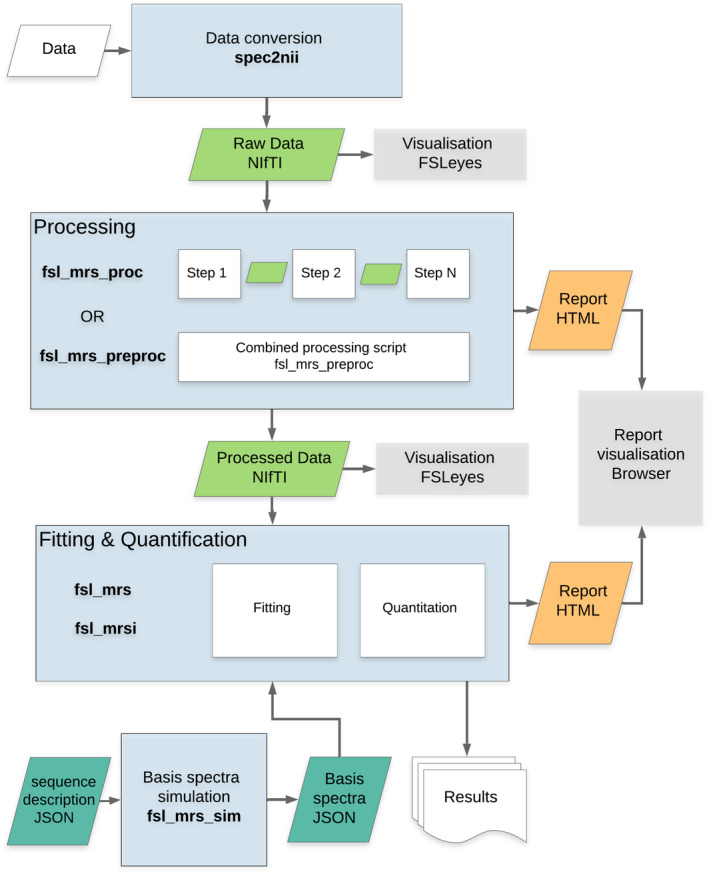
We introduce FSL-MRS, an end-to-end, modular, open-source MRS analysis toolbox. It provides spectroscopic data conversion, preprocessing, spectral simulation, fitting, quantitation, and visualization.
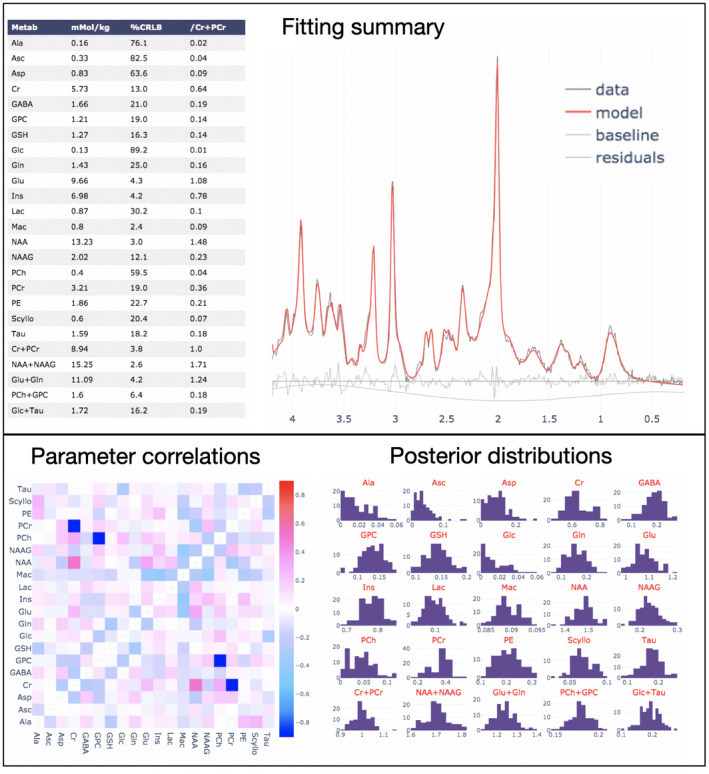
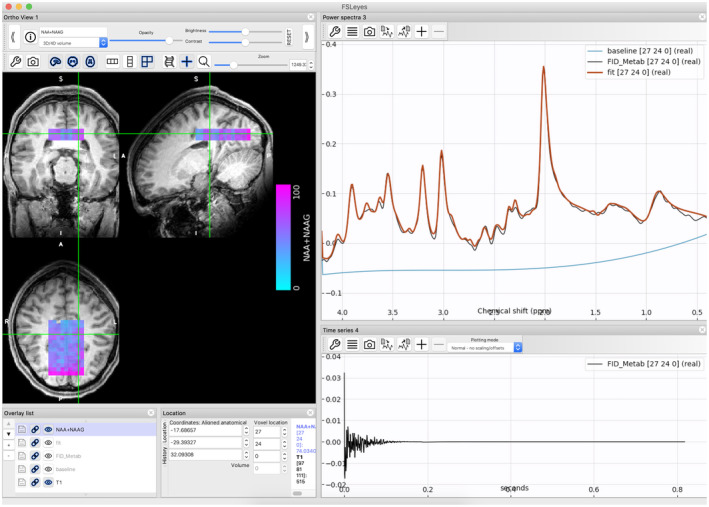
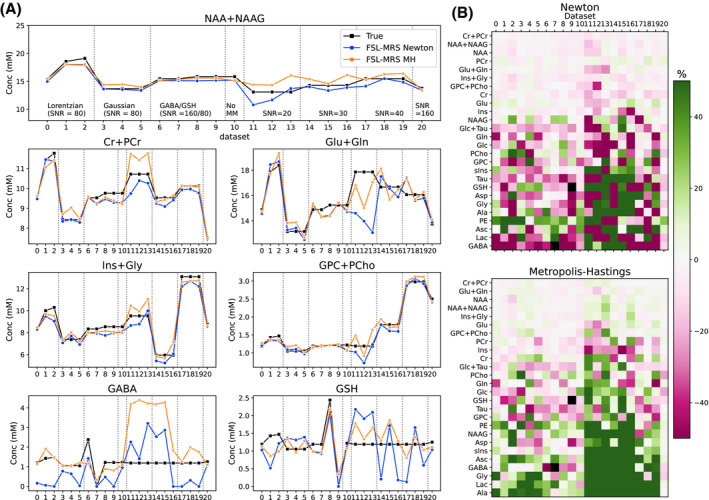
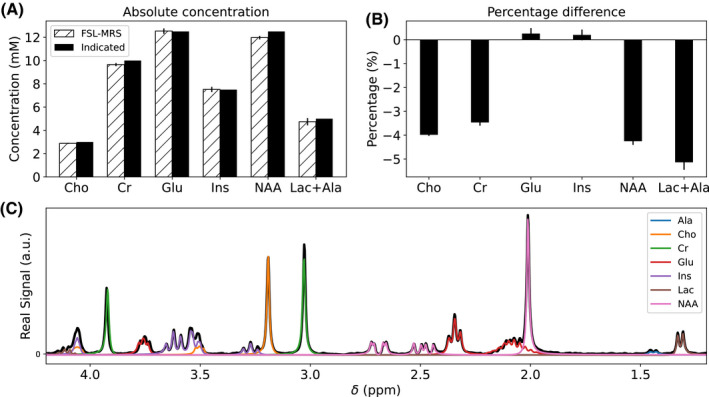
The FSL-MRS package is modular. Its programs operate on data in a standard format (Neuroimaging Informatics Technology Initiative [NIfTI]) capable of storing single-voxel and multivoxel spectroscopy, including spatial orientation information. The FSL-MRS toolbox includes tools for preprocessing of raw spectroscopy data, including coil combination, frequency and phase alignment, and filtering. A density matrix simulation program is supplied for generation of basis spectra from simple text-based descriptions of pulse sequences. Fitting is based on linear combination of basis spectra and implements Markov chain Monte Carlo optimization for the estimation of the full posterior distribution of metabolite concentrations. Validation of the fitting is carried out on independently created simulated data, phantom data, and three in vivo human data sets (257 single-voxel spectroscopy and 8 MRSI data sets) at 3 T and 7 T. Interactive HTML reports are automatically generated by processing and fitting stages of the toolbox. The FSL-MRS package can be used on the command line or interactively in the Python language.
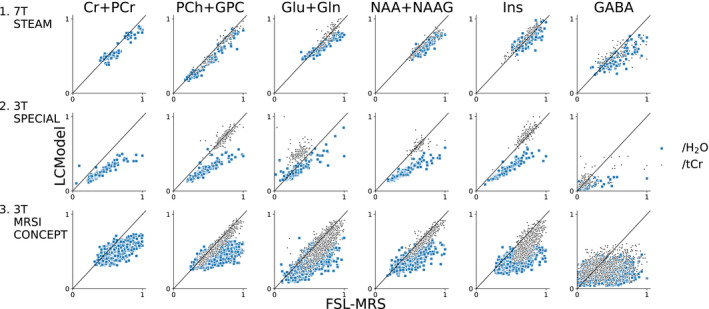
Validation of the fitting shows low error in simulation (median error of 11.9%) and in phantom (3.4%). Average correlation between a third-party toolbox (LCModel) and FSL-MRS was high (0.53-0.81) in all three in vivo data sets.
The FSL-MRS toolbox is designed to be flexible and extensible to new forms of spectroscopic acquisitions. Custom fitting models can be specified within the framework for dynamic or multivoxel spectroscopy. It is available as part of the FMRIB Software Library.
我们介绍FSL-MRS,一个端到端、模块化的开源磁共振波谱分析工具箱。它提供光谱数据转换、预处理、光谱模拟、拟合、定量分析和可视化功能。
FSL-MRS软件包是模块化的。其程序对标准格式(神经影像信息学技术倡议组织 [NIfTI])的数据进行操作,该格式能够存储单体素和多体素波谱,包括空间方向信息。FSL-MRS工具箱包括用于原始波谱数据预处理的工具,如线圈组合、频率和相位校准以及滤波。提供了一个密度矩阵模拟程序,用于根据基于文本的简单脉冲序列描述生成基础谱。拟合基于基础谱的线性组合,并实现马尔可夫链蒙特卡罗优化,以估计代谢物浓度的完整后验分布。在独立创建的模拟数据、体模数据以及三个3T和7T的体内人体数据集(257个单体素波谱和8个磁共振波谱成像数据集)上对拟合进行验证。通过工具箱的处理和拟合阶段自动生成交互式HTML报告。FSL-MRS软件包既可以在命令行使用,也可以用Python语言进行交互式使用。
拟合验证显示在模拟中误差较低(中位数误差为11.9%),在体模中误差为3.4%。在所有三个体内数据集中,第三方工具箱(LCModel)与FSL-MRS之间的平均相关性较高(0.53 - 0.81)。
FSL-MRS工具箱设计灵活,可扩展到新形式的数据采集。可以在动态或多体素波谱框架内指定自定义拟合模型。它作为FMRIB软件库的一部分提供。