Tsuzuki Fernanda-Midori, de Castro-Hoshino Lidiane-Vizioli, Lopes Larissa-Coelho-Pires, Sato Francielle, Baesso Mauro-Luciano, Terada Raquel-Sano-Suga
Postgraduate student, Department of restorative dentistry, Dental Materials area, Campinas State University (FOP/Unicamp), Piracicaba, Brazil.
Postgraduate student, Department of physics, State University of Maringá (UEM), Maringá, Brazil.
J Clin Exp Dent. 2020 Dec 1;12(12):e1117-e1123. doi: 10.4317/jced.57288. eCollection 2020 Dec.
It is known that bulk-fill have been widely studied and used by dentists in the clinic. However, the use of light-curing units that do not have the ability to adequately light-cure these materials at the appropriate depth can affect their clinical performance. The aim of this study was evaluating the influence of 5 different light curing units (LCUs) on the degree of conversion (DC) of a bulk-fill resin at depths of 0 to 4 mm and determined the effect of using 20s exposure and 40s.
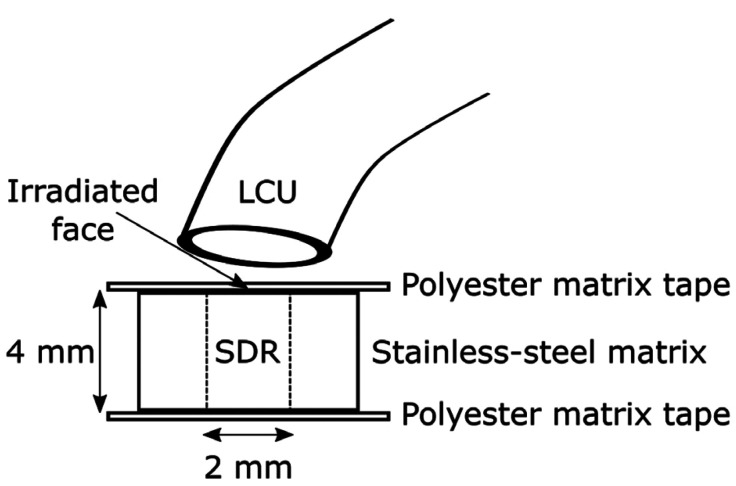
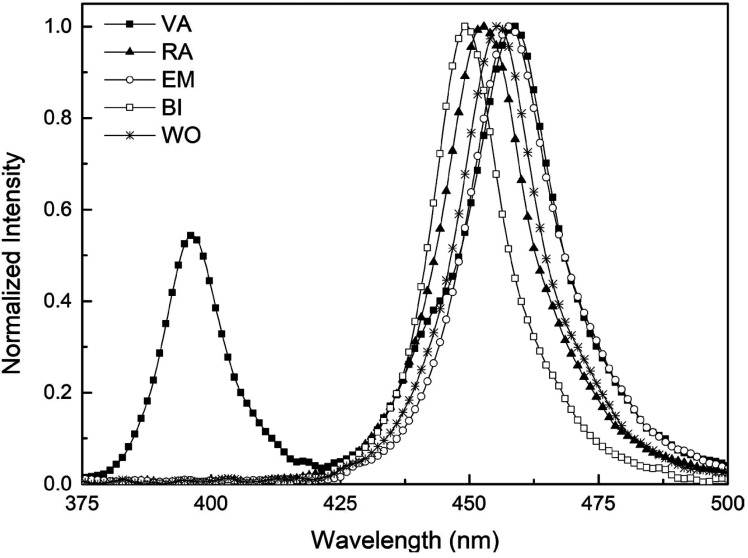
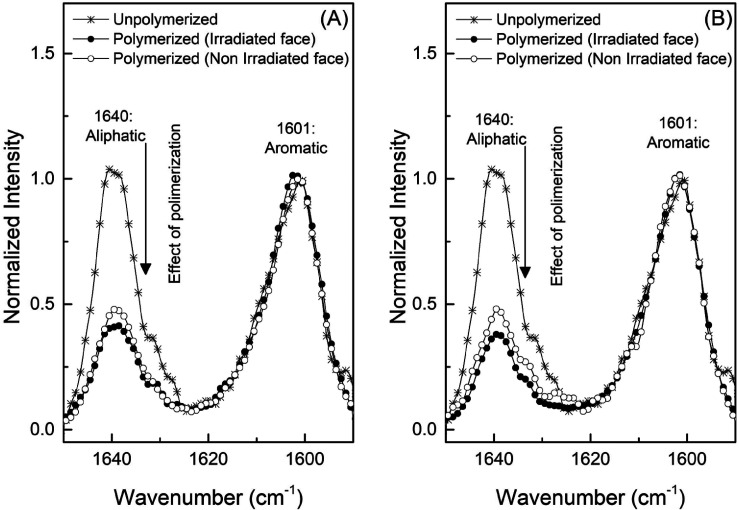
Cylinders of composite were made in a stainless steel matrix (n=10). The specimens were exposed from the top surface using 5 LCUs: Valo® Cordless (VA); Radii Plus (RA); Emitter.D (EM), Biolux Plus (BI), Woodpecker® (WO). The emission wavelength and the power density was determined. After the photoactivation, the Raman vibrational modes were calculated taking as reference the peaks at 1,601 (aromatic bonds C=C) and 1,640 cm-1 (aliphatic bonds C=C).
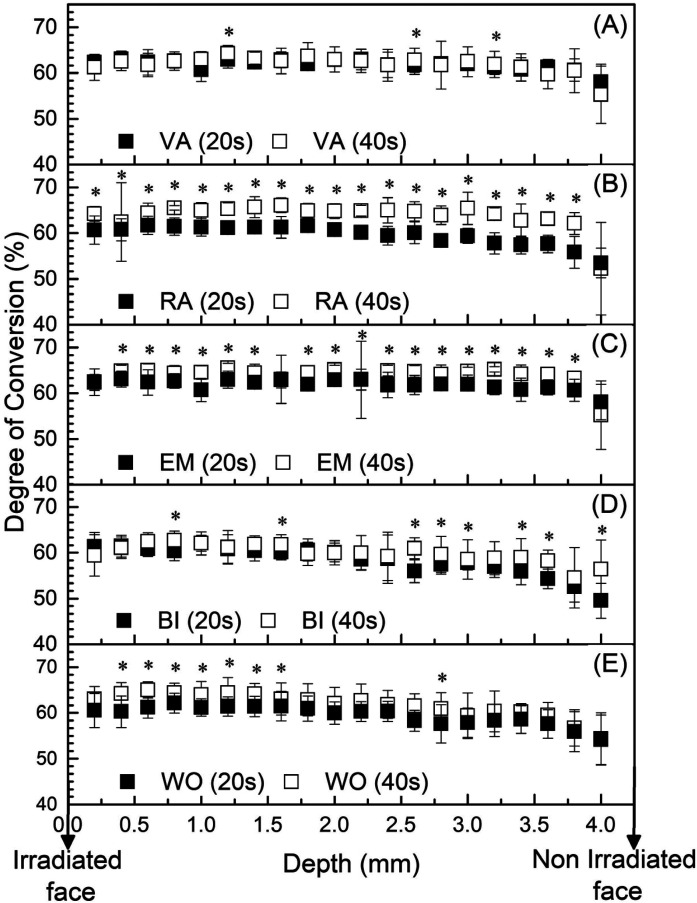
The largest difference in DC in 20s, comparing the values obtained in the first and last layer is for BI, with a variation from 61.24% to 53.86%. Comparing the LCUs, the last layer in 40s DC values are 57.40% (BI), 58.21% (WO), 58.97% (VA), 60.90% (RA) and 62.42% (EM). The higher the dose (J/cm²) and the close the λmax is to the maximum CQ absorption length (λmax ~ 470 nm) the better the DC value.
There was a significant difference in the DC values between the LCUs with increasing depth of the bulk-fill increments. Results indicate significant differences in DC among the different LCUs as well as enhanced DC when using 40s exposure compared to 20s. It is suggested that for DC improvement using lower power photoactivator increase the exposure time the exposure time should be 20s to 40s. Polymerization, Composite Resins, Raman spectroscopy.
众所周知,大体积充填材料已在临床上得到广泛研究并被牙医使用。然而,使用无法在适当深度对这些材料进行充分光固化的光固化设备会影响其临床性能。本研究的目的是评估5种不同的光固化设备(LCU)对大体积充填树脂在0至4毫米深度处转化率(DC)的影响,并确定20秒曝光和40秒曝光的效果。
在不锈钢模具中制作复合树脂圆柱体(n = 10)。使用5种光固化设备从顶面照射标本:Valo® Cordless(VA);Radii Plus(RA);Emitter.D(EM),Biolux Plus(BI),啄木鸟®(WO)。测定发射波长和功率密度。光活化后,以1,601(芳香族键C = C)和1,640 cm-1(脂肪族键C = C)处的峰为参考计算拉曼振动模式。
在20秒时,比较第一层和最后一层获得的值,DC差异最大的是BI,从61.24%变化到53.86%。比较光固化设备,40秒时最后一层的DC值分别为57.40%(BI)、58.21%(WO)、58.97%(VA)、60.90%(RA)和62.42%(EM)。剂量(J/cm²)越高且λmax越接近最大CQ吸收长度(λmax ~ 470 nm),DC值越好。
随着大体积充填增量深度增加,光固化设备之间的DC值存在显著差异。结果表明不同光固化设备之间的DC存在显著差异,并且与20秒曝光相比,40秒曝光时DC增强。建议为了使用较低功率的光活化剂提高DC,增加曝光时间,曝光时间应为20秒至40秒。聚合反应、复合树脂、拉曼光谱。