European Programme for Intervention Epidemiology Training (EPIET), European Centre for Disease Prevention and Control (ECDC), Gustav III:s Boulevard 40, Solna, Stockholm16973, Sweden.
Department of Foodborne and Waterborne Diseases, National Public Health Organisation (EODY), 3-5 Agrafon str., Marousi, Attiki15123, Greece.
Epidemiol Infect. 2020 Dec 9;149:e83. doi: 10.1017/S0950268820002976.
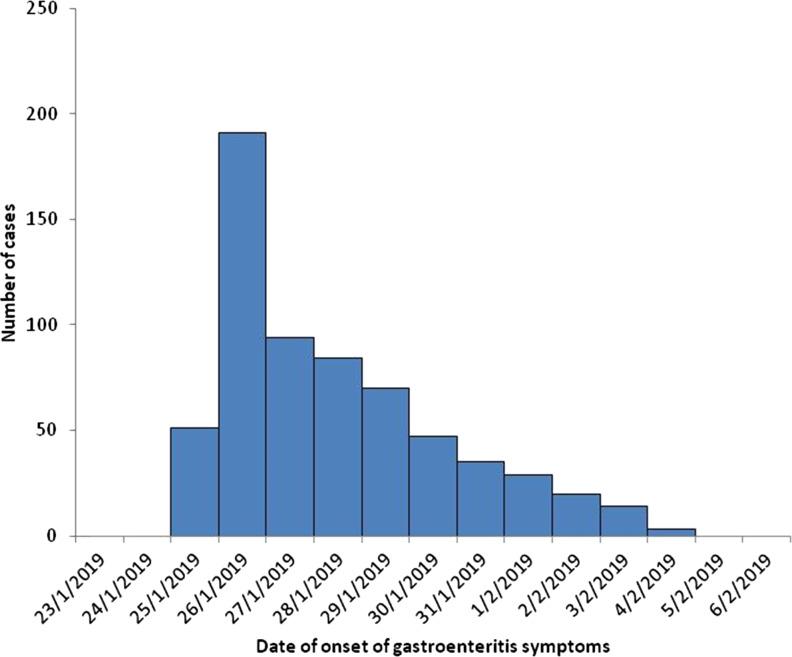
We investigated a large gastroenteritis outbreak that occurred in Northern Greece in 2019. A case was defined as anyone presenting with diarrhoea and/or vomiting from 24 January 2019 to 04 February 2019. We conducted a case-control study (CCS) using random selection of participants >16 years of age, residents of town X, who visited the health care centre between 25 and 28 January 2019. Moreover, we conducted a retrospective cohort study (CS) at the four elementary schools of the town. We collected clinical and water samples and the water supply system was inspected. In total, we recorded 638 cases (53% female; median age was 44 years (range 0-93)). Forty-eight cases and 52 controls participated in the CCS and 236 students in the CS. Both CCS and CS indicated tap water as the most likely source (OR 10, 95% CI 2.09-93.4, explaining 95.7% of cases; RR = 2.22, 95% CI 1.42-3.46, respectively). More than one pathogen was detected from stool samples of 6 of the 11 cases tested (norovirus, Campylobacter jejuni, Enterohemorrhagic E. coli (EHEC) and Enteropathogenic E. coli (EPEC)). Water samples, collected after ad-hoc chlorination, tested negative. Technical failures of the water tanks' status were identified. Our results suggested a waterborne outbreak. We recommended regular monitoring of the water supply system and immediate repair of technical failures.
我们调查了 2019 年希腊北部发生的一次大规模肠胃炎暴发。病例定义为 2019 年 1 月 24 日至 2 月 4 日期间出现腹泻和/或呕吐的任何人。我们使用随机选择年龄>16 岁的参与者进行病例对照研究(CCS),这些参与者居住在城镇 X,于 2019 年 1 月 25 日至 28 日期间访问了医疗保健中心。此外,我们在城镇的四所小学进行了回顾性队列研究(CS)。我们收集了临床和水样,并检查了供水系统。总共记录了 638 例病例(53%为女性;中位年龄为 44 岁(0-93 岁))。CCS 有 48 例病例和 52 名对照者,CS 有 236 名学生参加。CCS 和 CS 均表明自来水是最可能的来源(OR 10,95%CI 2.09-93.4,解释了 95.7%的病例;RR=2.22,95%CI 1.42-3.46)。在 11 例送检粪便样本中,有 6 例检测到一种以上病原体(诺如病毒、空肠弯曲菌、肠出血性大肠杆菌(EHEC)和肠致病性大肠杆菌(EPEC))。收集后进行了专门氯化处理的水样检测结果为阴性。发现水箱状态的技术故障。我们的结果提示了一次水源性暴发。我们建议定期监测供水系统并立即修复技术故障。