Jha Ashwani, Menozzi Elisa, Oyekan Rebecca, Latorre Anna, Mulroy Eoin, Schreglmann Sebastian R, Stamate Cosmin, Daskalopoulos Ioannis, Kueppers Stefan, Luchini Marco, Rothwell John C, Roussos George, Bhatia Kailash P
Department of Clinical and Movement Neurosciences, UCL Queen Square Institute of Neurology, London, UK.
Department of Biomedical, Metabolic and Neural Sciences, University of Modena and Reggio Emilia, Modena, Italy.
NPJ Parkinsons Dis. 2020 Dec 8;6(1):36. doi: 10.1038/s41531-020-00135-w.
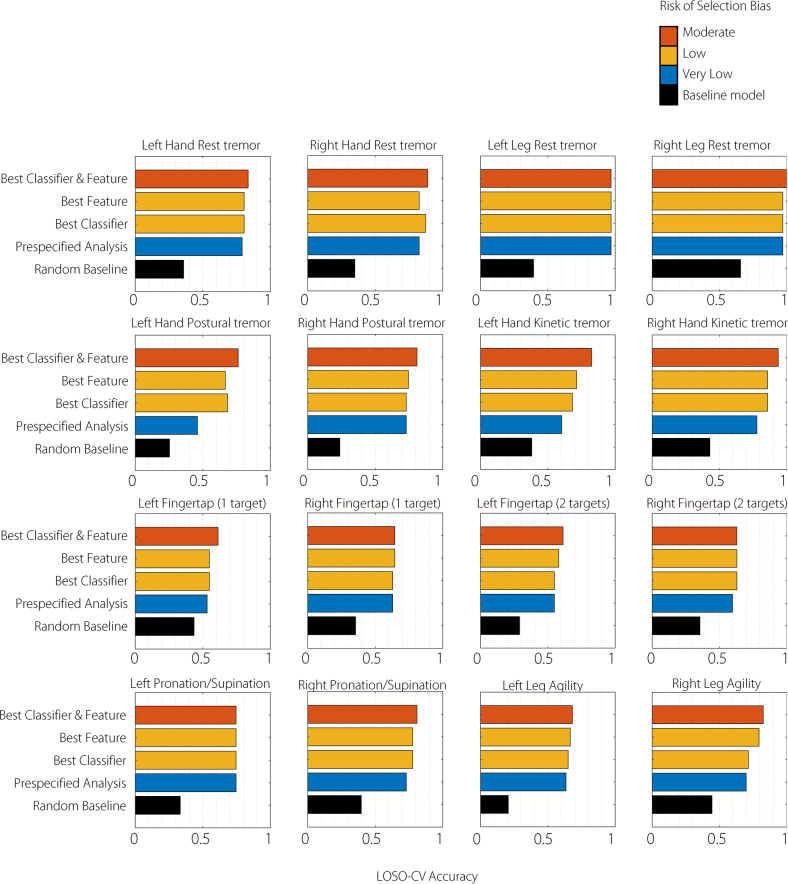
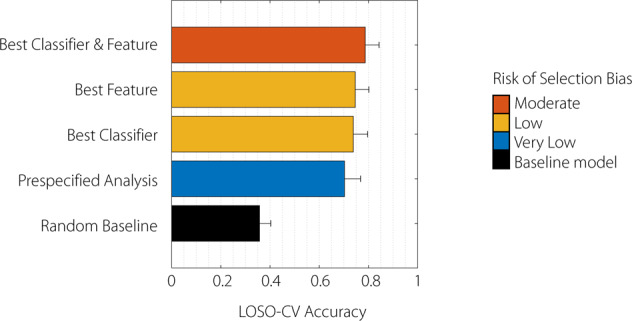
Digital assessments of motor severity could improve the sensitivity of clinical trials and personalise treatment in Parkinson's disease (PD) but have yet to be widely adopted. Their ability to capture individual change across the heterogeneous motor presentations typical of PD remains inadequately tested against current clinical reference standards. We conducted a prospective, dual-site, crossover-randomised study to determine the ability of a 16-item smartphone-based assessment (the index test) to predict subitems from the Movement Disorder Society-Unified Parkinson's Disease Rating Scale part III (MDS-UPDRS III) as assessed by three blinded clinical raters (the reference-standard). We analysed data from 60 subjects (990 smartphone tests, 2628 blinded video MDS-UPDRS III subitem ratings). Subject-level predictive performance was quantified as the leave-one-subject-out cross-validation (LOSO-CV) accuracy. A pre-specified analysis classified 70.3% (SEM 5.9%) of subjects into a similar category to any of three blinded clinical raters and was better than random (36.7%; SEM 4.3%) classification. Post hoc optimisation of classifier and feature selection improved performance further (78.7%, SEM 5.1%), although individual subtests were variable (range 53.2-97.0%). Smartphone-based measures of motor severity have predictive value at the subject level. Future studies should similarly mitigate against subjective and feature selection biases and assess performance across a range of motor features as part of a broader strategy to avoid overly optimistic performance estimates.
对运动严重程度进行数字评估可以提高帕金森病(PD)临床试验的敏感性并实现个性化治疗,但尚未得到广泛应用。在当前临床参考标准下,其捕捉PD典型异质性运动表现中个体变化的能力仍未得到充分测试。我们进行了一项前瞻性、双中心、交叉随机研究,以确定一项基于智能手机的16项评估(指标测试)预测由三名盲法临床评估者评估的运动障碍协会统一帕金森病评定量表第三部分(MDS-UPDRS III)子项目的能力(参考标准)。我们分析了60名受试者的数据(990次智能手机测试,2628次盲法视频MDS-UPDRS III子项目评分)。将受试者水平的预测性能量化为留一受试者交叉验证(LOSO-CV)准确性。一项预先指定的分析将70.3%(标准误5.9%)的受试者归类为与三名盲法临床评估者中的任何一位相似的类别,并且优于随机分类(36.7%;标准误4.3%)。分类器和特征选择的事后优化进一步提高了性能(78.7%,标准误5.1%),尽管各个子测试存在差异(范围为53.2 - 97.0%)。基于智能手机的运动严重程度测量在受试者水平具有预测价值。未来的研究应同样减轻主观和特征选择偏差,并评估一系列运动特征的性能,作为避免过于乐观的性能估计的更广泛策略的一部分。