Bui Duy Tung
School of Public Finance, University of Economics Ho Chi Minh City, 279 Nguyen Tri Phuong, Phuong 5, Quan 10, Ho Chi Minh City, Viet Nam.
Heliyon. 2020 Nov 18;6(11):e05509. doi: 10.1016/j.heliyon.2020.e05509. eCollection 2020 Nov.
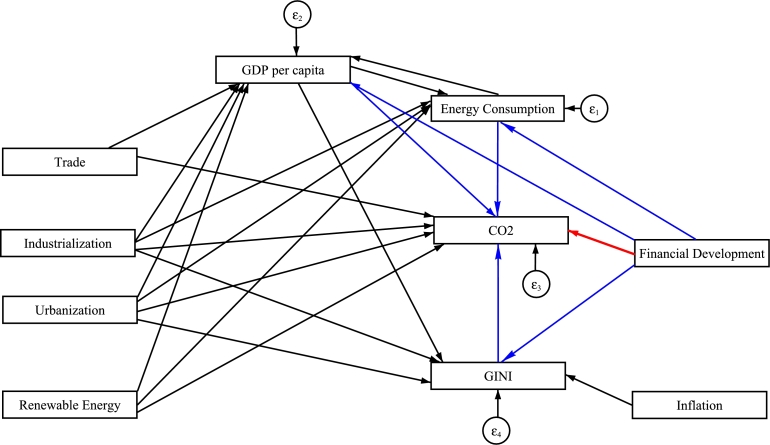
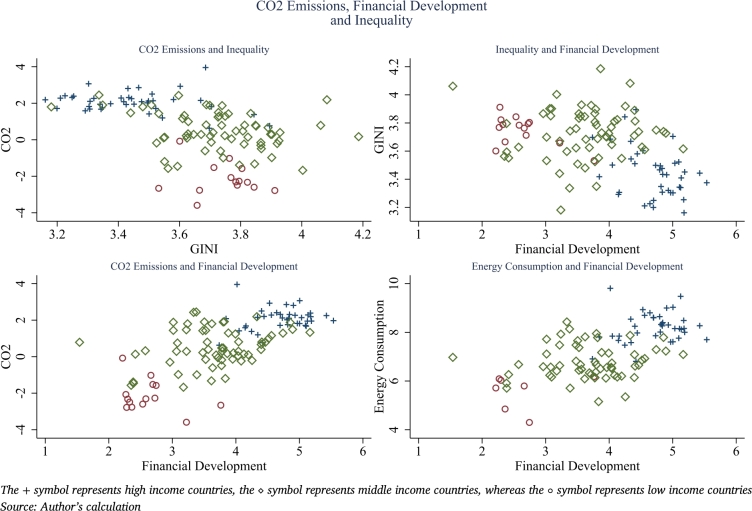
This paper aims to investigate the direct and indirect effects of financial development on CO2 emissions, using a global sample of 100 countries from 1990 - 2012. Our main contribution to the literature lies in the identification and explanation of possible transmission channels that allow financial development to affect environmental quality. The paper employs 2SLS and 3SLS estimators to investigate these channels. Empirical results confirm the positive direct effect of financial development on environmental degradation. Development of the financial system also gives rise to more energy demand and consequently leads to more pollutant emissions. Besides, there is evidence about a trade-off between income inequality and environmental quality. Financial development can help redistribute income more effectively. However, high living standards will put pressure on environmental conservation. The paper also considers the nonlinear effects of financial development on carbon emission rates. Only a small proportion of the population receive the benefits at the early stages of financial development. After a certain amount of time, financial development benefits a more significant part of the population and reduces income inequality.
本文旨在利用1990年至2012年期间100个国家的全球样本,研究金融发展对二氧化碳排放的直接和间接影响。我们对该文献的主要贡献在于识别和解释金融发展影响环境质量的可能传导渠道。本文采用两阶段最小二乘法(2SLS)和三阶段最小二乘法(3SLS)估计量来研究这些渠道。实证结果证实了金融发展对环境退化的正向直接影响。金融体系的发展也会带来更多的能源需求,从而导致更多的污染物排放。此外,有证据表明收入不平等与环境质量之间存在权衡。金融发展有助于更有效地重新分配收入。然而,高生活水平会给环境保护带来压力。本文还考虑了金融发展对碳排放率的非线性影响。在金融发展的早期阶段,只有一小部分人口受益。经过一段时间后,金融发展使更大比例的人口受益,并减少了收入不平等。