Kan Juntao, Li Ao, Zou Hong, Chen Liang, Du Jun
Nutrilite Health Institute, Shanghai, China.
Department of Bioinformatics, WuXi NextCODE Genomics, Shanghai, China.
Front Nutr. 2020 Nov 13;7:577923. doi: 10.3389/fnut.2020.577923. eCollection 2020.
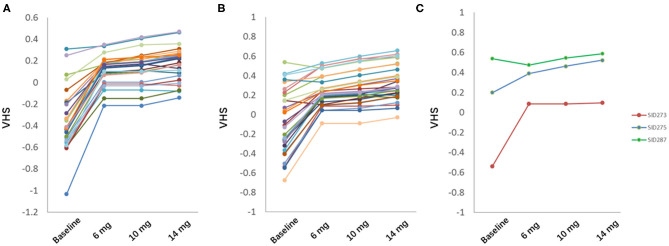
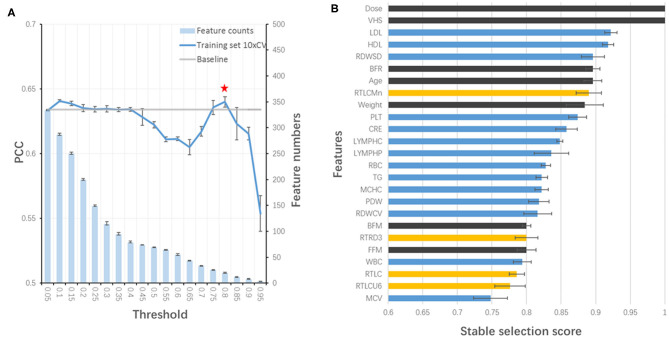
Nutritional intervention was always implemented based on "one-size-fits-all" recommendation instead of personalized strategy. We aimed to develop a machine learning based model to predict the optimal dose of a botanical combination of lutein ester, zeaxanthin, extracts of black currant, chrysanthemum, and goji berry for individuals with eye fatigue. 504 features, including demographic, anthropometrics, eye-related indexes, blood biomarkers, and dietary habits, were collected at baseline from 303 subjects in a randomized controlled trial. An aggregated score of visual health (VHS) was developed from total score of eye fatigue symptoms, visuognosis persistence, macular pigment optical density, and Schirmer test to represent an overall eye fatigue level. VHS at 45 days after intervention was predicted by XGBoost algorithm using all features at baseline to show the eye fatigue improvement. Optimal dose of the combination was chosen based on the predicted VHS. After feature selection and parameter optimization, a model was trained and optimized with a Pearson's correlation coefficient of 0.649, 0.638, and 0.685 in training, test and validation set, respectively. After removing the features collected by invasive blood test and costly optical coherence tomography, the model remained good performance. Among 58 subjects in test and validation sets, 39 should take the highest dose as the optimal option, 17 might take a lower dose, while 2 could not benefit from the combination. We applied XGBoost algorithm to develop a model which could predict optimized dose of the combination to provide personalized nutrition solution for individuals with eye fatigue.
营养干预一直是基于“一刀切”的建议实施的,而非个性化策略。我们旨在开发一种基于机器学习的模型,以预测叶黄素酯、玉米黄质、黑加仑提取物、菊花和枸杞的植物组合对眼疲劳个体的最佳剂量。在一项随机对照试验中,从303名受试者基线时收集了504个特征,包括人口统计学、人体测量学、眼部相关指标、血液生物标志物和饮食习惯。通过眼疲劳症状总分、视诊持久性、黄斑色素光密度和泪液分泌试验的总分得出视觉健康综合评分(VHS),以代表整体眼疲劳水平。使用基线时的所有特征,通过XGBoost算法预测干预45天后的VHS,以显示眼疲劳的改善情况。根据预测的VHS选择组合的最佳剂量。经过特征选择和参数优化后,训练并优化了一个模型,其在训练集、测试集和验证集中的皮尔逊相关系数分别为0.649、0.638和0.685。去除通过侵入性血液检测和昂贵的光学相干断层扫描收集的特征后,该模型仍保持良好性能。在测试集和验证集的58名受试者中,39人应采用最高剂量作为最佳选择,17人可能采用较低剂量,而2人可能无法从该组合中获益。我们应用XGBoost算法开发了一个模型,该模型可以预测组合的优化剂量,为眼疲劳个体提供个性化营养解决方案。