Vieux Florent, Maillot Matthieu, Rehm Colin D, Barrios Pamela, Drewnowski Adam
MS-Nutrition, 27 bld Jean Moulin, Faculté de Médecine la Timone, Laboratoire C2VN, Marseille, France.
PepsiCo Inc., Purchase, NY, United States.
Front Nutr. 2020 Nov 16;7:587123. doi: 10.3389/fnut.2020.587123. eCollection 2020.
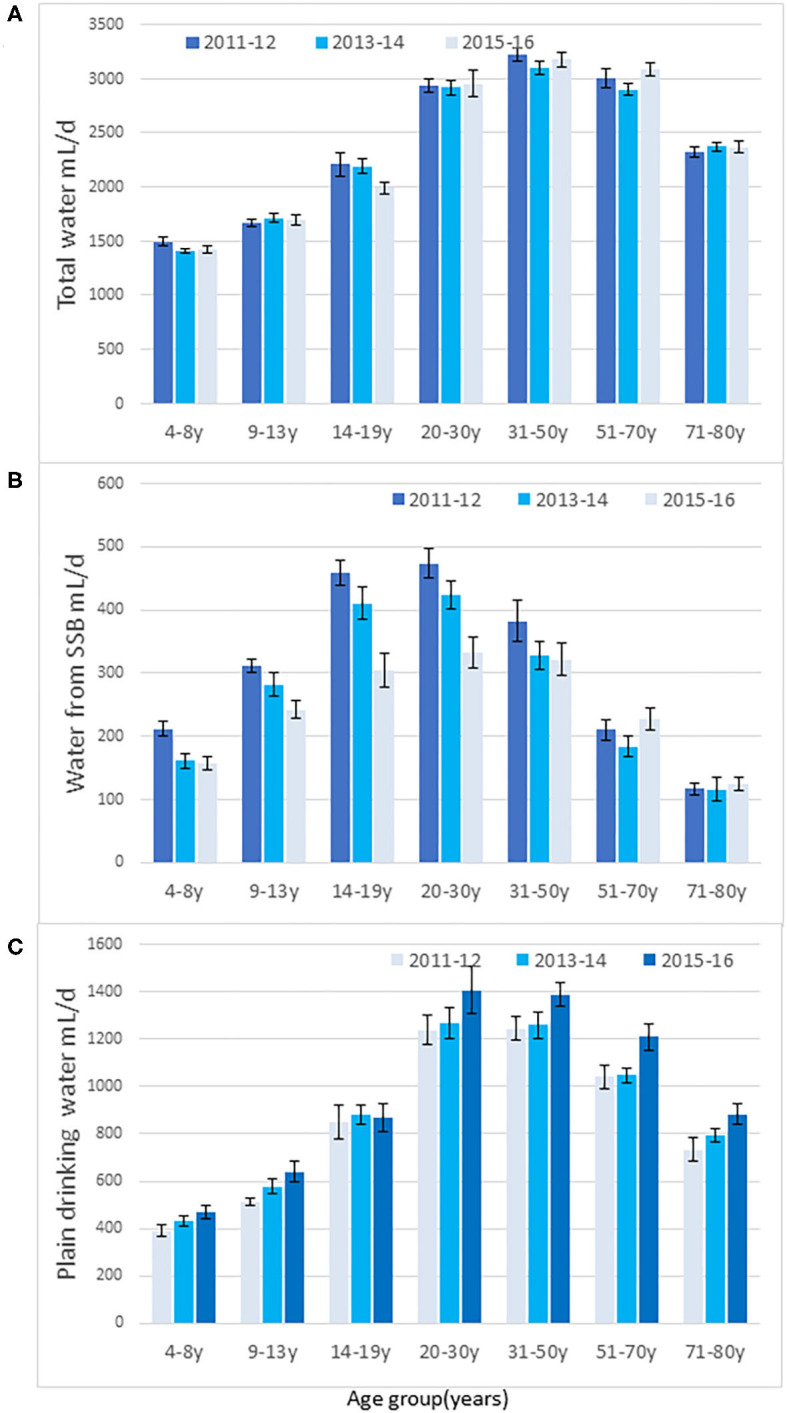
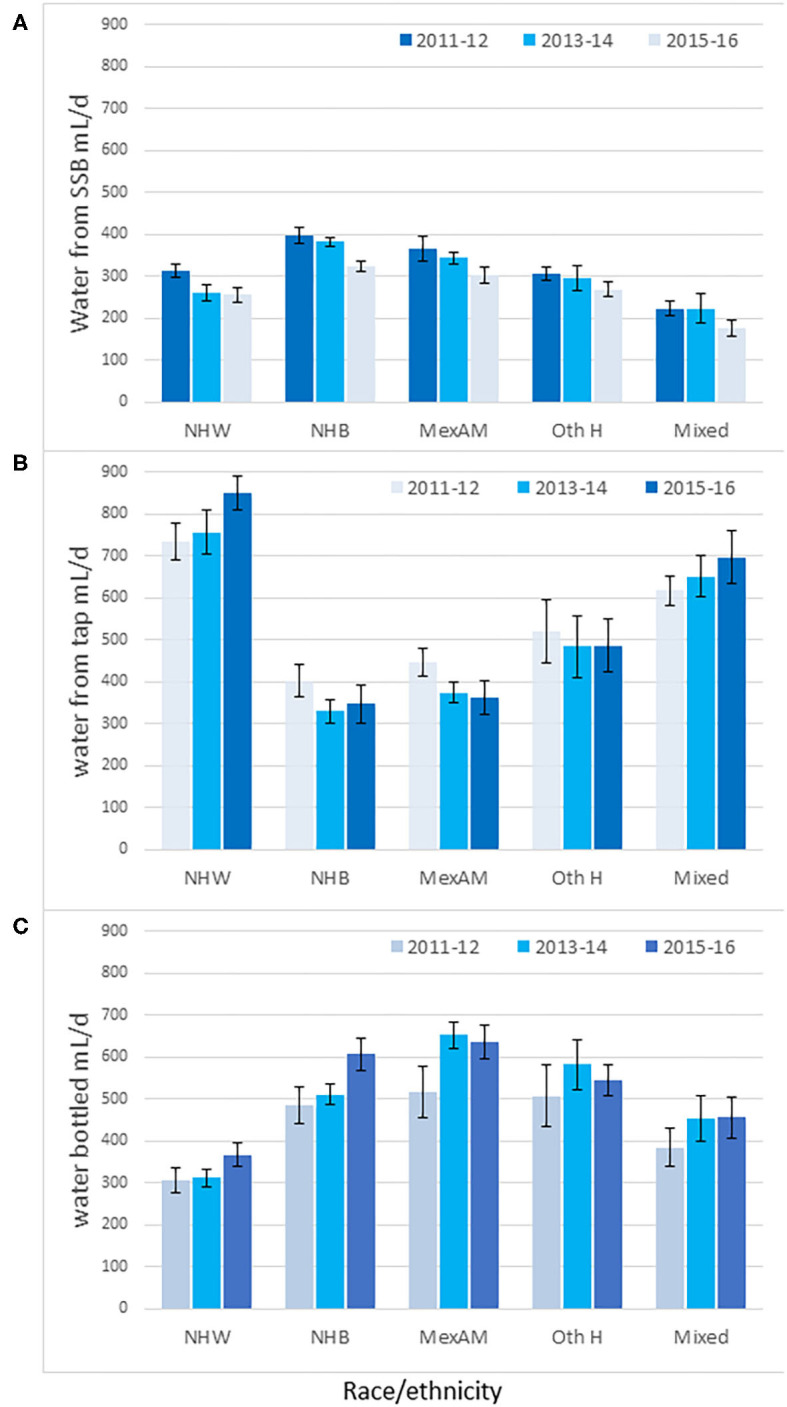
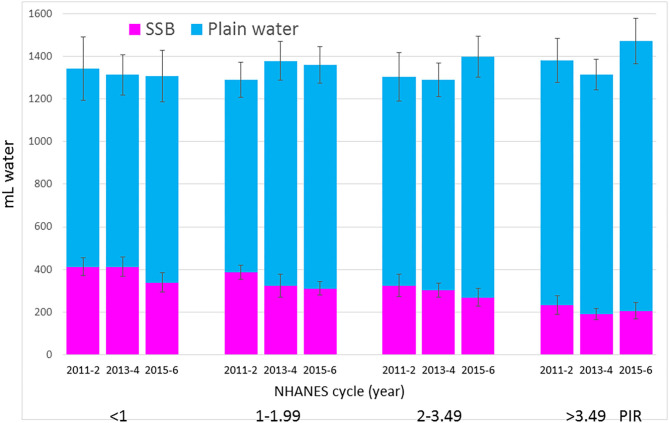
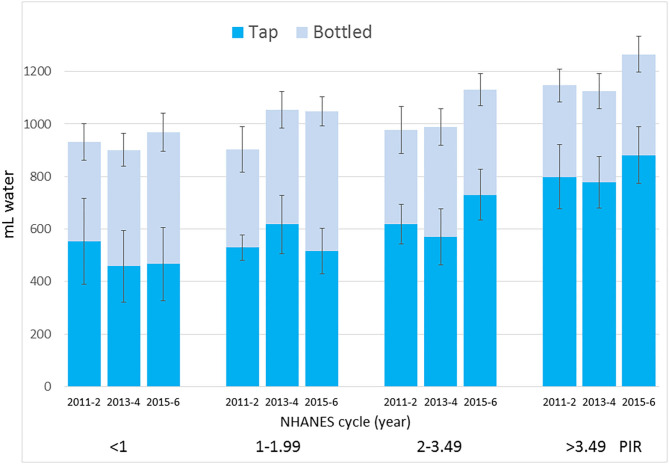
Choosing water in place of sugar-sweetened beverages (SSB) can reduce added sugars while maintaining adequate hydration. The present goal was to examine 2011-16 time trends in SSB vs. water consumption across US population subgroups. Dietary intake data for 22,716 persons aged >4 years came from two 24-h dietary recalls in successive cycles of the National Health and Examination Survey (NHANES 2011-16). Water intakes (in mL/d) from plain water (tap and bottled) and from beverages (SSB and not-SSB) were the principal outcome variables. Intakes were analyzed by age group, income to poverty ratio (IPR), and race/ethnicity. Time trends by demographics were also examined. SSB and water intakes followed distinct social gradients. Most SSB was consumed by Non-Hispanic Black and lower-income groups. Most tap water was consumed by Non-Hispanic White and higher-income groups. During 2011-16, water from SSB declined from 322 to 262 mL/d ( < 0.005), whereas plain water increased (1,011-1,144 mL/d) ( < 0.05). Groups aged <30 years reduced SSB consumption ( < 0.0001) but it was groups aged >30 years that increased drinking water ( < 0.001). Non-Hispanic White groups reduced SSB and increased tap water consumption. Non-Hispanic Black and lower income groups reduced SSB and increased bottled water, not tap. The opposing time trends in SSB and water consumption were not uniform across age groups or sociodemographic strata. Only the non-Hispanic White population reduced SSB and showed a corresponding increase in tap water. Lower-income and minority groups consumed relatively little plain drinking water from the tap.
选择喝水而非含糖饮料(SSB)可以减少添加糖的摄入,同时保持充足的水分。当前的目标是研究2011 - 2016年美国不同人群亚组中SSB与水的消费时间趋势。来自22716名4岁以上人群的饮食摄入数据来自美国国家健康与营养检查调查(NHANES 2011 - 2016)连续周期的两次24小时饮食回忆。来自普通水(自来水和瓶装水)以及饮料(SSB和非SSB)的水摄入量(以毫升/天为单位)是主要的结果变量。摄入量按年龄组、收入与贫困比率(IPR)以及种族/族裔进行分析。还研究了人口统计学的时间趋势。SSB和水的摄入量呈现出不同的社会梯度。大多数SSB由非西班牙裔黑人及低收入群体消费。大多数自来水由非西班牙裔白人及高收入群体消费。在2011 - 2016年期间,来自SSB的水从322毫升/天降至262毫升/天(<0.005),而普通水增加(从1011毫升/天增至1144毫升/天)(<0.05)。30岁以下的人群减少了SSB的消费(<0.0001),但30岁以上的人群增加了饮用水的摄入量(<0.001)。非西班牙裔白人组减少了SSB的消费并增加了自来水的摄入量。非西班牙裔黑人及低收入群体减少了SSB的消费并增加了瓶装水的摄入量,而非自来水。SSB和水消费的相反时间趋势在不同年龄组或社会人口阶层中并不一致。只有非西班牙裔白人人群减少了SSB的消费并相应增加了自来水的摄入量。低收入和少数族裔群体从水龙头获取的普通饮用水相对较少。