Department of Biomedical Science, University of Padova, Nutrition and Exercise Physiology Lab - Via Marzolo, 3, 35131, Padova, Italy.
Department of Kinesiology & Sport Management, Texas Tech University, Lubbock, TX, USA.
J Int Soc Sports Nutr. 2020 Dec 11;17(1):65. doi: 10.1186/s12970-020-00396-z.
Although there is substantial interest in intermittent fasting as a dietary approach in active individuals, information regarding its effects in elite endurance athletes is currently unavailable. The present parallel randomized trial investigated the effects of a particular intermittent fasting approach, called time-restricted eating (TRE), during 4 weeks of high-level endurance training.
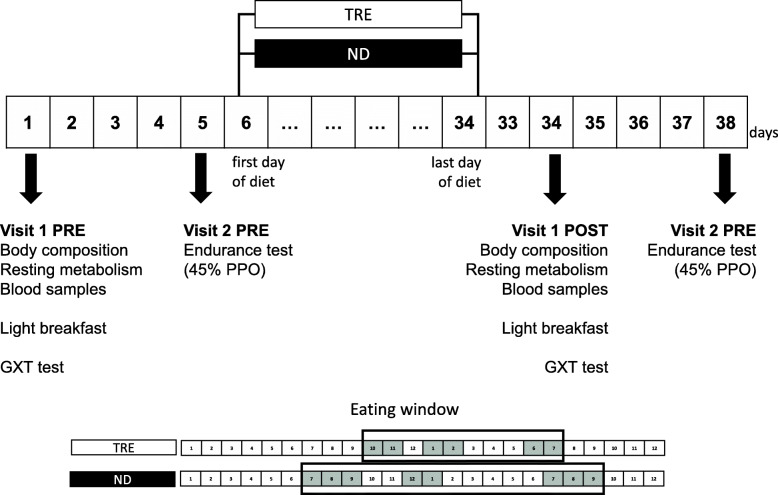
Sixteen elite under-23 cyclists were randomly assigned either to a TRE group or a control group (ND). The TRE group consumed 100% of its estimated daily energy needs in an 8-h time window (from 10:00 a.m. to 6:00 p.m.) whilst energy intake in the ND group was distributed in 3 meals consumed between 7:00 a.m. and 9:00 p.m. Fat and fat-free mass were estimated by bioelectrical impedance analysis and VO and basal metabolism by indirect gas analyzer. In addition, blood counts, anabolic hormones (i.e. free testosterone, IGF-1) and inflammatory markers (i.e. IL-6, TNF-α) were assessed.
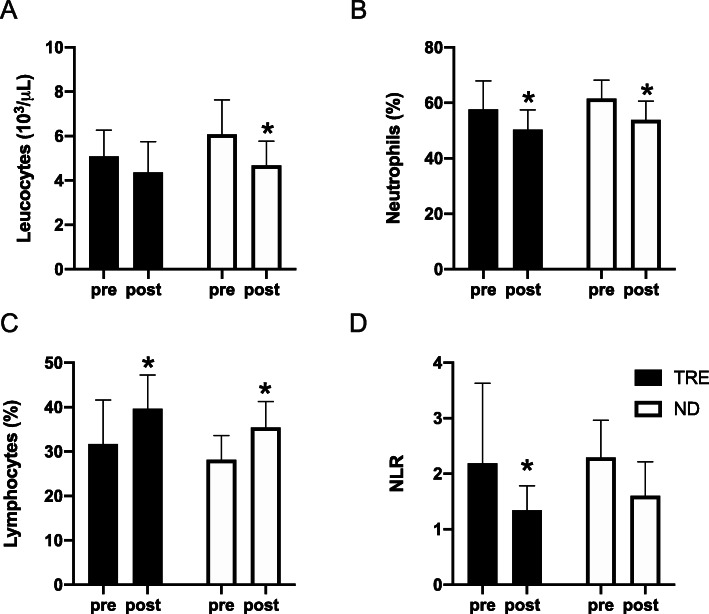
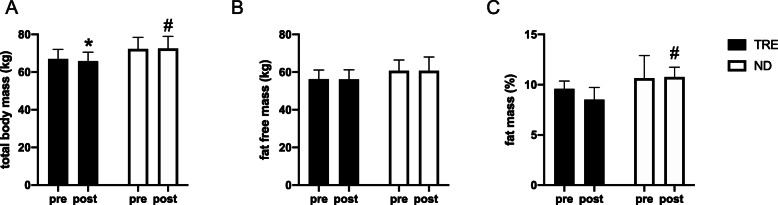
TRE reduced body weight (- 2%; p = 0.04) and fat mass percentage (- 1.1%; p = 0.01) with no change in fat-free mass. Performance tests showed no significant differences between groups, however the peak power output/body weight ratio (PPO/BW) improved in TRE group due to weight loss (p = 0.02). Free testosterone and IGF-1 decreased significantly (p = 0.01 and p = 0.03 respectively) in TRE group. Leucocyte count decreased in ND group (p = 0.02) whilst the neutrophils-to-lymphocytes ratio (NLR) decreased significantly (p = 0.03) in TRE group.
Our results suggest that a TRE program with an 8-h feeding window elicits weight loss, improves body composition and increases PPO/BW in elite cyclists. TRE could also be beneficial for reducing inflammation and may have a protective effect on some components of the immune system. Overall, TRE could be considered as a component of a periodized nutrition plan in endurance athletes.
This trial was retrospectively registered at clinicaltrials.gov as NCT04320784 on 25 March 2020.
虽然间歇性禁食作为一种积极个体的饮食方法引起了广泛关注,但目前尚缺乏关于其在精英耐力运动员中影响的信息。本平行随机试验研究了一种特殊的间歇性禁食方法,即限时进食(TRE),在 4 周的高水平耐力训练中的效果。
16 名 23 岁以下的精英自行车运动员被随机分配到 TRE 组或对照组(ND)。TRE 组在 8 小时的时间窗口内摄入其估计的每日能量需求的 100%(从上午 10:00 到下午 6:00),而 ND 组的能量摄入分布在 3 餐中,在上午 7:00 到下午 9:00 之间摄入。通过生物电阻抗分析和间接气体分析仪估计脂肪和去脂体重。此外,还评估了血液计数、合成代谢激素(即游离睾酮、IGF-1)和炎症标志物(即 IL-6、TNF-α)。
TRE 降低了体重(-2%;p=0.04)和体脂百分比(-1.1%;p=0.01),而去脂体重没有变化。性能测试显示两组之间没有显著差异,但由于体重减轻,TRE 组的峰值功率输出/体重比(PPO/BW)有所提高(p=0.02)。TRE 组的游离睾酮和 IGF-1 显著下降(p=0.01 和 p=0.03)。ND 组的白细胞计数下降(p=0.02),而 TRE 组的中性粒细胞与淋巴细胞比值(NLR)显著下降(p=0.03)。
我们的结果表明,8 小时进食窗口的 TRE 方案可引起体重减轻、改善身体成分并提高精英自行车运动员的 PPO/BW。TRE 还可能有助于减轻炎症,并可能对免疫系统的某些成分产生保护作用。总的来说,TRE 可以被认为是耐力运动员周期化营养计划的一个组成部分。
该试验于 2020 年 3 月 25 日在 clinicaltrials.gov 上作为 NCT04320784 号进行了回顾性注册。