Munhoz da Rocha Isadora Filipaki, Amatuzzi Rafaela Ferreira, Lucena Aline Castro Rodrigues, Faoro Helisson, Alves Lysangela Ronalte
Gene Expression Regulation Laboratory, Carlos Chagas Institute, Oswaldo Cruz Foundation (FIOCRUZ), Curitiba, Brazil.
Laboratory for Applied Science and Technology in Health, Carlos Chagas Institute, Oswaldo Cruz Foundation (FIOCRUZ), Curitiba, Brazil.
Front Cell Infect Microbiol. 2020 Nov 18;10:593160. doi: 10.3389/fcimb.2020.593160. eCollection 2020.
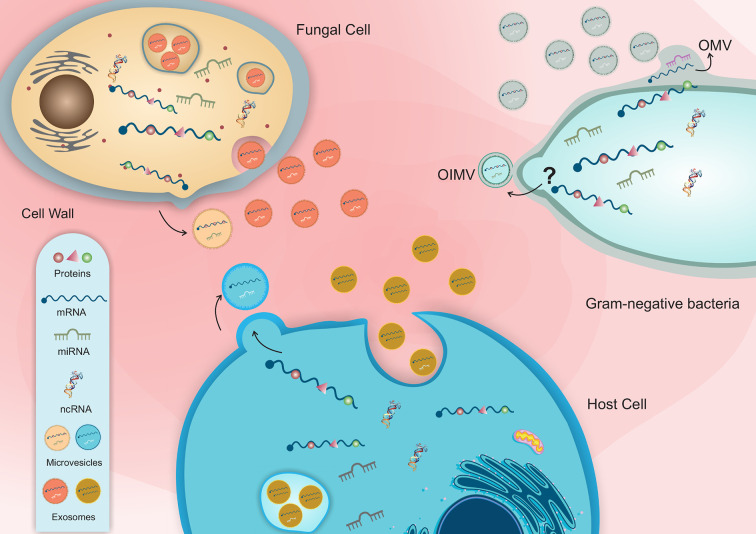
The extracellular vesicle (EVs) traffic has been highlighted as a very important pathway of cellular communication. EVs are produced by prokaryotes and eukaryotes organisms and can carry molecules to help maintain homeostasis, responding to general disbalance, infections, and allowing rapid modulation of the immune system. In the context of infection, EVs from both the host and the pathogen have been identified as playing roles in the recruitment of immunological molecules that can lead to the resolution of the infection or the host's defeat. Bacterial vesicles RNA cargo play roles in the host cell by regulating gene expression and modulating immune response. In fungi the RNA molecules present in EVs are diverse and participate in communication between the host and pathogenic fungi. Little is known about how cross-kingdom sRNA trafficking occurs, although in recent years, there has been an increase in studies that relate EV participation in sRNA delivery. This review aims to elucidate and update the reader concerning the role of extracellular vesicles, with emphasis in the RNA content. We describe the EVs during infection from the host point-of-view, as well as the bacteria and fungi pathogens producing EVs that help the establishment of the disease.
细胞外囊泡(EVs)运输已被视为细胞通讯的一条非常重要的途径。原核生物和真核生物都会产生EVs,其可携带分子以帮助维持体内平衡,应对整体失衡、感染,并实现免疫系统的快速调节。在感染的情况下,已确定宿主和病原体的EVs在募集免疫分子方面发挥作用,这些免疫分子可导致感染的消退或宿主的失败。细菌囊泡RNA货物通过调节基因表达和调节免疫反应在宿主细胞中发挥作用。在真菌中,EVs中存在的RNA分子多种多样,并参与宿主与致病真菌之间的通讯。尽管近年来,有关EV参与小RNA(sRNA)传递的研究有所增加,但对于跨物种sRNA运输的发生方式仍知之甚少。本综述旨在阐明并向读者更新细胞外囊泡的作用,重点是RNA含量。我们从宿主的角度描述感染期间的EVs,以及产生有助于疾病发生的EVs的细菌和真菌病原体。