Majeed Salman, Ramkissoon Haywantee
Department of Marketing, College of Management, Shenzhen University, Shenzhen, China.
School of Business and Economics, Faculty of Biosciences, Fisheries and Economics, UiT The Arctic University of Norway, Tromsø, Norway.
Front Psychol. 2020 Nov 26;11:573220. doi: 10.3389/fpsyg.2020.573220. eCollection 2020.
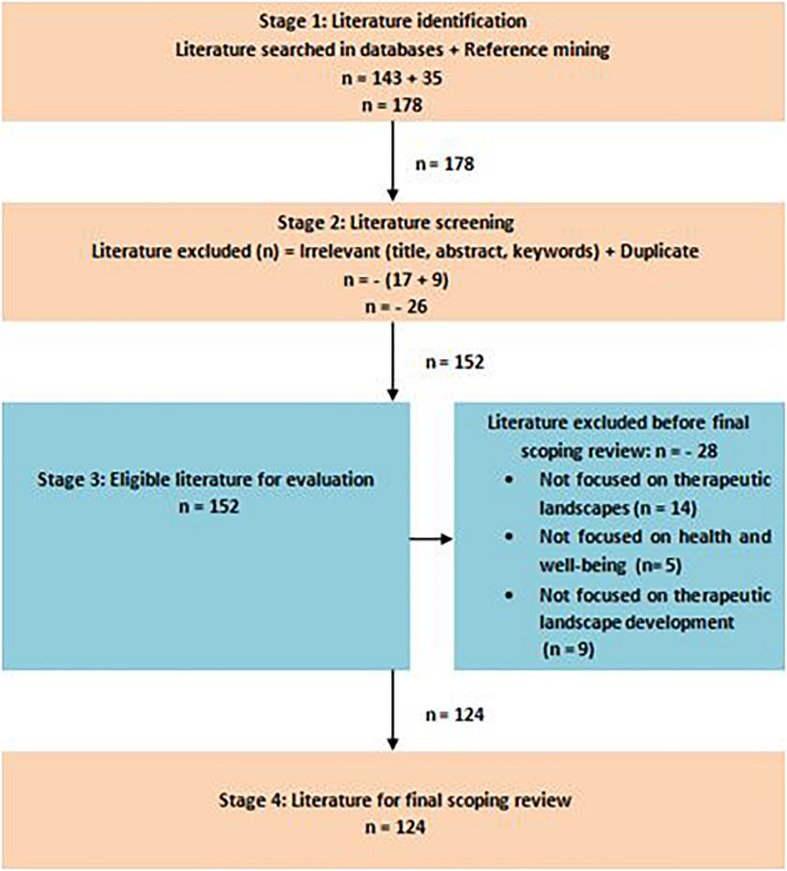
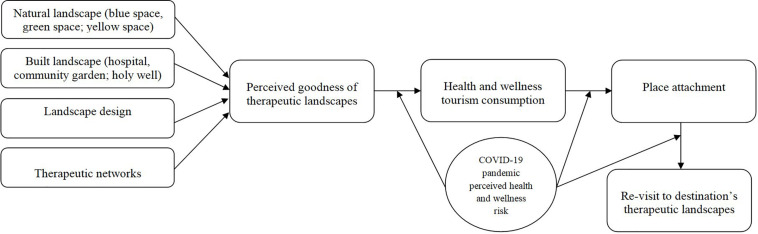
Therapeutic landscapes encapsulate healing and recovery notions in natural and built environmental settings. Tourists' perceptions determine their decision making of health and wellness tourism consumption. Researchers struggle with the conceptualization of the term 'therapeutic landscapes' across disciplines. Drawing on extant literature searched in nine databases, this scoping review identifies different dimensions of therapeutic landscapes. Out of identified 178 literature sources, 124 met the inclusion criteria of identified keywords. We review the contribution and the potential of environmental psychology in understanding tourist behavior to promote health and wellness tourism destinations in a post COVID-19 context. We develop and propose a conceptual framework comprising: (1) perceived goodness of therapeutic landscapes, (2) health and wellness consumption, (3) COVID-19 pandemic perceived health and wellness risk, (4) place attachment, and (5) re-visitation. We propose measurement scales and discuss implications and major issues in the immediate and post the COVID-19 pandemic to inform future research.
治疗性景观在自然和人造环境中蕴含着治愈和康复的概念。游客的认知决定了他们对健康养生旅游消费的决策。研究人员在跨学科领域中对“治疗性景观”这一术语的概念化存在困难。通过对九个数据库中检索到的现有文献进行梳理,本综述确定了治疗性景观的不同维度。在178篇已识别的文献来源中,有124篇符合已识别关键词的纳入标准。我们回顾了环境心理学在理解游客行为以促进后新冠疫情时代健康养生旅游目的地方面的贡献和潜力。我们开发并提出了一个概念框架,包括:(1)治疗性景观的感知优势,(2)健康养生消费,(3)新冠疫情下感知到的健康养生风险,(4)场所依恋,以及(5)再次到访。我们提出了测量量表,并讨论了新冠疫情期间及之后的影响和主要问题,以为未来研究提供参考。