Jager Inge J, Vulink Nienke C C, Bergfeld Isidoor O, van Loon Arnoud J J M, Denys Damiaan A J P
Department of Psychiatry, Amsterdam UMC, Amsterdam Neuroscience, University of Amsterdam, Amsterdam, The Netherlands.
Amsterdam Brain and Cognition, Amsterdam, The Netherlands.
Depress Anxiety. 2020 Dec 18;38(7):708-18. doi: 10.1002/da.23127.
Patients with misophonia suffer from anger or disgust confronted with specific sounds such as smacking or breathing. Avoidance of cue-related situations results in social isolation and significant functional impairment. This is the first randomized, controlled cognitive behavioral therapy (CBT) trial for misophonia, evaluating the short- and long-term efficacy.
The evaluator-blinded, randomized clinical trial was conducted from May 2017 until December 2018 at an academic outpatient clinic. Misophonia patients were randomly assigned to 3 months of weekly group-CBT or a waiting list and tested at baseline, 3 months (following CBT or waiting list), 6 months (after cross-over), and 15/18 months (1-year follow-up). CBT consisted of task concentration and arousal reduction, positive affect labeling, and stimulus manipulation. Co-primary outcomes were symptom severity assessed by the Amsterdam Misophonia Scale-Revised (AMISOS-R) and improvement on the Clinical Global Impression-Improvement (CGI-I). Secondary outcomes were self-assessed ratings of general psychopathology (Symptom Checklist-90-Revised [SCL-90-R]) and quality of life (five-dimensional EuroQol [EQ5-D], Sheehan Disability Scale [SDS], WHO Quality of Life-BREF [WHOQoL-BREF]).
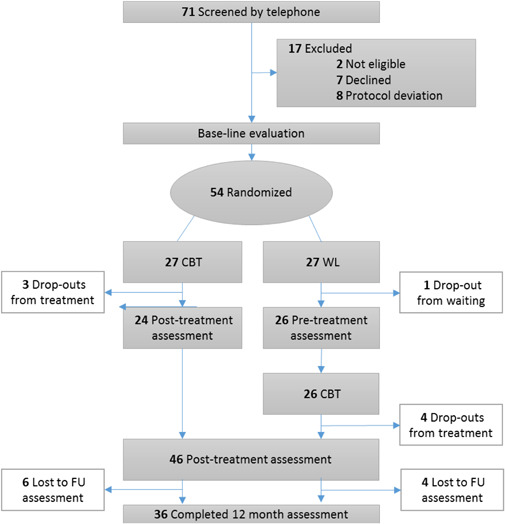
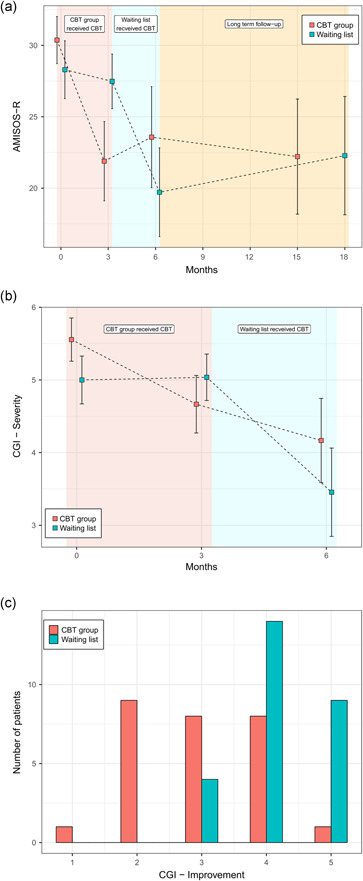
In all, 54 out of 71 patients were included (mean age, 33.06 [SD, 14.13] years; 38 women [70.4%]) and 46 (85%) completed the study. In the randomized phase, CBT resulted in statistically significant less misophonia symptoms in the short-term (-9.7 AMISOS-R; 95% CI, -12.0 to -7.4; p < .001, d = 1.97). The CBT group had an observed clinical improvement (CGI-I < 3) in 37% compared to 0% in the waiting list group (p < .001). The effect of CBT was maintained at 1-year follow-up on primary and secondary outcomes.
This first randomized control trial shows both short-term and long-term efficacy of CBT for misophonia.
恐音症患者在面对特定声音(如咂嘴声或呼吸声)时会感到愤怒或厌恶。避免与提示相关的情境会导致社交隔离和严重的功能障碍。这是第一项针对恐音症的随机对照认知行为疗法(CBT)试验,评估其短期和长期疗效。
这项评估者盲法的随机临床试验于2017年5月至2018年12月在一家学术门诊诊所进行。恐音症患者被随机分配到为期3个月的每周一次的团体CBT组或等待名单组,并在基线、3个月(CBT或等待名单后)、6个月(交叉后)和15/18个月(1年随访)时进行测试。CBT包括任务集中和唤醒减少、积极情感标记和刺激操纵。共同主要结局是通过修订的阿姆斯特丹恐音症量表(AMISOS-R)评估的症状严重程度以及临床总体印象改善量表(CGI-I)的改善情况。次要结局是一般精神病理学的自我评估评分(症状自评量表90修订版[SCL-90-R])和生活质量(五维欧洲生活质量量表[EQ5-D]、希恩残疾量表[SDS]、世界卫生组织生活质量简表[WHOQoL-BREF])。
总共纳入了71名患者中的54名(平均年龄33.06[标准差,14.13]岁;38名女性[70.4%]),46名(85%)完成了研究。在随机阶段,CBT在短期内导致恐音症症状在统计学上显著减轻(AMISOS-R降低9.7;95%置信区间,-12.0至-7.4;p<.001,d=1.97)。CBT组有37%的患者观察到临床改善(CGI-I<3),而等待名单组为0%(p<.001)。CBT的效果在1年随访时在主要和次要结局上均得以维持。
这项第一项随机对照试验显示了CBT对恐音症的短期和长期疗效。