Department of Psychiatry, Amsterdam UMC (Location AMC), Amsterdam, The Netherlands.
Department of Child and Adolescent Psychiatry, Amsterdam UMC (Location AMC), Amsterdam, The Netherlands.
Eur J Psychotraumatol. 2021 Sep 24;12(1):1968613. doi: 10.1080/20008198.2021.1968613. eCollection 2021.
Misophonia is a disorder in which patients suffer from anger or disgust when confronted with specific sounds such as loud chewing or breathing, causing avoidance of cue-related situations resulting in significant functional impairment. Though the first treatment studies with cognitive behavioural therapy (CBT) showed promising results, an average of 50% of the patients has not improved much clinically.
The aim of this pilot study was to assess the effectiveness of eye movement desensitization and reprocessing (EMDR) therapy as a trauma-focused approach in treating misophonia symptoms.
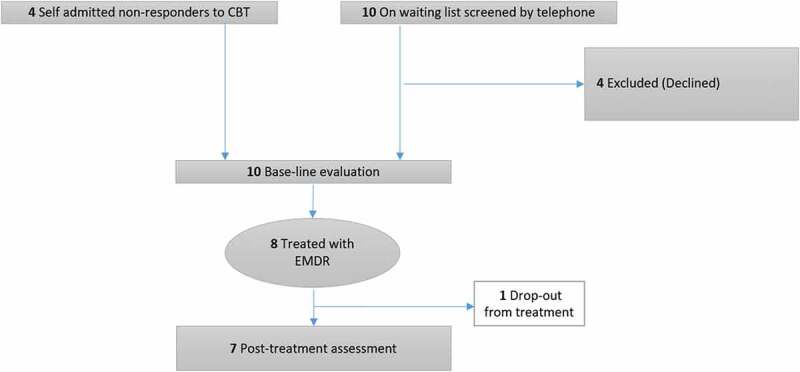
A sample of 10 adult participants with misophonia was studied at the outpatient clinic of the Academic Medical Center in Amsterdam. Participants were either on the waiting list for CBT or non-responders to CBT. EMDR was focused on misophonia-related emotionally disturbing memories and delivered in a mean of 2.6 sessions of 60-90 minutes. Pre- and post-treatment self-assessed ratings of misophonia symptoms (AMISOS-R, primary outcome), of general psychopathology (SCL-90-R) and of quality of life (SDS) were administered. The co-primary outcome was the Clinical Global Impression Improvement scale (CGI-I).
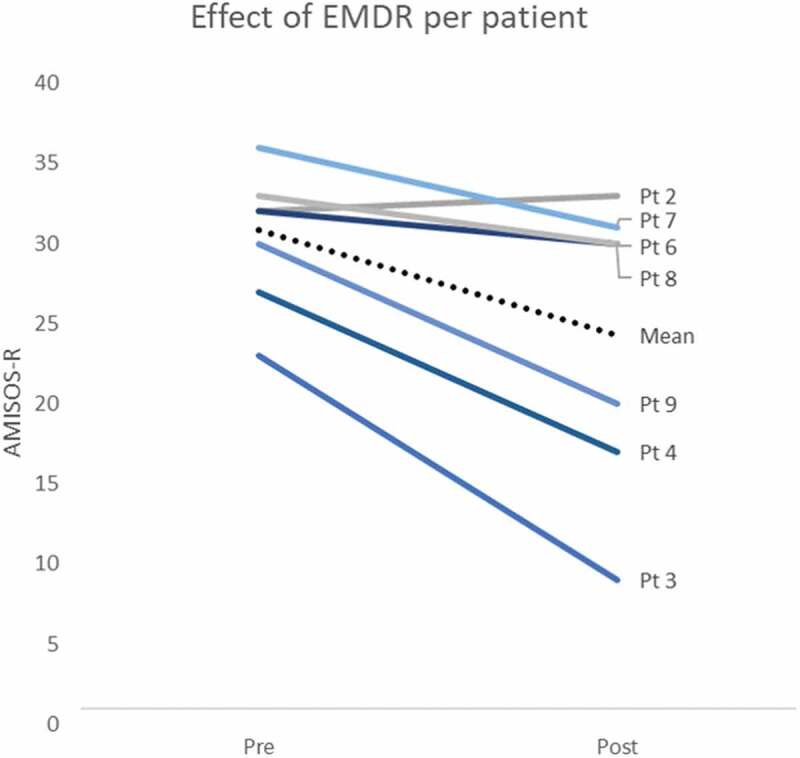
A paired -test ( = 8) showed improvement on the primary outcome (-6.14 [MD], 5.34 [SD]) on the AMISOS-R ( = .023). Three of the eight patients showed clinically significant improvement measured with the CGI-I. No significant effect on secondary outcomes was found.
These preliminary results suggest that EMDR therapy focused on emotionally disturbing misophonia-related memories can reduce misophonia symptoms. RCTs with sufficient sample sizes are required to firmly establish the value of EMDR therapy for misophonia.
恐音症是一种患者听到特定声音(如大声咀嚼或呼吸声)时会感到愤怒或厌恶的疾病,导致回避与 cue 相关的情况,从而导致显著的功能障碍。尽管最初的认知行为疗法(CBT)治疗研究显示出了有希望的结果,但平均有 50%的患者在临床上没有得到很大的改善。
本研究旨在评估眼动脱敏再处理(EMDR)疗法作为一种创伤聚焦方法治疗恐音症症状的有效性。
在阿姆斯特丹学术医学中心的门诊诊所,对 10 名成年恐音症患者进行了样本研究。参与者要么正在等待 CBT 治疗,要么是对 CBT 无反应者。EMDR 主要针对与恐音症相关的情绪困扰记忆,并在 2.6 次 60-90 分钟的疗程中进行。在治疗前后,患者自我评估了恐音症症状(AMISOS-R,主要结局)、一般心理病理(SCL-90-R)和生活质量(SDS)。主要的次要结局是临床总体印象改善量表(CGI-I)。
配对检验( = 8)显示 AMISOS-R 主要结局改善(-6.14[MD],5.34[SD])( = 0.023)。在 CGI-I 中,有 3 名患者表现出明显的临床改善。次要结局没有显著影响。
这些初步结果表明,针对与情绪困扰相关的恐音症记忆的 EMDR 疗法可以减轻恐音症症状。需要进行足够样本量的 RCT 来确定 EMDR 疗法治疗恐音症的价值。