Maras Katie, Norris Jade Eloise, Nicholson Jemma, Heasman Brett, Remington Anna, Crane Laura
University of Bath, UK.
University College London, UK.
Autism. 2021 May;25(4):1060-1075. doi: 10.1177/1362361320981319. Epub 2020 Dec 18.
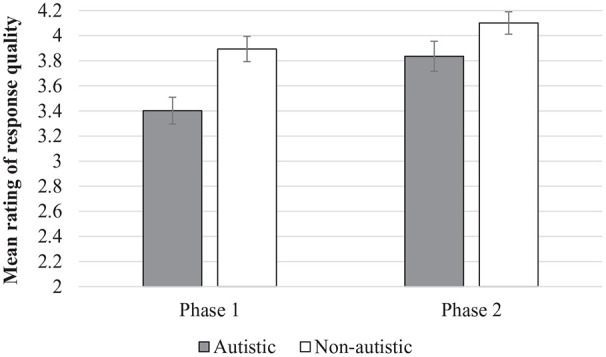
Despite possessing valuable skills, differences in the way that autistic people understand and respond to others in social situations mean that they are frequently disadvantaged in job interviews. We examined how autistic and non-autistic adults compared on standard (unmodified) job interview questions, and then used these findings to develop and evaluate supportive adaptations to questions. Fifty adults (25 autistic, 25 non-autistic) took part in two mock job interviews. Interview 1 provided a baseline measure of performance when answering typical, unmodified interview questions. Employment experts (unaware of participants' autism diagnoses) rated all interviewees on their responses to each question and their overall impressions of them and then provided feedback about how interviewees could improve and how questions could be adapted to facilitate this. Interviewees also provided feedback about the interview process, from their perspective. Adaptations to the questions were developed, with Interview 2 taking place approximately 6 months later. Results demonstrated that, in Interview 1, employment experts rated autistic interviewees less favourably than non-autistic interviewees. Ratings of both autistic and non-autistic participants' answers improved in Interview 2, but particularly for autistic interviewees (such that differences between autistic and non-autistic interviewees' performance reduced in Interview 2). Employers should be aware that adaptations to job interview questions are critical to level the playing field for autistic candidates.
尽管自闭症患者拥有宝贵的技能,但他们在社交场合中理解和回应他人的方式存在差异,这意味着他们在求职面试中常常处于劣势。我们研究了自闭症成年人与非自闭症成年人在标准(未修改)求职面试问题上的表现差异,然后利用这些研究结果来开发和评估对问题的支持性调整。五十名成年人(25名自闭症患者,25名非自闭症患者)参加了两次模拟求职面试。面试1提供了回答典型、未修改面试问题时的表现基线测量。就业专家(不知道参与者的自闭症诊断情况)对所有受访者对每个问题的回答以及他们对受访者的总体印象进行评分,然后提供关于受访者如何改进以及问题如何调整以促进改进的反馈。受访者也从他们的角度提供了关于面试过程的反馈。针对问题进行了调整,大约6个月后进行了面试2。结果表明,在面试1中,就业专家对自闭症受访者的评价不如非自闭症受访者。在面试2中,自闭症和非自闭症参与者的回答评分都有所提高,但自闭症受访者的提高尤为明显(以至于面试2中自闭症和非自闭症受访者表现的差异有所缩小)。雇主应该意识到,对求职面试问题的调整对于为自闭症候选人创造公平竞争环境至关重要。