Norwegian Centre for Mental Disorders Research (NORMENT), Institute of Clinical Medicine, University of Oslo & Division of Mental Health and Addiction, Oslo University Hospital, Oslo, Norway.
Department of Psychology, University of Oslo, Oslo, Norway.
Hum Brain Mapp. 2021 Apr 15;42(6):1714-1726. doi: 10.1002/hbm.25323. Epub 2020 Dec 19.
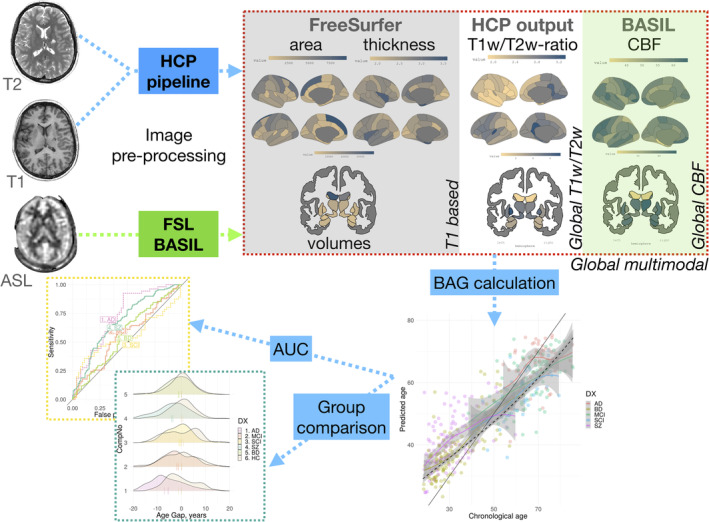
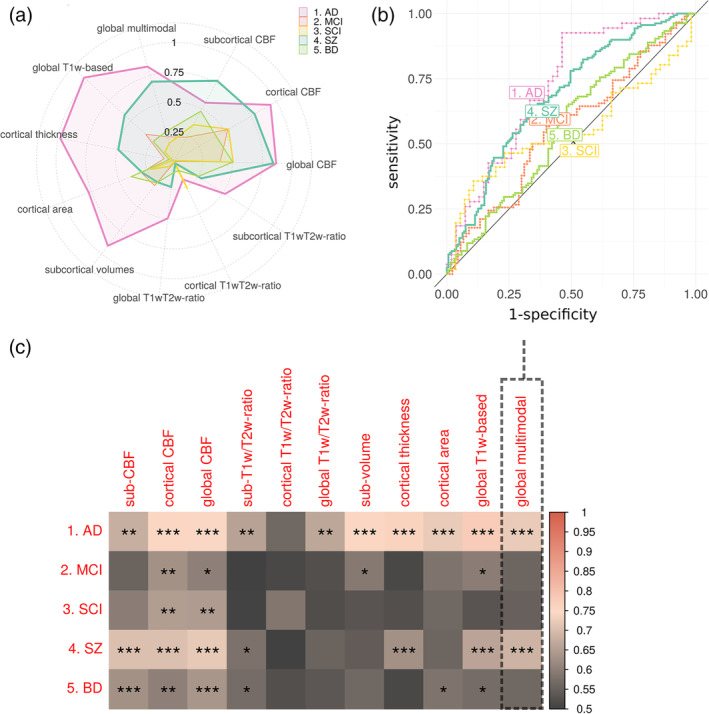
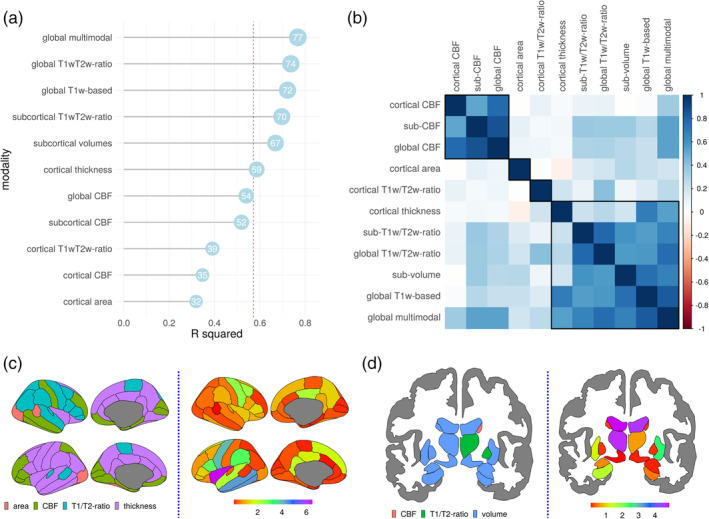
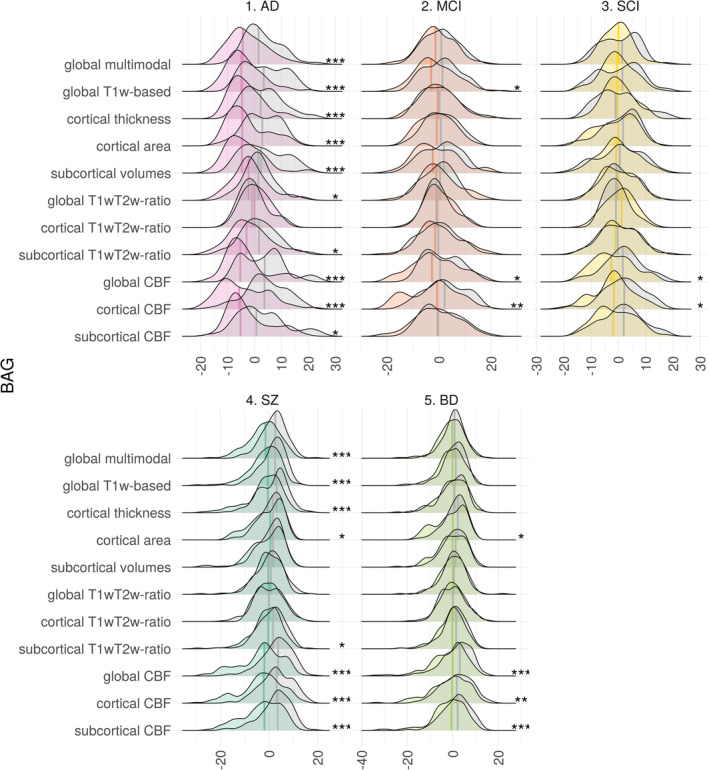
The deviation between chronological age and age predicted using brain MRI is a putative marker of overall brain health. Age prediction based on structural MRI data shows high accuracy in common brain disorders. However, brain aging is complex and heterogenous, both in terms of individual differences and the underlying biological processes. Here, we implemented a multimodal model to estimate brain age using different combinations of cortical area, thickness and sub-cortical volumes, cortical and subcortical T1/T2-weighted ratios, and cerebral blood flow (CBF) based on arterial spin labeling. For each of the 11 models we assessed the age prediction accuracy in healthy controls (HC, n = 750) and compared the obtained brain age gaps (BAGs) between age-matched subsets of HC and patients with Alzheimer's disease (AD, n = 54), mild (MCI, n = 90) and subjective (SCI, n = 56) cognitive impairment, schizophrenia spectrum (SZ, n = 159) and bipolar disorder (BD, n = 135). We found highest age prediction accuracy in HC when integrating all modalities. Furthermore, two-group case-control classifications revealed highest accuracy for AD using global T1-weighted BAG, while MCI, SCI, BD and SZ showed strongest effects in CBF-based BAGs. Combining multiple MRI modalities improves brain age prediction and reveals distinct deviations in patients with psychiatric and neurological disorders. The multimodal BAG was most accurate in predicting age in HC, while group differences between patients and HC were often larger for BAGs based on single modalities. These findings indicate that multidimensional neuroimaging of patients may provide a brain-based mapping of overlapping and distinct pathophysiology in common disorders.
大脑 MRI 预测的年龄与实际年龄的偏差是整体大脑健康的一个潜在标志物。基于结构 MRI 数据的年龄预测在常见脑部疾病中具有很高的准确性。然而,大脑老化是复杂且异质的,无论是在个体差异还是潜在的生物学过程方面。在这里,我们使用不同的皮质区域、厚度和皮质下体积、皮质和皮质下 T1/T2 加权比以及基于动脉自旋标记的脑血流 (CBF) 的组合,实现了一种多模态模型来估计大脑年龄。对于每种 11 种模型,我们评估了健康对照组(HC,n = 750)的年龄预测准确性,并比较了 HC 中年龄匹配子集中获得的脑龄差距(BAG)与阿尔茨海默病(AD,n = 54)、轻度认知障碍(MCI,n = 90)和主观认知障碍(SCI,n = 56)、精神分裂症谱系(SZ,n = 159)和双相障碍(BD,n = 135)患者之间的年龄差距。当整合所有模态时,我们在 HC 中发现了最高的年龄预测准确性。此外,两组病例对照分类显示,使用全局 T1 加权 BAG 对 AD 的准确率最高,而 MCI、SCI、BD 和 SZ 在基于 CBF 的 BAG 中表现出最强的效果。结合多种 MRI 模式可以提高大脑年龄预测的准确性,并揭示出精神和神经障碍患者的明显偏差。多模态 BAG 最准确地预测了 HC 中的年龄,而患者与 HC 之间的组间差异对于基于单一模态的 BAG 通常更大。这些发现表明,对患者进行多维神经影像学检查可能会为常见疾病中的重叠和独特的病理生理学提供基于大脑的映射。