Department of Epidemiology, Erasmus MC, Erasmus University Medical Center, Rotterdam, the Netherlands.
Institute for Community Medicine, University Medicine Greifswald, Greifswald, Germany.
Eur J Clin Invest. 2021 May;51(5):e13479. doi: 10.1111/eci.13479. Epub 2021 Jan 4.
Fatty liver disease (FLD), primarily nonalcoholic fatty liver disease (NAFLD), is the most common liver disorder that affects a quarter of the global population. NAFLD is a spectrum of disease ranging from simple steatosis to nonalcoholic steatohepatitis, which is associated with increased risk of developing liver cancer. Given that the pathogenic mechanisms of fatty liver remain largely elusive, it is important to further investigate potential underlying mechanisms including epigenetic modifications. Here, we performed a systematic review of human epigenetic studies on FLD presence.
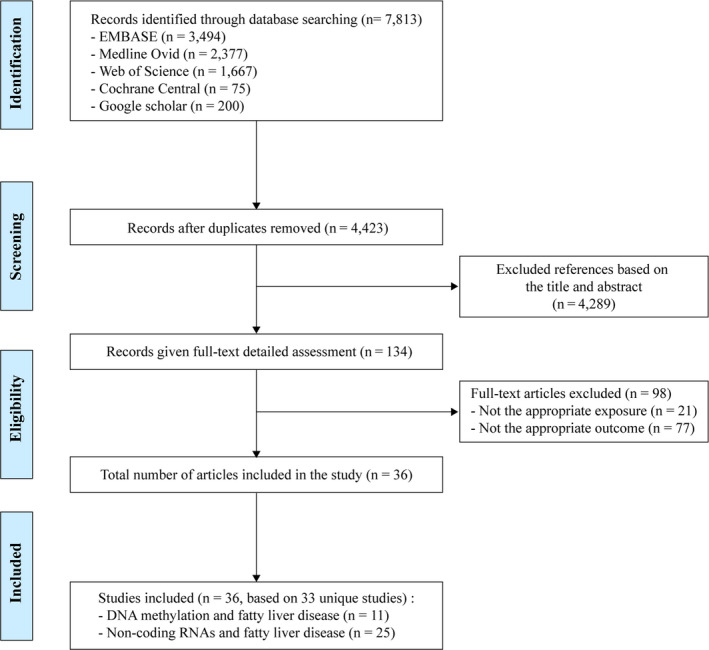
Five bibliographic databases were screened until 28 August 2020. We included cross-sectional, case-control and cohort studies in humans that examined the association of epigenetic modifications including global, candidate or epigenome-wide methylation of DNA, noncoding RNAs and histone modifications with FLD.
In total 36 articles, based on 33 unique studies, consisting of 12 112 participants met the inclusion criteria. Among these, two recent epigenome-wide association studies conducted among large population-based cohorts have reported the association between cg06690548 (SLC7A11) and FLD. Moreover, several studies have demonstrated the association between microRNAs (miRNAs) and FLD, in which miR-122, miR-34a and miR-192 were recognized as the most relevant miRNAs as biomarkers for FLD. We did not find any studies examining histone modifications in relation to FLD.
Cumulative evidence suggests a link between epigenetic mechanisms, specifically DNA methylation and miRNAs, and FLD. Further efforts should investigate the molecular pathways by which these epigenetic markers may regulate FLD and also the potential role of histone modifications in FLD.
脂肪肝疾病(FLD),主要是非酒精性脂肪肝疾病(NAFLD),是影响全球四分之一人口的最常见肝脏疾病。NAFLD 是一种疾病谱,从单纯性脂肪变性到非酒精性脂肪性肝炎不等,与肝癌风险增加相关。鉴于脂肪性肝病的发病机制在很大程度上仍难以捉摸,因此有必要进一步研究潜在的机制,包括表观遗传修饰。在这里,我们对人类 FLD 存在的表观遗传研究进行了系统回顾。
我们筛选了五个文献数据库,直到 2020 年 8 月 28 日。我们纳入了横断面、病例对照和队列研究,这些研究检查了表观遗传修饰(包括 DNA 的全基因组、候选或表观基因组甲基化、非编码 RNA 和组蛋白修饰)与 FLD 之间的关联。
总共 36 篇文章,基于 33 项独特的研究,包括 12112 名参与者,符合纳入标准。其中,两项最近在大型基于人群的队列中进行的全基因组关联研究报告了 cg06690548(SLC7A11)与 FLD 之间的关联。此外,几项研究表明 miRNA 与 FLD 之间存在关联,其中 miR-122、miR-34a 和 miR-192 被认为是 FLD 最相关的 miRNA 生物标志物。我们没有发现任何研究检查组蛋白修饰与 FLD 的关系。
累积证据表明,表观遗传机制,特别是 DNA 甲基化和 miRNA,与 FLD 之间存在联系。进一步的研究应调查这些表观遗传标记可能调节 FLD 的分子途径,以及组蛋白修饰在 FLD 中的潜在作用。