Department of Ocean Sciences and Institute of Marine Sciences, University of California, Santa Cruz, Santa Cruz, California, United States of America.
PLoS One. 2020 Dec 22;15(12):e0244217. doi: 10.1371/journal.pone.0244217. eCollection 2020.
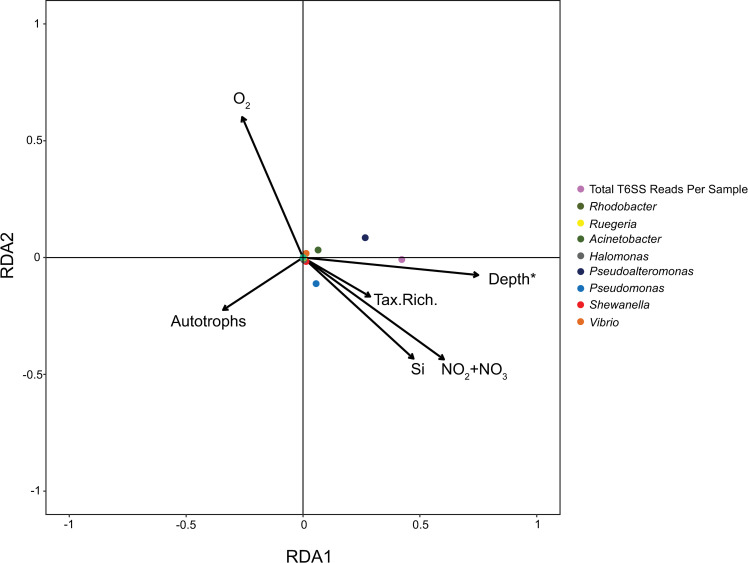
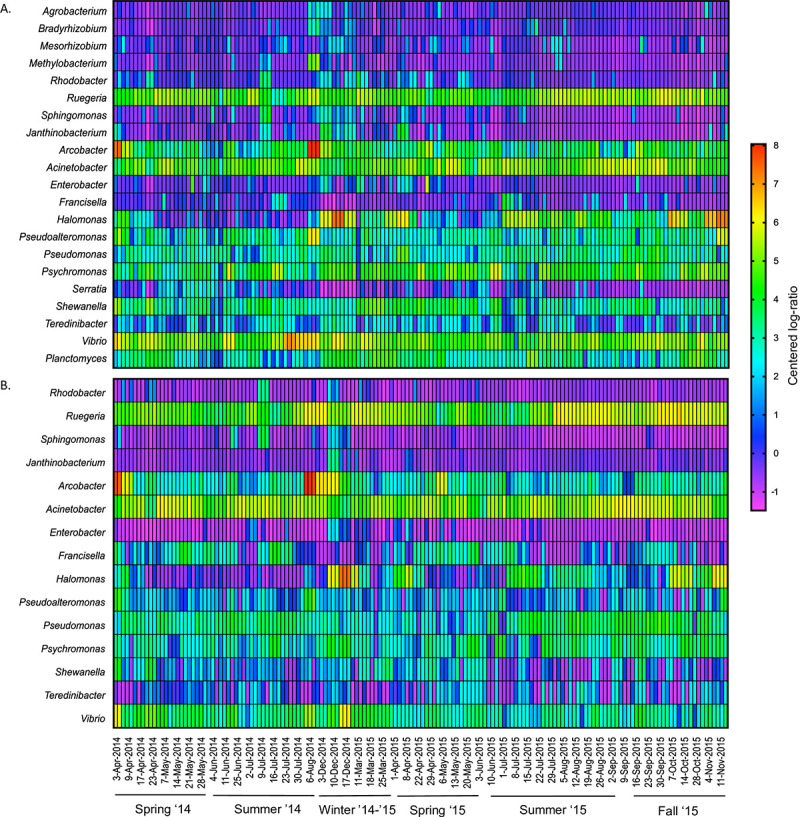
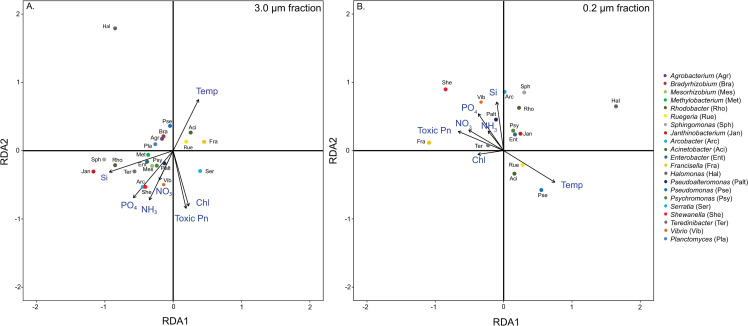
Marine bacteria employ various strategies to maintain their competitive advantage over others in a mixed community. The use of Type VI Secretion Systems (T6SS), a protein secretion apparatus used as a molecular weapon for interbacterial competition and eukaryotic interactions, is one of the competitive strategies that is least studied among heterotrophic bacteria living in the water column. To get an insight into the temporal and spatial distribution of bacteria with T6SS in this portion of the marine environment, we examine the presence and abundance of T6SS-bearing bacteria at both local and global scales through the use of metagenome data from water samples obtained from the coast of Monterey Bay and the TARA Oceans project. We also track the abundance of T6SS-harboring bacteria through a two-year time series of weekly water samples in the same coastal site to examine the environmental factors that may drive their presence and abundance. Among the twenty-one T6SS-bearing bacterial genera examined, we found several genera assume a particle-attached lifestyle, with only a few genera having a free-living lifestyle. The abundance of T6SS-harboring bacteria in both niches negatively correlates with the abundance of autotrophs. Globally, we found that T6SS genes are much more abundant in areas with low biological productivity. Our data suggest that T6SS-harboring bacteria tend to be abundant spatially and temporally when organic resources are limited. This ecological study agrees with the patterns observed from several in vitro studies; that T6SS could be an adaptive strategy employed by heterotrophic bacteria to obtain nutrients or reduce competition when resources are in limited quantity.
海洋细菌采用各种策略来保持在混合群落中的竞争优势。使用 VI 型分泌系统(T6SS)是一种作为细菌间竞争和真核生物相互作用的分子武器的蛋白质分泌装置,是在水柱中生活的异养细菌中研究最少的竞争策略之一。为了深入了解海洋环境这一部分具有 T6SS 的细菌的时空分布,我们通过使用从蒙特雷湾海岸和 TARA 海洋项目获得的水样中的宏基因组数据,在本地和全球范围内检查具有 T6SS 的细菌的存在和丰度。我们还通过在同一沿海地点进行为期两年的每周水样时间序列来跟踪 T6SS 携带细菌的丰度,以检查可能驱动其存在和丰度的环境因素。在检查的二十一个具有 T6SS 的细菌属中,我们发现有几个属采用颗粒附着的生活方式,只有少数属具有自由生活的方式。这两个生态位中 T6SS 携带细菌的丰度与自养生物的丰度呈负相关。在全球范围内,我们发现 T6SS 基因在生物生产力低的区域更为丰富。我们的数据表明,当有机资源有限时,T6SS 携带细菌在空间和时间上往往更为丰富。这项生态研究与从几项体外研究中观察到的模式一致;即 T6SS 可能是异养细菌在资源有限时获取营养或减少竞争的适应性策略。