Department of Mechanical Engineering, Stanford University, Stanford, California, United States of America.
Department of Movement Sciences, KU Leuven, Leuven, Belgium.
PLoS Comput Biol. 2020 Dec 28;16(12):e1008493. doi: 10.1371/journal.pcbi.1008493. eCollection 2020 Dec.
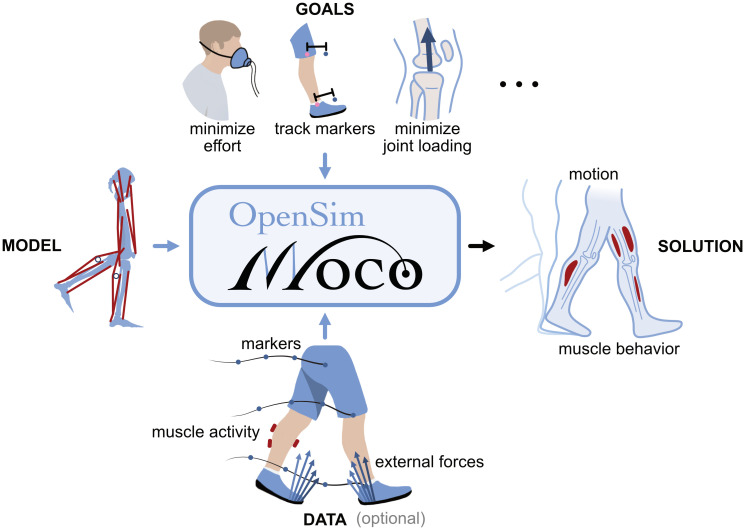
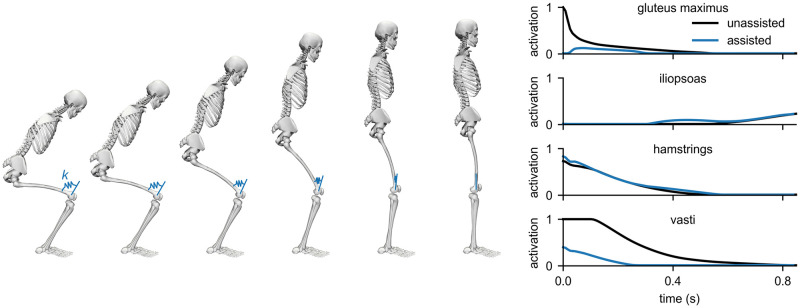
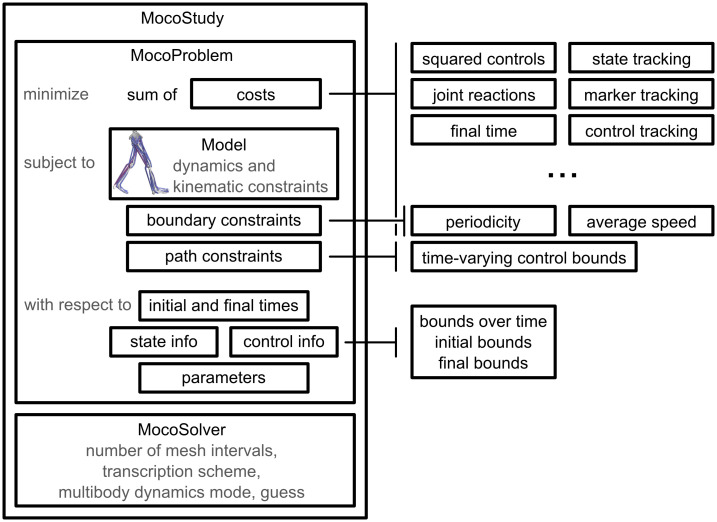
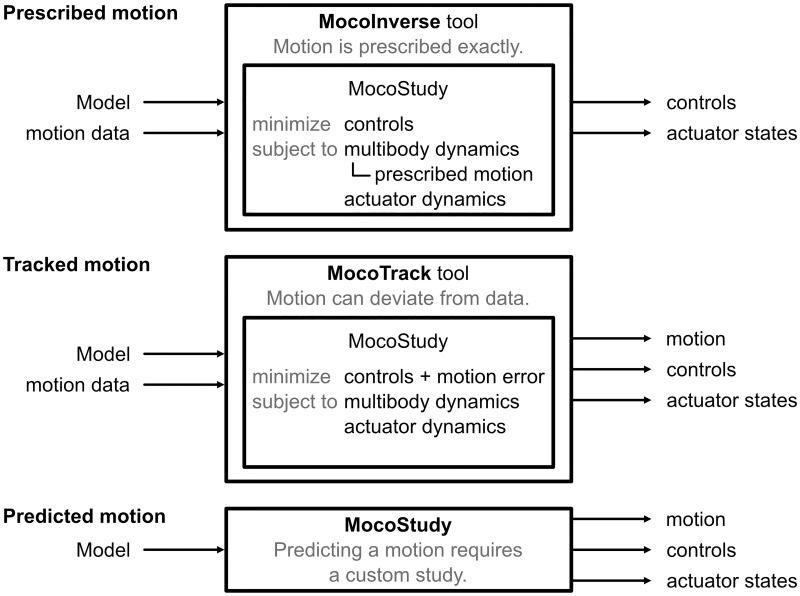
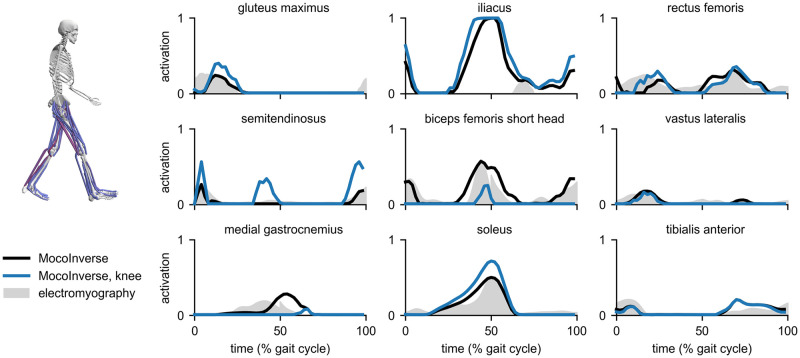
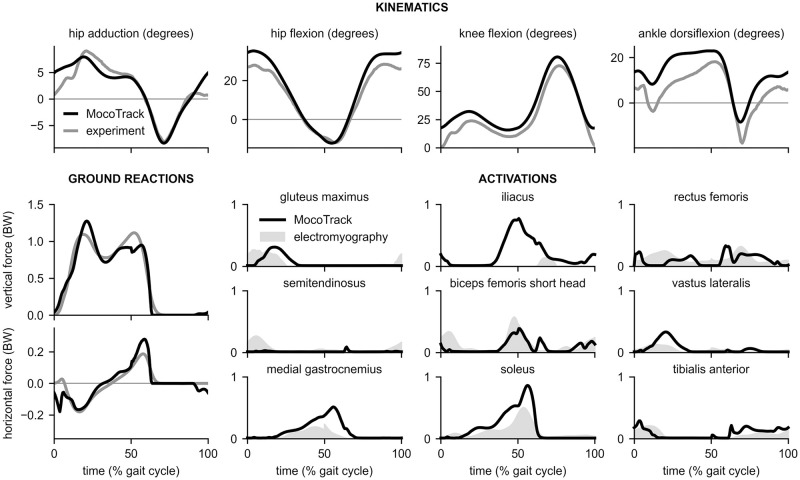
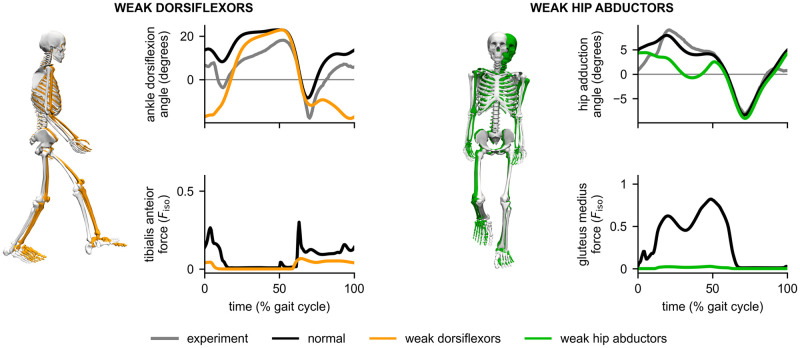
Musculoskeletal simulations are used in many different applications, ranging from the design of wearable robots that interact with humans to the analysis of patients with impaired movement. Here, we introduce OpenSim Moco, a software toolkit for optimizing the motion and control of musculoskeletal models built in the OpenSim modeling and simulation package. OpenSim Moco uses the direct collocation method, which is often faster and can handle more diverse problems than other methods for musculoskeletal simulation. Moco frees researchers from implementing direct collocation themselves-which typically requires extensive technical expertise-and allows them to focus on their scientific questions. The software can handle a wide range of problems that interest biomechanists, including motion tracking, motion prediction, parameter optimization, model fitting, electromyography-driven simulation, and device design. Moco is the first musculoskeletal direct collocation tool to handle kinematic constraints, which enable modeling of kinematic loops (e.g., cycling models) and complex anatomy (e.g., patellar motion). To show the abilities of Moco, we first solved for muscle activity that produced an observed walking motion while minimizing squared muscle excitations and knee joint loading. Next, we predicted how muscle weakness may cause deviations from a normal walking motion. Lastly, we predicted a squat-to-stand motion and optimized the stiffness of an assistive device placed at the knee. We designed Moco to be easy to use, customizable, and extensible, thereby accelerating the use of simulations to understand the movement of humans and other animals.
肌肉骨骼模拟在许多不同的应用中都有使用,从与人类交互的可穿戴机器人的设计到运动障碍患者的分析。在这里,我们介绍了 OpenSim Moco,这是一个用于优化在 OpenSim 建模和仿真包中构建的肌肉骨骼模型的运动和控制的软件工具包。OpenSim Moco 使用直接配点法,该方法通常比其他肌肉骨骼模拟方法更快,并且可以处理更多样化的问题。Moco 使研究人员无需自己实现直接配点法(通常需要大量技术专长),从而使他们能够专注于自己的科学问题。该软件可以处理生物力学学家感兴趣的各种问题,包括运动跟踪、运动预测、参数优化、模型拟合、肌电图驱动的模拟和设备设计。Moco 是第一个处理运动学约束的肌肉骨骼直接配点工具,这些约束使运动学循环(例如,循环模型)和复杂解剖结构(例如,髌骨运动)的建模成为可能。为了展示 Moco 的能力,我们首先求解了在最小化肌肉激励平方和膝关节负荷的情况下产生观察到的步行运动的肌肉活动。接下来,我们预测了肌肉无力可能如何导致正常步行运动的偏差。最后,我们预测了深蹲到站立的运动,并优化了放置在膝关节处的辅助设备的刚度。我们设计了 Moco,使其易于使用、可定制和可扩展,从而加速了使用模拟来理解人类和其他动物的运动。