Life Sciences Center, Department of Biological Models, Institute of Biochemistry, Vilnius University, Sauletekio Ave. 7, LT-10257 Vilnius, Lithuania.
Nutrients. 2020 Dec 24;13(1):37. doi: 10.3390/nu13010037.
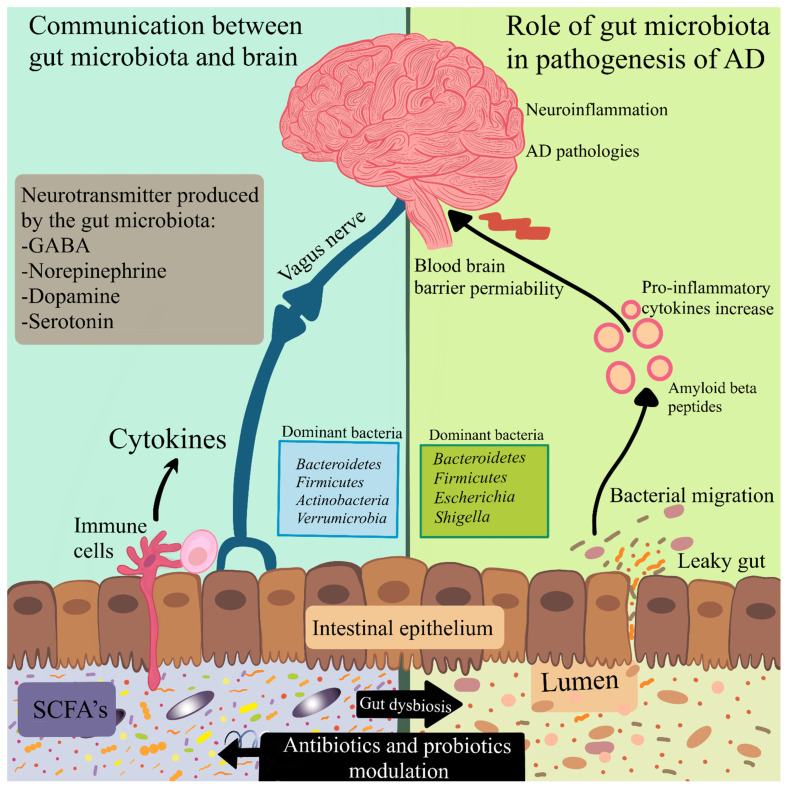
For years, it has been reported that Alzheimer's disease (AD) is the most common cause of dementia. Various external and internal factors may contribute to the early onset of AD. This review highlights a contribution of the disturbances in the microbiota-gut-brain (MGB) axis to the development of AD. Alteration in the gut microbiota composition is determined by increase in the permeability of the gut barrier and immune cell activation, leading to impairment in the blood-brain barrier function that promotes neuroinflammation, neuronal loss, neural injury, and ultimately AD. Numerous studies have shown that the gut microbiota plays a crucial role in brain function and changes in the behavior of individuals and the formation of bacterial amyloids. Lipopolysaccharides and bacterial amyloids synthesized by the gut microbiota can trigger the immune cells residing in the brain and can activate the immune response leading to neuroinflammation. Growing experimental and clinical data indicate the prominent role of gut dysbiosis and microbiota-host interactions in AD. Modulation of the gut microbiota with antibiotics or probiotic supplementation may create new preventive and therapeutic options in AD. Accumulating evidences affirm that research on MGB involvement in AD is necessary for new treatment targets and therapies for AD.
多年来,一直有报道称阿尔茨海默病(AD)是痴呆症最常见的病因。各种外部和内部因素可能导致 AD 的早期发病。这篇综述强调了微生物群-肠道-大脑(MGB)轴的紊乱对 AD 发展的贡献。肠道微生物群落组成的改变是由肠道屏障通透性的增加和免疫细胞的激活引起的,这导致血脑屏障功能受损,促进神经炎症、神经元丧失、神经损伤,最终导致 AD。许多研究表明,肠道微生物群在大脑功能和个体行为的变化以及细菌淀粉样蛋白的形成中起着至关重要的作用。肠道微生物群合成的脂多糖和细菌淀粉样蛋白可以触发驻留在大脑中的免疫细胞,并激活免疫反应,导致神经炎症。越来越多的实验和临床数据表明,肠道菌群失调和微生物群-宿主相互作用在 AD 中起着突出的作用。用抗生素或益生菌补充剂调节肠道微生物群可能为 AD 创造新的预防和治疗选择。越来越多的证据证实,研究 MGB 对 AD 的参与对于 AD 的新治疗靶点和疗法是必要的。