Department of Team Sports Games, Poznan University of Physical Education, 61-871 Poznan, Poland.
Department of Physiotherapy, Poznan University of Medical Sciences, 61-701 Poznan, Poland.
Int J Environ Res Public Health. 2020 Dec 23;18(1):35. doi: 10.3390/ijerph18010035.
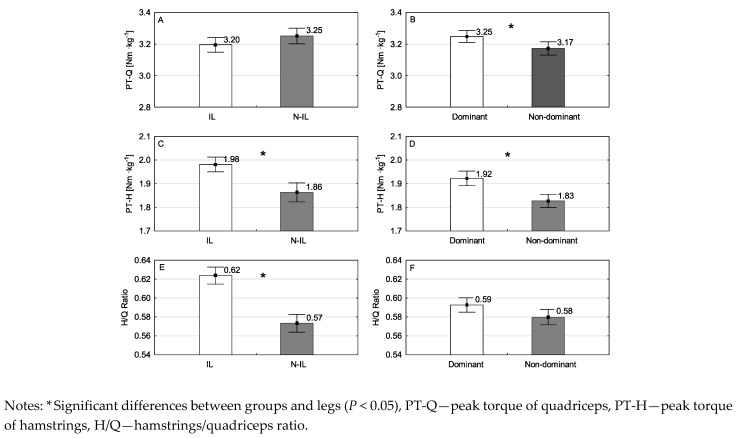
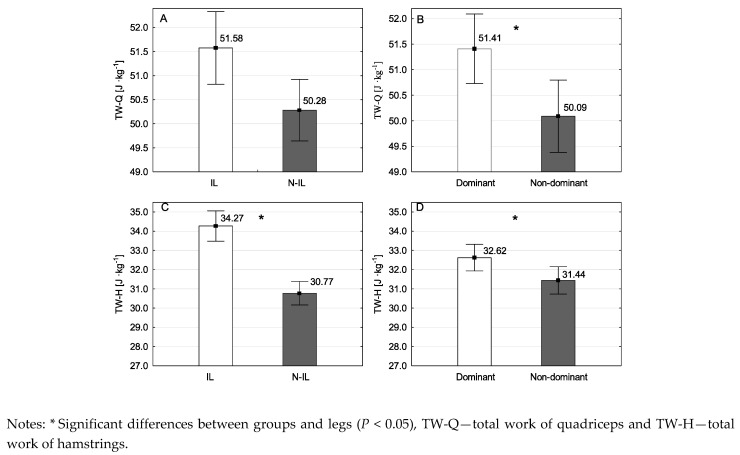
The purpose of this study is to evaluate the differences in concentric isokinetic strength characteristics of the knee extensor and knee flexor musculature between international (IL) and non-international level (N-IL) soccer players. The second aim is to establish strength symmetry status in knee muscles for dominant (DL) and non-dominant (NDL) legs for both within and between groups. 100 male top elite soccer players (IL: = 36, age = 27.5 ± 3.4 years and N-IL: = 64, age = 27.7 ± 6.4 years) underwent concentric isokinetic strength tests, using a Biodex System 3 dynamometer. Results indicate that statistically significant differences between groups were noted for peak torque of hamstrings (PT-H), hamstrings/quadriceps (H/Q) ratio, and total work of hamstrings (TW-H), where mean values for the IL were similarly higher than for the N-IL group ( = 0.006, < 0.001, and = 0.012, respectively). Our results also showed statistically significant differences for peak torque of quadriceps (PT-Q), PT-H, total work of quadriceps (TW-Q) and TW-H between legs, where mean values noted for the DL were higher than for the NDL for both groups ( = 0.021, < 0.001, = 0.006, and = 0.004, respectively). Additional results show that IL players presented more symmetrical strength between legs than N-IL. The results of this study indicate that that the greatest differences in isokinetic strength performance across players at different soccer levels relate to the hamstring muscle. As a result, systematic strength training of these muscle groups is strongly recommended.
本研究旨在评估国际(IL)和非国际(N-IL)水平足球运动员的膝关节伸肌和屈肌等速向心力量特征的差异。第二个目的是为主要(DL)和非主要(NDL)腿部的膝关节肌肉建立力量对称状态,无论是在组内还是组间。100 名男性顶级精英足球运动员(IL:=36,年龄=27.5±3.4 岁;N-IL:=64,年龄=27.7±6.4 岁)使用 Biodex System 3 测力计进行了向心等速力量测试。结果表明,组间在腘绳肌峰值扭矩(PT-H)、腘绳肌/四头肌(H/Q)比值和腘绳肌总功(TW-H)方面存在统计学上的显著差异,IL 的平均值明显高于 N-IL 组(=0.006,<0.001 和=0.012,分别)。我们的结果还显示,在四头肌峰值扭矩(PT-Q)、PT-H、四头肌总功(TW-Q)和 TW-H 方面,双腿之间也存在统计学上的显著差异,DL 的平均值高于两组的 NDL(=0.021,<0.001,=0.006 和=0.004,分别)。进一步的结果表明,IL 运动员的双腿之间力量更对称。本研究的结果表明,不同足球水平的运动员在等速力量表现上的最大差异与腘绳肌有关。因此,强烈建议对这些肌肉群进行系统的力量训练。