Department of Nursing, The First Affiliated Hospital of Dalian Medical University, Dalian, Liaoning Province, 116011 PR China.
The Graduate School of Nursing, Chiba University, Chiba, 263-0043, Japan.
Sleep Med. 2021 Feb;78:8-14. doi: 10.1016/j.sleep.2020.12.003. Epub 2020 Dec 9.
Recent studies have demonstrated that first-line nurses involved in the coronavirus disease-2019 (COVID-19) crisis may experience sleep disturbances. As breathing relaxation techniques can improve sleep quality, anxiety, and depression, the current study aimed to evaluate the effectiveness of diaphragmatic breathing relaxation training (DBRT) for improving sleep quality among nurses in Wuhan, China during the COVID-19 outbreak.
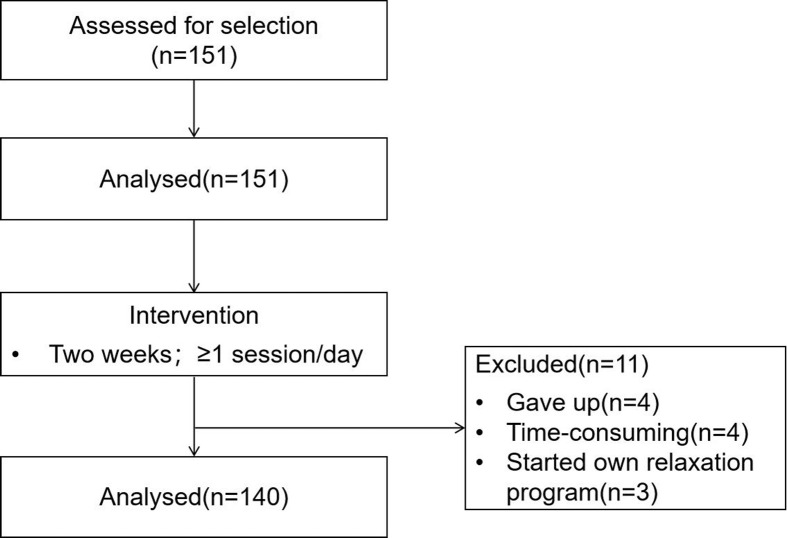
This study used a quasi-experimental (before and after) intervention strategy, with 151 first-line nurses from four wards in Leishenshan hospital. The Pittsburgh Sleep Quality Index (PSQI), Self-Rating Anxiety Scale (SAS), and Self-Rating Depression Scale (SDS) to evaluate the effectiveness of DBRT before and after the intervention. Data were examined using the Shapiro-Wilk test, Levene's test, and paired t-test.
A total of 140 nurses completed the DBRT sessions. First-line nurses achieved significant reductions in global sleep quality (p < 0.01), subjective sleep quality (p < 0.001), sleep latency (p < 0.01), sleep duration (p < 0.001), sleep disturbances (p < 0.001), habitual sleep efficiency (p = 0.015), daytime dysfunction (p = 0.001), and anxiety (p = 0.001). There were no significant reductions in the use of sleeping medication (p = 0.134) and depression (p = 0.359).
DBRT is a useful non-pharmacological treatment for improving sleep quality and reducing anxiety among first-line nurses involved in the COVID-19 outbreak. The study protocol was clinically registered by the Chinese Clinical Trial Registry.
ChiCTR2000032743.
最近的研究表明,参与 2019 年冠状病毒病(COVID-19)危机的一线护士可能会出现睡眠障碍。由于呼吸放松技术可以改善睡眠质量、焦虑和抑郁,因此本研究旨在评估膈肌呼吸放松训练(DBRT)在中国武汉 COVID-19 爆发期间改善护士睡眠质量的效果。
本研究采用准实验(前后)干预策略,对雷神山医院四个病房的 151 名一线护士进行研究。采用匹兹堡睡眠质量指数(PSQI)、焦虑自评量表(SAS)和抑郁自评量表(SDS)评估干预前后 DBRT 的效果。采用 Shapiro-Wilk 检验、Levene 检验和配对 t 检验进行数据分析。
共有 140 名护士完成了 DBRT 课程。一线护士的总体睡眠质量(p<0.01)、主观睡眠质量(p<0.001)、入睡潜伏期(p<0.01)、睡眠时间(p<0.001)、睡眠障碍(p<0.001)、习惯性睡眠效率(p=0.015)、日间功能障碍(p=0.001)和焦虑(p=0.001)均显著降低。而使用睡眠药物(p=0.134)和抑郁(p=0.359)无显著降低。
DBRT 是一种有用的非药物治疗方法,可改善 COVID-19 一线护士的睡眠质量和降低焦虑。该研究方案已在中国临床试验注册中心注册。
ChiCTR2000032743。