Dai Yuntao, Wang Dongbo, Zhao Manjia, Yan Lihua, Zhu Chao, Li Pengyue, Qin Xuemei, Verpoorte Rob, Chen Shilin
Institute of Chinese Materia Medica, China Academy of Chinese Medical Sciences, Beijing, China.
College of Medicine and Nursing, Dezhou University, Shandong, China.
Front Pharmacol. 2020 Dec 18;11:554777. doi: 10.3389/fphar.2020.554777. eCollection 2020.
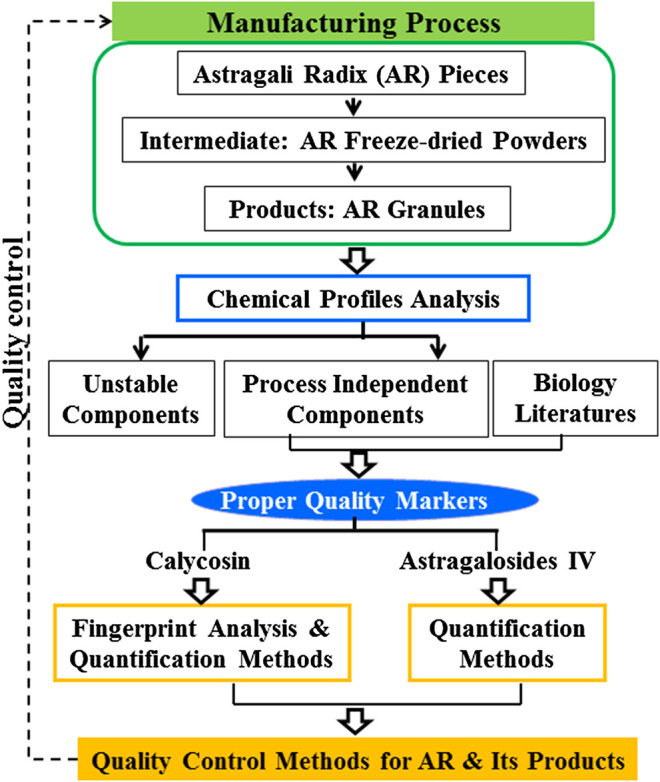
Due to the complex nature of traditional medicines, quality control methods need to cover two aspects: compliance of raw materials with quality standards and process control. Astragali radix (AR), the roots of Bunge, was selected in this study as an example of a widely used traditional medicine in various formulations. Astragaloside IV (AG IV) and calycosin 7--β-D-glucoside (CG) are used as the markers for the quality control of AR and its products in the Chinese Pharmacopoeia. However, in the raw materials, malic acid esters of the CG and acetate esters of the astragaloside are easily decomposed into CG and AG IV during storage and processing of AR to make extracts for various preparations. The thermal stability of the isoflavonoids and astragalosides in decoction was studied. The level of CG and astragalosides (AG I/AG II/AG IV) was strongly affected by prolonged heat during processing, while calycosin was stable in the conditions. Also the major astragalosides in AR could fully converted into AG IV which eventually reaches a stable level under certain conditions. With calycosin and AG IV as marker components, practical, reproducible, and precise methods were established and applied to the quality analysis of AR from its raw materials to its intermediates and products. This study demonstrates that a full chemical profiles analysis of the whole manufacturing process (from "raw materials-intermediates/extracts-final product") is important to identify quality markers (Q-markers) and even to establish proper analysis methods for traditional Chinese medicine products.
由于传统药物性质复杂,质量控制方法需要涵盖两个方面:原材料符合质量标准以及过程控制。本研究选取黄芪(蒙古黄芪的根)作为各种制剂中广泛使用的传统药物的示例。黄芪甲苷(AG IV)和毛蕊异黄酮葡萄糖苷(CG)被用作《中国药典》中黄芪及其产品质量控制的指标成分。然而,在原材料中,CG的苹果酸酯和黄芪甲苷的乙酸酯在黄芪储存和加工以制备各种制剂提取物的过程中容易分解为CG和AG IV。研究了水煎液中异黄酮类化合物和黄芪皂苷的热稳定性。加工过程中长时间加热对CG和黄芪皂苷(AG I/AG II/AG IV)的含量有很大影响,而毛蕊异黄酮在此条件下稳定。此外,黄芪中的主要黄芪皂苷可完全转化为AG IV,最终在一定条件下达到稳定水平。以毛蕊异黄酮和AG IV作为指标成分,建立了实用、可重现且精确的方法,并应用于黄芪从原材料到中间体及产品的质量分析。本研究表明,对整个生产过程(从“原材料-中间体/提取物-最终产品”)进行全面的化学特征分析对于确定质量标志物(Q-标志物)乃至建立合适的中药产品分析方法很重要。