Guiot Julien, Vaidyanathan Akshayaa, Deprez Louis, Zerka Fadila, Danthine Denis, Frix Anne-Noëlle, Thys Marie, Henket Monique, Canivet Gregory, Mathieu Stephane, Eftaxia Evanthia, Lambin Philippe, Tsoutzidis Nathan, Miraglio Benjamin, Walsh Sean, Moutschen Michel, Louis Renaud, Meunier Paul, Vos Wim, Leijenaar Ralph T H, Lovinfosse Pierre
Department of Pneumology, University Hospital of Liège, 4020 Liège, Belgium.
Research and Development, Oncoradiomics SA, 4000 Liège, Belgium.
Diagnostics (Basel). 2020 Dec 30;11(1):41. doi: 10.3390/diagnostics11010041.
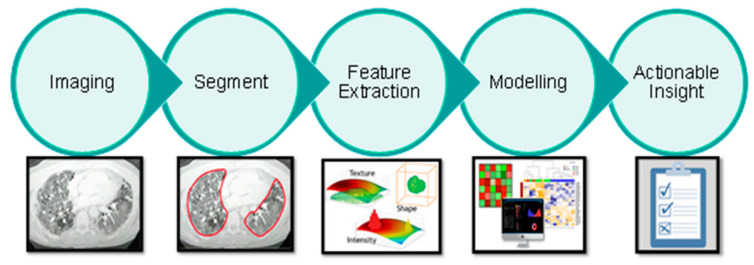
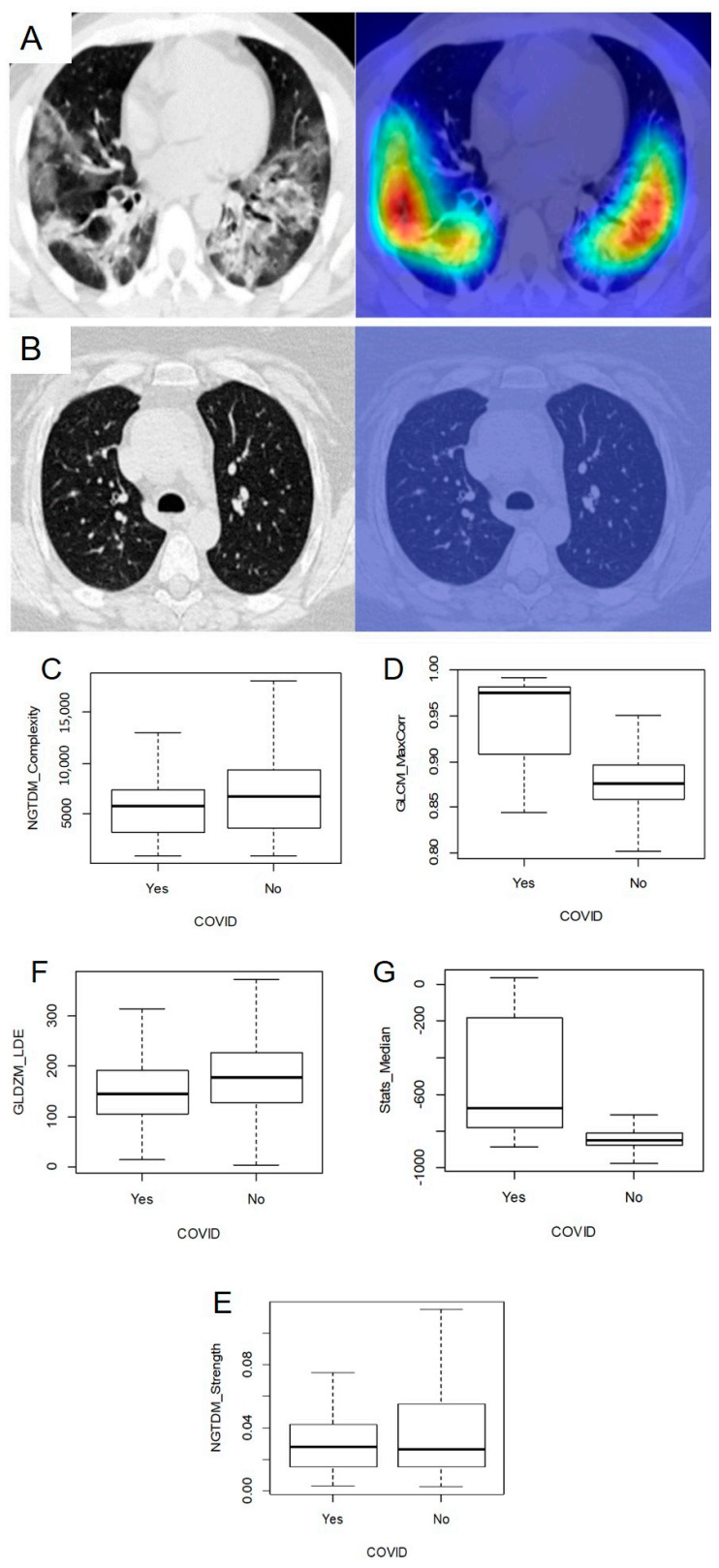
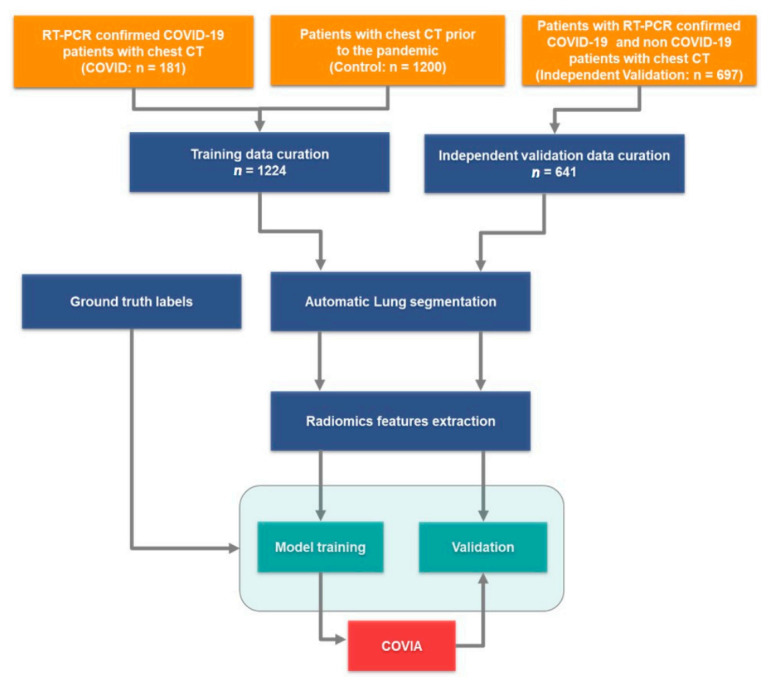
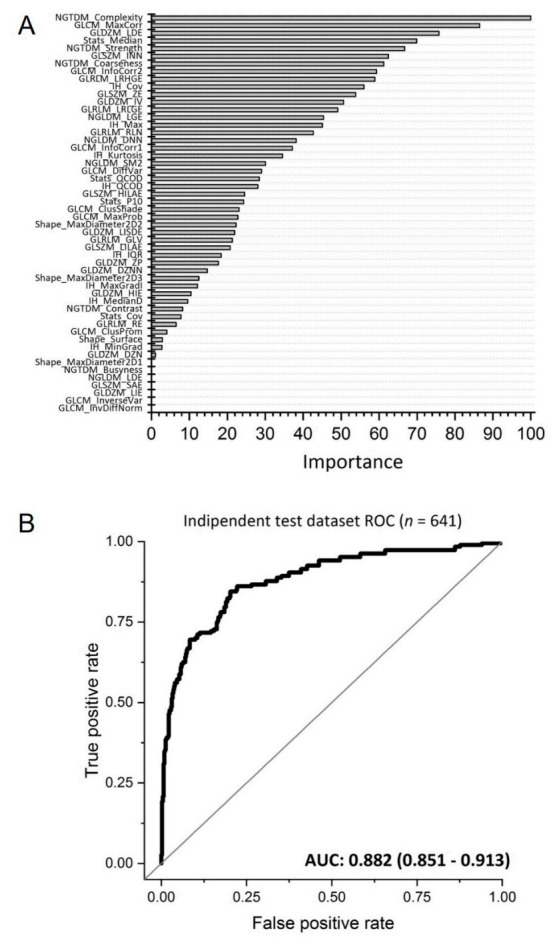
The coronavirus disease 2019 (COVID-19) outbreak has reached pandemic status. Drastic measures of social distancing are enforced in society and healthcare systems are being pushed to and beyond their limits. To help in the fight against this threat on human health, a fully automated AI framework was developed to extract radiomics features from volumetric chest computed tomography (CT) exams. The detection model was developed on a dataset of 1381 patients (181 COVID-19 patients plus 1200 non COVID control patients). A second, independent dataset of 197 RT-PCR confirmed COVID-19 patients and 500 control patients was used to assess the performance of the model. Diagnostic performance was assessed by the area under the receiver operating characteristic curve (AUC). The model had an AUC of 0.882 (95% CI: 0.851-0.913) in the independent test dataset (641 patients). The optimal decision threshold, considering the cost of false negatives twice as high as the cost of false positives, resulted in an accuracy of 85.18%, a sensitivity of 69.52%, a specificity of 91.63%, a negative predictive value (NPV) of 94.46% and a positive predictive value (PPV) of 59.44%. Benchmarked against RT-PCR confirmed cases of COVID-19, our AI framework can accurately differentiate COVID-19 from routine clinical conditions in a fully automated fashion. Thus, providing rapid accurate diagnosis in patients suspected of COVID-19 infection, facilitating the timely implementation of isolation procedures and early intervention.
2019冠状病毒病(COVID-19)疫情已达到大流行状态。社会上实施了严格的社交距离措施,医疗系统面临着巨大压力,甚至超出了其极限。为了帮助应对这一人类健康威胁,开发了一个全自动人工智能框架,用于从胸部容积计算机断层扫描(CT)检查中提取放射组学特征。检测模型是基于一个包含1381名患者的数据集开发的(181名COVID-19患者加上1200名非COVID对照患者)。另一个由197名经逆转录聚合酶链反应(RT-PCR)确诊的COVID-19患者和500名对照患者组成的独立数据集用于评估该模型的性能。通过受试者操作特征曲线(AUC)下的面积评估诊断性能。该模型在独立测试数据集(641名患者)中的AUC为0.882(95%CI:0.851-0.913)。考虑到假阴性成本是假阳性成本的两倍,最佳决策阈值下的准确率为85.18%,灵敏度为69.52%,特异性为91.63%,阴性预测值(NPV)为94.46%。,阳性预测值(PPV)为59.44%。与RT-PCR确诊的COVID-19病例相比,我们的人工智能框架可以以全自动方式准确区分COVID-19与常规临床情况。因此,能够对疑似COVID-19感染的患者进行快速准确的诊断,便于及时实施隔离程序和早期干预。