Plant and Animal Genomics, Centre de Recerca en Agrigenòmica (CRAG) CSIC-IRTA-UAB-UB, Campus UAB, Bellaterra, Spain.
Université Paris-Saclay, INRAE, Jouy-En-Josas, AgroParisTech, GABI, 78350, France.
Genet Sel Evol. 2021 Jan 4;53(1):3. doi: 10.1186/s12711-020-00597-9.
In the early 20th century, Cuban farmers imported Charolais cattle (CHFR) directly from France. These animals are now known as Chacuba (CHCU) and have become adapted to the rough environmental tropical conditions in Cuba. These conditions include long periods of drought and food shortage with extreme temperatures that European taurine cattle have difficulty coping with.
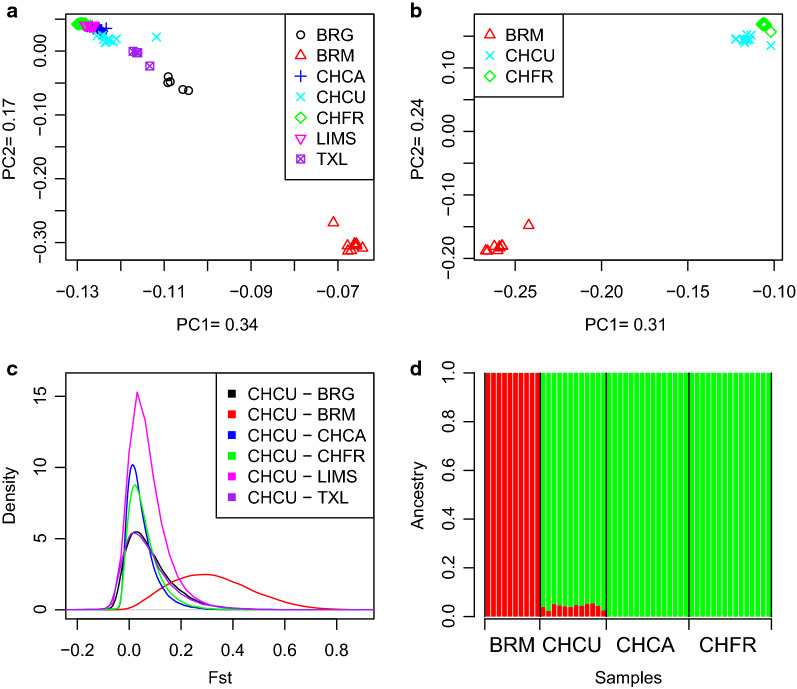
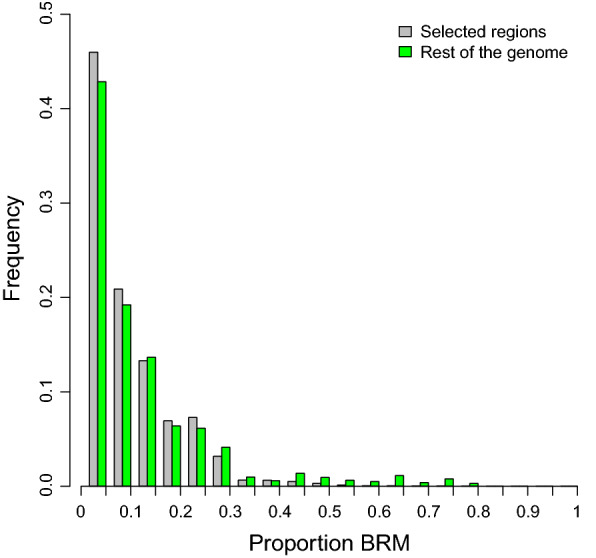
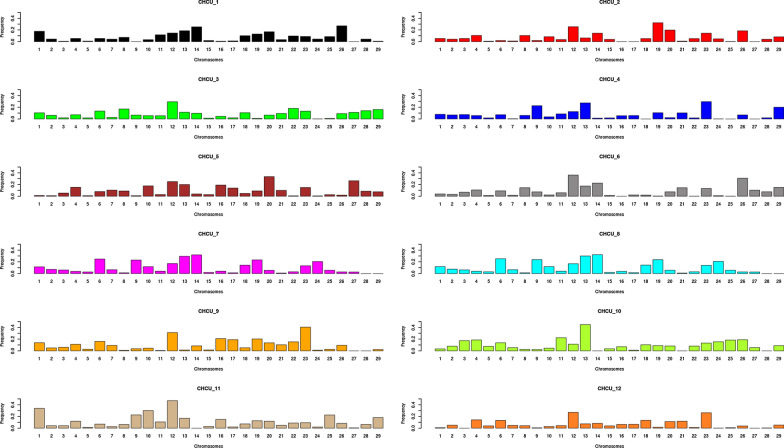
In this study, we used whole-genome sequence data from 12 CHCU individuals together with 60 whole-genome sequences from six additional taurine, indicus and crossed breeds to estimate the genetic diversity, structure and accurate ancestral origin of the CHCU animals. Although CHCU animals are assumed to form a closed population, the results of our admixture analysis indicate a limited introgression of Bos indicus. We used the extended haplotype homozygosity (EHH) approach to identify regions in the genome that may have had an important role in the adaptation of CHCU to tropical conditions. Putative selection events occurred in genomic regions with a high proportion of Bos indicus, but they were not sufficient to explain adaptation of CHCU to tropical conditions by Bos indicus introgression only. EHH suggested signals of potential adaptation in genomic windows that include genes of taurine origin involved in thermogenesis (ATP9A, GABBR1, PGR, PTPN1 and UCP1) and hair development (CCHCR1 and CDSN). Within these genes, we identified single nucleotide polymorphisms (SNPs) that may have a functional impact and contribute to some of the observed phenotypic differences between CHCU and CHFR animals.
Whole-genome data confirm that CHCU cattle are closely related to Charolais from France (CHFR) and Canada, but also reveal a limited introgression of Bos indicus genes in CHCU. We observed possible signals of recent adaptation to tropical conditions between CHCU and CHFR founder populations, which were largely independent of the Bos indicus introgression. Finally, we report candidate genes and variants that may have a functional impact and explain some of the phenotypic differences observed between CHCU and CHFR cattle.
20 世纪初,古巴农民直接从法国进口夏洛来牛(Charolais cattle,CHFR)。这些动物现在被称为 Chacuba(CHCU),已经适应了古巴恶劣的热带环境条件。这些条件包括长时间的干旱和食物短缺,以及欧洲瘤牛难以应对的极端温度。
在这项研究中,我们使用了 12 头 CHCU 个体的全基因组序列数据,以及另外 60 头来自六个其他瘤牛、印度牛和杂交品种的全基因组序列,来估计 CHCU 动物的遗传多样性、结构和准确的祖先起源。尽管 CHCU 动物被认为是一个封闭的群体,但我们的混合分析结果表明,印度牛的基因渗入是有限的。我们使用扩展的单倍型纯合度(EHH)方法来鉴定基因组中可能在 CHCU 适应热带条件方面起重要作用的区域。在具有高比例印度牛的基因组区域中发生了推定的选择事件,但这些事件不足以仅通过印度牛的基因渗入来解释 CHCU 对热带条件的适应。EHH 表明,在包括与产热(ATP9A、GABBR1、PGR、PTPN1 和 UCP1)和毛发发育(CCHCR1 和 CDSN)相关的牛起源基因的基因组窗口中,存在潜在适应的信号。在这些基因中,我们鉴定了可能具有功能影响并有助于解释 CHCU 和 CHFR 动物之间一些观察到的表型差异的单核苷酸多态性(SNP)。
全基因组数据证实,CHCU 牛与来自法国(CHFR)和加拿大的夏洛来牛密切相关,但也揭示了 CHCU 中印度牛基因的有限渗入。我们观察到 CHCU 和 CHFR 创始群体之间对热带条件的近期适应可能存在信号,这些信号在很大程度上独立于印度牛的基因渗入。最后,我们报告了可能具有功能影响并解释 CHCU 和 CHFR 牛之间观察到的一些表型差异的候选基因和变体。