Palayam Malathy, Ganapathy Jagadeesan, Guercio Angelica M, Tal Lior, Deck Samuel L, Shabek Nitzan
Department of Plant Biology, University of California - Davis, One shields Avenue, 1002 Life sciences, Davis, CA, 95616, USA.
Commun Biol. 2021 Jan 4;4(1):28. doi: 10.1038/s42003-020-01531-x.
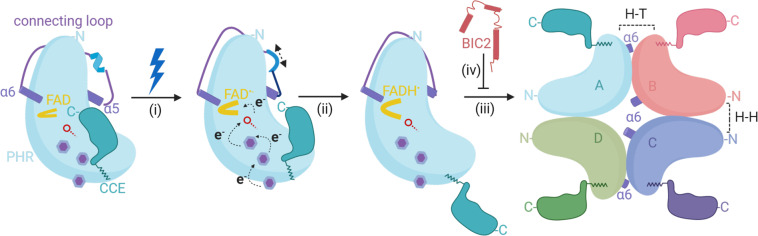
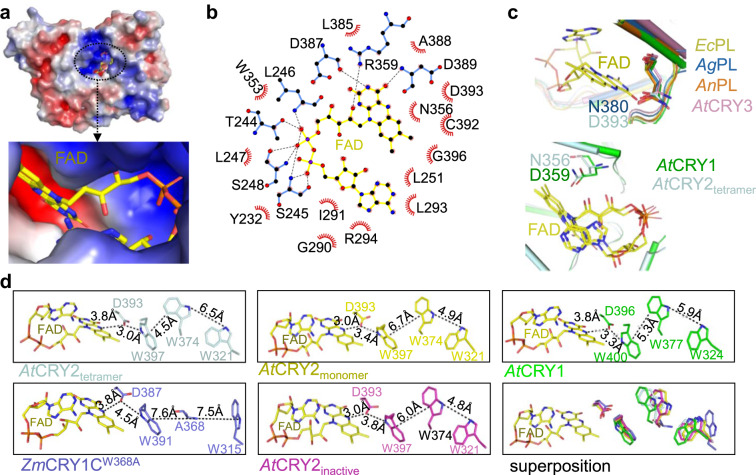
Cryptochromes (CRYs) are evolutionarily conserved photoreceptors that mediate various light-induced responses in bacteria, plants, and animals. Plant cryptochromes govern a variety of critical growth and developmental processes including seed germination, flowering time and entrainment of the circadian clock. CRY's photocycle involves reduction of their flavin adenine dinucleotide (FAD)-bound chromophore, which is completely oxidized in the dark and semi to fully reduced in the light signaling-active state. Despite the progress in characterizing cryptochromes, important aspects of their photochemistry, regulation, and light-induced structural changes remain to be addressed. In this study, we determine the crystal structure of the photosensory domain of Arabidopsis CRY2 in a tetrameric active state. Systematic structure-based analyses of photo-activated and inactive plant CRYs elucidate distinct structural elements and critical residues that dynamically partake in photo-induced oligomerization. Our study offers an updated model of CRYs photoactivation mechanism as well as the mode of its regulation by interacting proteins.
隐花色素(CRYs)是进化上保守的光感受器,介导细菌、植物和动物中的各种光诱导反应。植物隐花色素控制着各种关键的生长和发育过程,包括种子萌发、开花时间和生物钟的调节。CRY的光循环涉及与其黄素腺嘌呤二核苷酸(FAD)结合的发色团的还原,该发色团在黑暗中完全氧化,在光信号激活状态下部分或完全还原。尽管在表征隐花色素方面取得了进展,但其光化学、调节和光诱导结构变化的重要方面仍有待解决。在这项研究中,我们确定了处于四聚体活性状态的拟南芥CRY2光感域的晶体结构。基于结构的系统分析光激活和失活的植物CRYs,阐明了动态参与光诱导寡聚化的不同结构元件和关键残基。我们的研究提供了CRYs光激活机制的更新模型及其与相互作用蛋白的调节模式。