Department of Obstetrics and Gynecology, Linyi People's Hospital, No. 27, Eastern Section of Jiefang Road, Lanshan District, Linyi, Shandong, 276000, People's Republic of China.
Department of Ultrasonography, Linyi People's Hospital, Linyi, 276000, People's Republic of China.
J Transl Med. 2021 Jan 6;19(1):4. doi: 10.1186/s12967-020-02652-x.
Recent studies have suggested a crucial role of mesenchymal stem cell (MSC)-derived extracellular vesicles (EVs) in ovarian cancer treatment. We, therefore, set out to explore the mechanism through which MSC-derived EVs delivered microRNA-424 (miR-424) to influence the development of ovarian cancer.
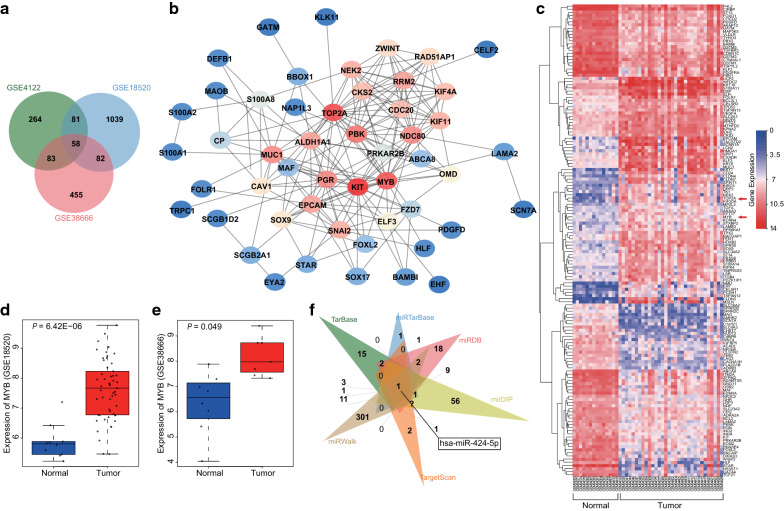
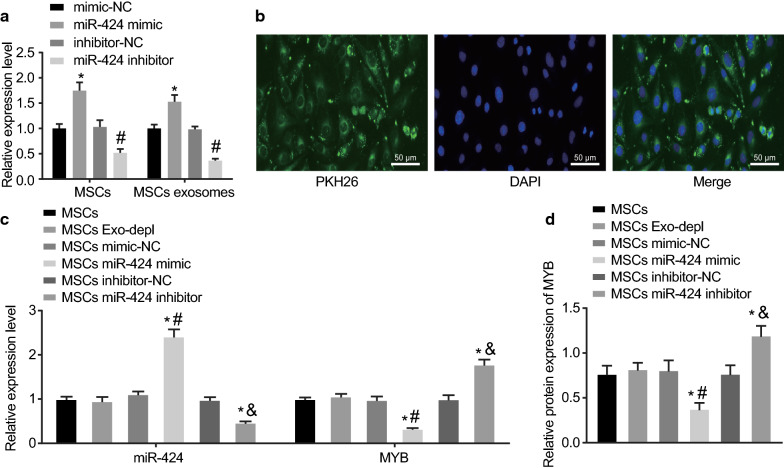
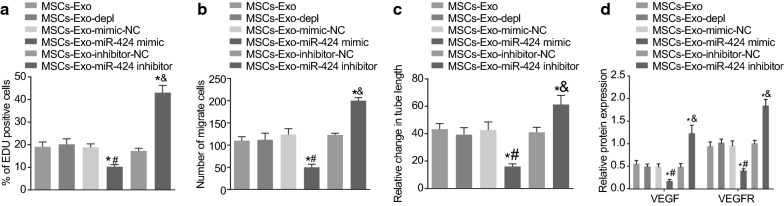
Bioinformatics analyses were first performed to screen ovarian cancer-related differentially expressed genes and to predict regulatory miRNAs. Then, dual-luciferase reporter gene assay was carried out to verify the relationship between miR-424 and MYB. Subsequently, the characterized MSCs and isolated EVs were co-cultured with ovarian cancer cells, followed by determination of the expression patterns of miR-424, MYB, vascular endothelial growth factor (VEGF), and VEGF receptor (VEGFR), respectively. In addition, the effects of EVs-delivered miR-424 on the proliferation, migration, invasion and tube formation of ovarian cancer cells were assessed using gain- and loss-of-function approaches. Lastly, tumor xenograft was induced in nude mice to illustrate the influence of EVs-loaded miR-424 on ovarian cancer in vivo.
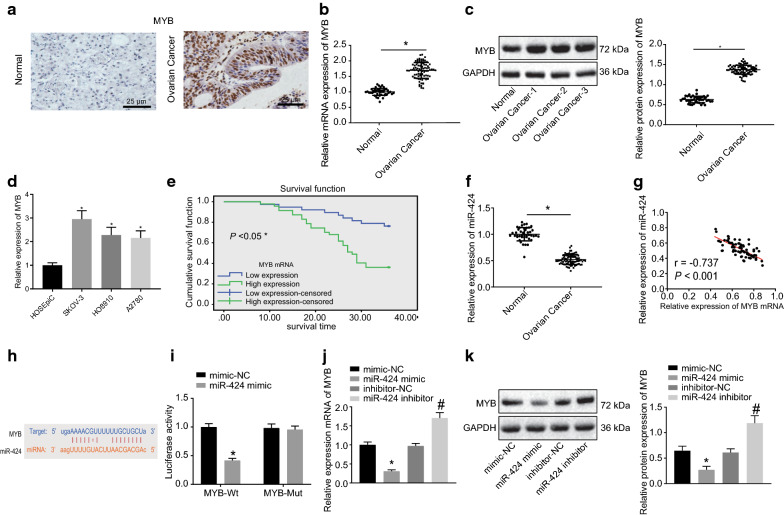
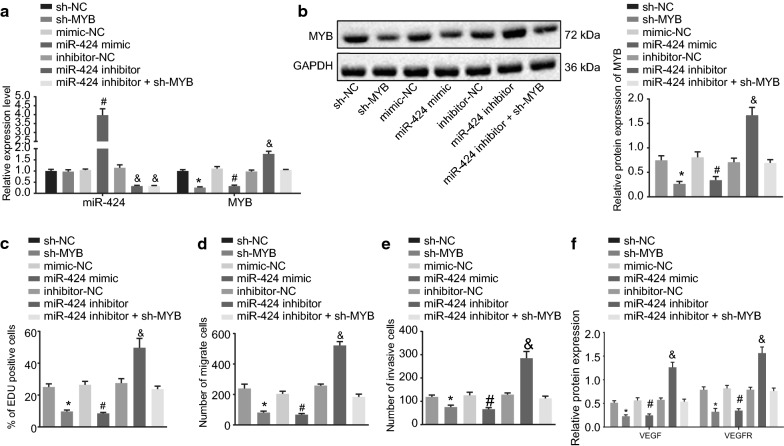
Our data exhibited that MYB was highly-expressed and miR-424 was poorly-expressed in ovarian cancer. More importantly, MYB was identified as a target gene of miR-424. Additionally, the transfer of miR-424 by MSC-derived EVs was found to repress the proliferation, migration, and invasion of ovarian cancer cells, with a reduction in the expressions of VEGF and VEGFR. Furthermore, MSC-derived EVs over-expressing miR-424 could inhibit the proliferation, migration, and tube formation of human umbilical vein endothelial cells, and also suppressed tumorigenesis and angiogenesis of ovarian tumors in vivo.
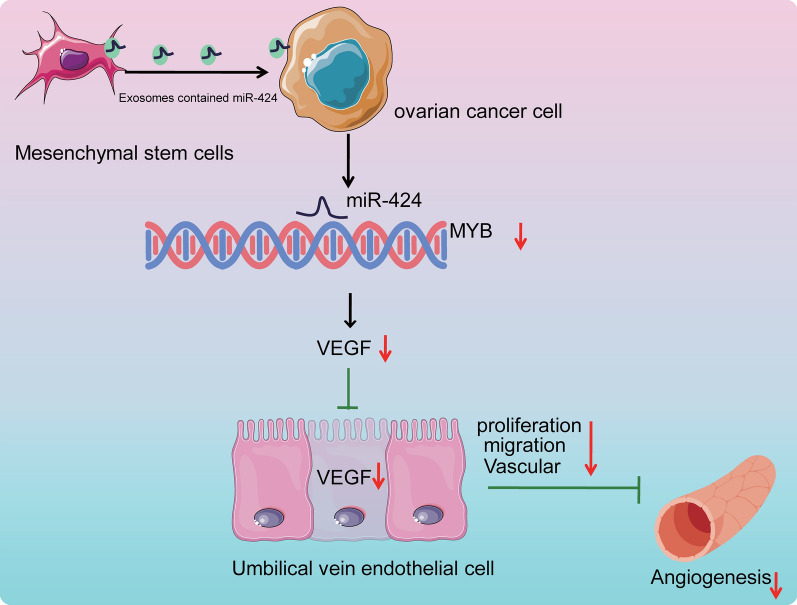
Collectively, our findings indicate that MSC-derived EVs transfer miR-424 to down-regulate MYB, which ultimately led to the inhibition of the tumorigenesis and angiogenesis of ovarian cancer. Hence, this study offers a potential prognostic marker and a therapeutic target for ovarian cancer.
最近的研究表明,间充质干细胞(MSC)衍生的细胞外囊泡(EVs)在卵巢癌治疗中起着至关重要的作用。因此,我们着手探索 MSC 衍生的 EV 传递 microRNA-424(miR-424)影响卵巢癌发展的机制。
首先进行生物信息学分析,筛选卵巢癌相关差异表达基因,并预测调节 miRNA。然后,进行双荧光素酶报告基因检测,验证 miR-424 与 MYB 的关系。随后,将鉴定的 MSC 和分离的 EV 与卵巢癌细胞共培养,分别检测 miR-424、MYB、血管内皮生长因子(VEGF)和 VEGF 受体(VEGFR)的表达模式。此外,采用 gain-和 loss-of-function 方法评估 EV 传递的 miR-424 对卵巢癌细胞增殖、迁移、侵袭和管形成的影响。最后,在裸鼠中诱导肿瘤异种移植,以说明 EV 负载的 miR-424 对体内卵巢癌的影响。
我们的数据表明,MYB 在卵巢癌中高表达,miR-424 低表达。更重要的是,MYB 被鉴定为 miR-424 的靶基因。此外,MSC 衍生的 EV 传递的 miR-424 被发现可抑制卵巢癌细胞的增殖、迁移和侵袭,降低 VEGF 和 VEGFR 的表达。此外,MSC 衍生的 EV 过表达 miR-424 可抑制人脐静脉内皮细胞的增殖、迁移和管形成,并抑制体内卵巢肿瘤的肿瘤发生和血管生成。
综上所述,我们的研究结果表明,MSC 衍生的 EV 转移 miR-424 以下调 MYB,从而最终抑制卵巢癌的肿瘤发生和血管生成。因此,本研究为卵巢癌提供了一个潜在的预后标志物和治疗靶点。