Department of Health Science, University Magna Grecia, 88100, Catanzaro, Italy.
Department of Medical and Surgical Science, Nutrition Unit, University Magna Grecia, 88100, Catanzaro, Italy.
J Transl Med. 2021 Jan 6;19(1):19. doi: 10.1186/s12967-020-02676-3.
Most studies focused on the benefits of lycopene on serum lipids but no studies have been specifically designed to assess the role of a tomato sauce from vine-ripened tomatoes on patients affected by polygenic hypercholesterolemia. The aim of this study was to compare the lipid-lowering effect of a novel functional tomato sauce with a well-known functional food with a lipid-lowering effect, i.e. a sterol-enriched yogurt.
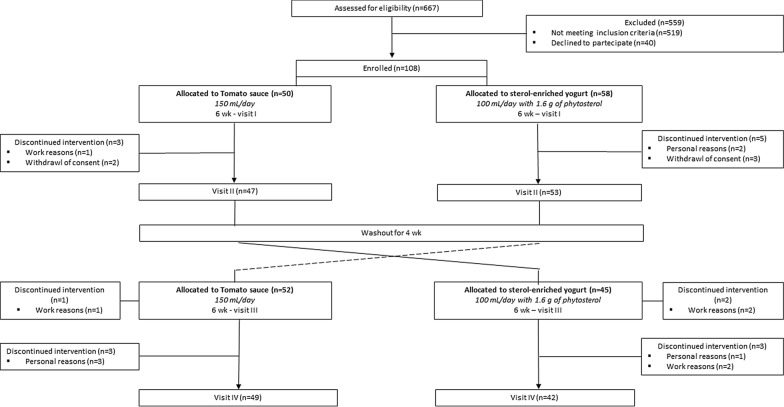
In this cross-over study, we evaluated a population of 108 ambulatory patients affected by polygenic hypercholesterolemia of both gender, who were allocated to a tomato sauce (namely OsteoCol) 150 ml/day or a sterol-enriched yogurt (containing sterols 1.6 g/die) treatment, for 6 weeks. Carotenoids content was 3.5 mg per gram of product. We measured serum lipids and creatinine and transaminases at basal and follow-up visit.
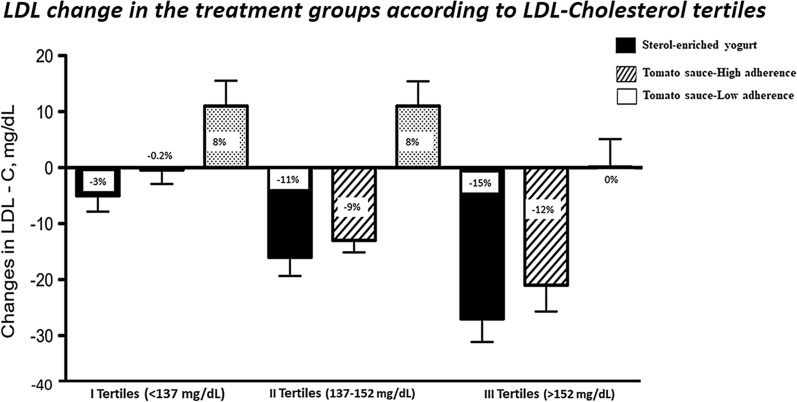
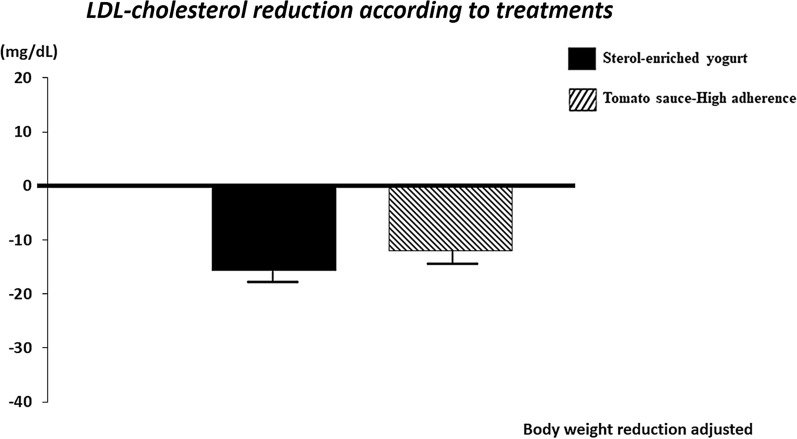
A total of 91 subjects completed the protocol. A significant difference in LDL-cholesterol change was found between participants taking yogurt, tomato sauce (high adherence) and tomato sauce (low adherence) (- 16; - 12; + 8 mg/dl respectively; p < 0.001). We found a greater LDL-cholesterol reduction in the participants with a basal LDL-cholesterol more than 152 mg/dl (15% for sterol-enriched yogurt and 12% for tomato sauce at high adherence).
A novel functional tomato sauce from vine-ripened tomatoes compares favourably with a commercialised sterol-enriched yogurt in term of absolute LDL-cholesterol change. Intake of a tomato sauce with a high carotenoid content may support treatment of patients affected by common hypercholesterolemia. The present study has various limitations. The presence of other dietary components, which may have influenced the results, cannot be ruled out. Of course, these results cannot be extrapolated to other populations. Furthermore, there was a low adherence rate in the tomato sauce group. Moreover, we did not report serum carotenoids data.
ID: 13244115 on the ISRCTN registry, retrospectively registered in 2019-5-14. URL: http://www.isrctn.com/ISRCTN13244115.
大多数研究都集中在番茄红素对血清脂质的益处上,但没有专门研究旨在评估来自成熟番茄的番茄酱对患有多基因高胆固醇血症的患者的作用。本研究的目的是比较新型功能性番茄酱与具有降血脂作用的知名功能性食品——富含固醇的酸奶对血脂的降低作用。
在这项交叉研究中,我们评估了 108 名患有男女两性多基因高胆固醇血症的门诊患者,将他们分为每天摄入 150 毫升番茄酱(即 OsteoCol)或富含固醇的酸奶(每天含固醇 1.6 克)治疗组,治疗 6 周。产品中的类胡萝卜素含量为每克 3.5 毫克。我们在基线和随访时测量血清脂质和肌酐以及转氨酶。
共有 91 名受试者完成了方案。服用酸奶、番茄酱(高依从性)和番茄酱(低依从性)的参与者的 LDL-胆固醇变化有显著差异(分别为-16;-12;+8mg/dl;p<0.001)。我们发现,在基线 LDL-胆固醇超过 152mg/dl 的参与者中,LDL-胆固醇降低幅度更大(富含固醇的酸奶降低 15%,高依从性的番茄酱降低 12%)。
来自成熟番茄的新型功能性番茄酱在绝对 LDL-胆固醇变化方面与商业化的富含固醇的酸奶相当。摄入高类胡萝卜素含量的番茄酱可能有助于治疗患有常见高胆固醇血症的患者。本研究存在各种局限性。不能排除其他饮食成分影响结果的可能性。当然,这些结果不能外推到其他人群。此外,番茄酱组的依从性较低。此外,我们没有报告血清类胡萝卜素数据。
注册号:13244115,在 ISRCTN 注册中心注册,于 2019 年 5 月 14 日进行了回顾性注册。网址:http://www.isrctn.com/ISRCTN13244115。