Uppsala Center for Prehospital Research, Department of Surgical Sciences - Anesthesiology and Intensive care, Uppsala University, 751 85, Uppsala, Sweden.
Scand J Trauma Resusc Emerg Med. 2021 Jan 6;29(1):3. doi: 10.1186/s13049-020-00826-6.
The novel coronavirus disease 2019 (Covid-19) pandemic has affected prehospital care systems across the world, but the prehospital presentation of affected patients and the extent to which prehospital care providers are able to identify them is not well characterized. In this study, we describe the presentation of Covid-19 patients in a Swedish prehospital care system, and asses the predictive value of Covid-19 suspicion as documented by dispatch and ambulance nurses.
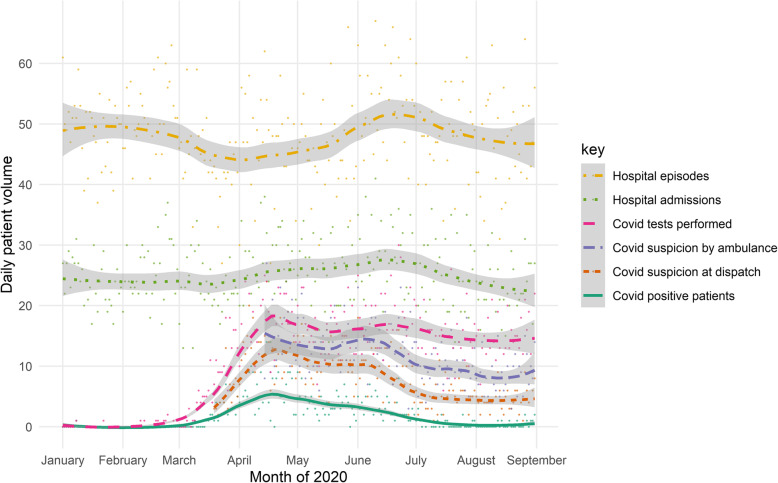
Data for all patients with dispatch, ambulance, and hospital records between January 1-August 31, 2020 were extracted. A descriptive statistical analysis of patients with and without hospital-confirmed Covid-19 was performed. In a subset of records beginning from April 14, we assessed the sensitivity and specificity of documented Covid-19 suspicion in dispatch and ambulance patient care records.
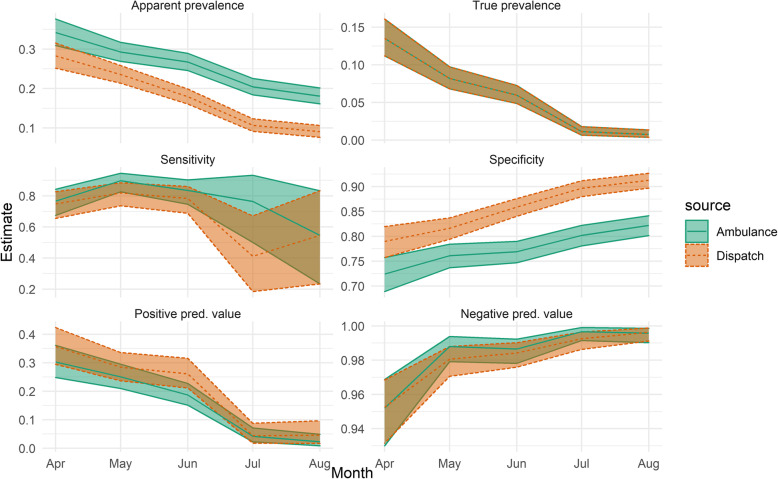
A total of 11,894 prehospital records were included, of which 481 had a primary hospital diagnosis code related to-, or positive test results for Covid-19. Covid-19-positive patients had considerably worse outcomes than patients with negative test results, with 30-day mortality rates of 24% vs 11%, but lower levels of prehospital acuity (e.g. emergent transport rates of 14% vs 22%). About half (46%) of Covid-19-positive patients presented to dispatchers with primary complaints typically associated with Covid-19. Six thousand seven hundred seventy-six records were included in the assessment of predictive value. Sensitivity was 76% (95% CI 71-80) and 82% (78-86) for dispatch and ambulance suspicion respectively, while specificities were 86% (85-87) and 78% (77-79).
While prehospital suspicion was strongly indicative of hospital-confirmed Covid-19, based on the sensitivity identified in this study, prehospital suspicion should not be relied upon as a single factor to rule out the need for isolation precautions. The data provided may be used to develop improved guidelines for identifying Covid-19 patients in the prehospital setting.
新型冠状病毒病 2019(Covid-19)大流行已经影响了世界各地的院前急救系统,但受影响患者的院前表现以及院前急救提供者识别他们的能力程度尚未得到充分描述。在这项研究中,我们描述了瑞典院前急救系统中 Covid-19 患者的表现,并评估了调度员和救护车护士记录的 Covid-19 疑似病例的预测价值。
提取了 2020 年 1 月 1 日至 8 月 31 日期间所有有调度、救护车和医院记录的患者的数据。对有和没有医院确诊的 Covid-19 的患者进行了描述性统计分析。在从 4 月 14 日开始的记录子集中,我们评估了调度和救护车患者护理记录中记录的 Covid-19 疑似病例的敏感性和特异性。
共纳入 11894 份院前记录,其中 481 份有与 Covid-19 相关的主要医院诊断代码或阳性检测结果。Covid-19 阳性患者的预后明显差于检测结果为阴性的患者,30 天死亡率分别为 24%和 11%,但院前严重程度较低(例如,紧急转运率分别为 14%和 22%)。大约一半(46%)的 Covid-19 阳性患者向调度员报告的主要症状通常与 Covid-19 相关。6776 份记录被纳入预测价值评估。调度员和救护车怀疑的敏感性分别为 76%(95%CI 71-80)和 82%(78-86),特异性分别为 86%(85-87)和 78%(77-79)。
虽然院前怀疑强烈提示医院确诊的 Covid-19,但根据本研究确定的敏感性,不能仅依靠院前怀疑作为排除隔离预防措施的单一因素。提供的数据可用于制定在院前环境中识别 Covid-19 患者的改进指南。