Department of Epidemiology and Health Monitoring, Robert Koch Institute, Berlin, Germany
Department of Epidemiology and Health Monitoring, Robert Koch Institute, Berlin, Germany.
BMJ Open. 2021 Jan 6;11(1):e041508. doi: 10.1136/bmjopen-2020-041508.
Little is known about the age-specific excess mortality pattern of people with diagnosed diabetes in Germany. Thus, our goal was to determine the excess mortality in diagnosed diabetes overall and stratified by age and sex based on claims data.
Routine data analysis using a claims dataset from all statutory health-insured persons in Germany in 2013, which accounts for about 90% of the population.
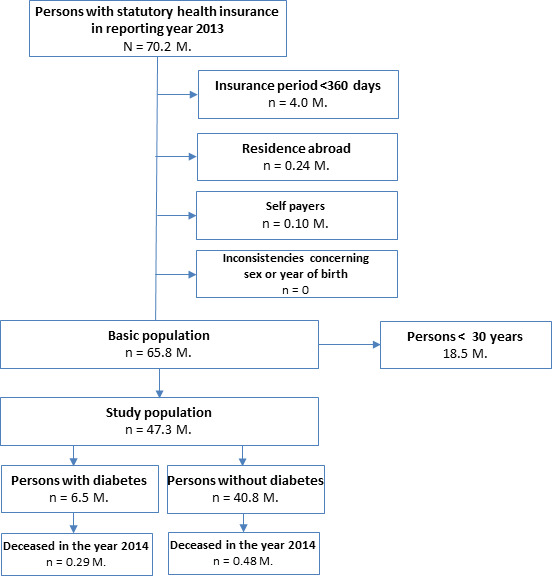
We included persons who lived in Germany, were insured at least 360 days, were not self-paying any health services and were aged 30 years or older leading to a total number of 47.3 million insured persons for analyses.
Diabetes was determined by the International Classification of Diseases-10 codes E10-E14, which were documented in 2013 in at least two-quarters on an outpatient setting or at least once on an inpatient setting.
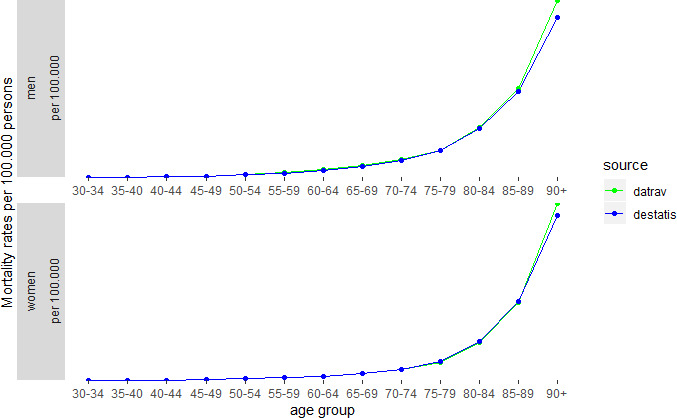
The vital status in the study population was drawn from the claims dataset for the year 2014. We derived the excess mortality estimated as an age-adjusted mortality rate ratio (MRR) by sex and for age groups using a Poisson model.
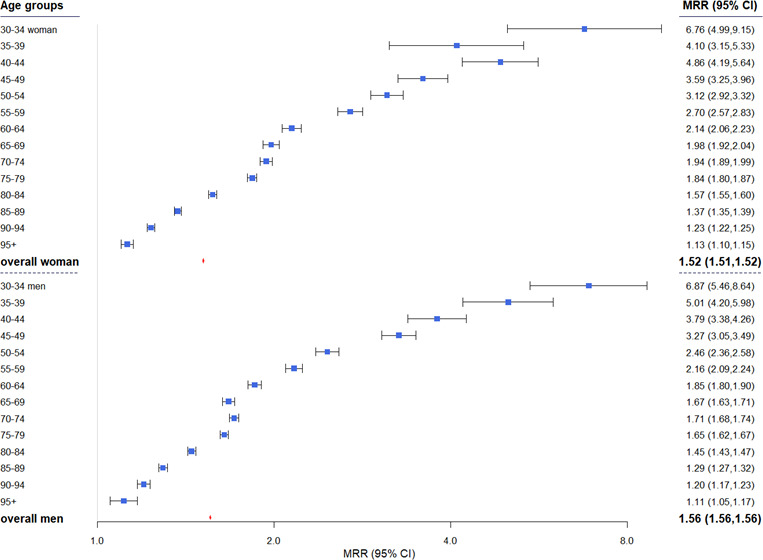
We found age-adjusted MRRs (95% CI) for diabetes of 1.52 (1.51 to 1.52) for women and 1.56 (1.56 to 1.56) for men. These figures declined with increasing age and were highest for ages 30-34 years with 6.76 (4.99 to 9.15) for women and 6.87 (5.46 to 8.64) for men, and lowest for age 95 years and older with 1.13 (1.10 to 1.15) for women and 1.11 (1.05 to 1.17) for men.
We derived deeply age-stratified figures on excess mortality in diabetes for Germany. Establishing a sustainable analysis of excess mortality is aimed at within the framework of diabetes surveillance.
德国关于确诊糖尿病患者特定年龄段超额死亡率的信息知之甚少。因此,我们的目标是根据索赔数据确定总体诊断为糖尿病患者以及按年龄和性别分层的超额死亡率。
使用德国 2013 年所有法定健康保险人员的索赔数据集进行常规数据分析,该数据集涵盖了约 90%的人口。
我们纳入了居住在德国、至少投保 360 天、不自行支付任何医疗服务费用且年龄在 30 岁及以上的人员,总计有 4730 万被保险人进行分析。
通过国际疾病分类第 10 版(ICD-10)代码 E10-E14 确定糖尿病,这些代码在 2013 年至少有四分之二在门诊或至少一次在住院时记录。
研究人群的生存状态从索赔数据集中 2014 年的数据中得出。我们使用泊松模型按性别和年龄组计算了超额死亡率,估计为年龄调整死亡率比(MRR)。
我们发现女性的年龄调整 MRR(95%CI)为 1.52(1.51 至 1.52),男性为 1.56(1.56 至 1.56)。这些数字随年龄的增加而下降,在 30-34 岁年龄组最高,女性为 6.76(4.99 至 9.15),男性为 6.87(5.46 至 8.64),在 95 岁及以上年龄组最低,女性为 1.13(1.10 至 1.15),男性为 1.11(1.05 至 1.17)。
我们得出了德国糖尿病超额死亡率的深度年龄分层数据。目标是在糖尿病监测框架内建立对超额死亡率的可持续分析。