
小叶原位癌与浸润性导管癌总生存率的比较:基于监测、流行病学和最终结果(SEER)数据库的倾向得分匹配研究
Comparison of Overall Survival Between Invasive Lobular Breast Carcinoma and Invasive Ductal Breast Carcinoma: A Propensity Score Matching Study Based on SEER Database.
作者信息
Yang Ciqiu, Lei Chuqian, Zhang Yi, Zhang Junsheng, Ji Fei, Pan Weijun, Zhang Liulu, Gao Hongfei, Yang Mei, Li Jieqing, Wang Kun
机构信息
Department of Breast Cancer, Cancer Center, Guangdong Provincial People's Hospital, Guangdong Academy of Medical Sciences, Guangzhou, China.
Department of Breast and Thyroid Surgery, The Eighth Affiliated Hospital, Sun Yat-sen University, Shenzhen, China.
出版信息
Front Oncol. 2020 Dec 22;10:590643. doi: 10.3389/fonc.2020.590643. eCollection 2020.
OBJECTIVE
Invasive lobular carcinoma (ILC) and invasive ductal carcinoma (IDC) account for most breast cancers. However, the overall survival (OS) differences between ILC and IDC remain controversial. This study aimed to compare nonmetastatic ILC to IDC in terms of survival and prognostic factors for ILC.
METHODS
This retrospective cohort study used data from the Surveillance, Epidemiology and End Results (SEER) Cancer Database (www.seer.cancer.gov). Women diagnosed with nonmetastatic ILC and IDC between 2006 and 2016 were included. A propensity score matching (PSM) method was used in our analysis to reduce baseline differences in clinicopathological characteristics and survival outcomes. Kaplan-Meier curves and log-rank test were used for survival analysis.
RESULTS
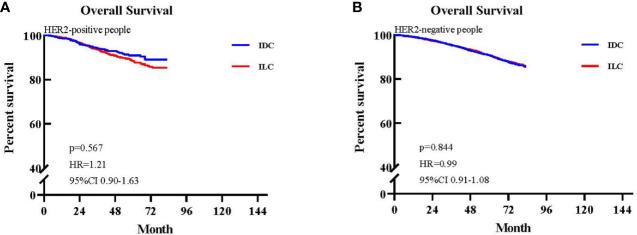
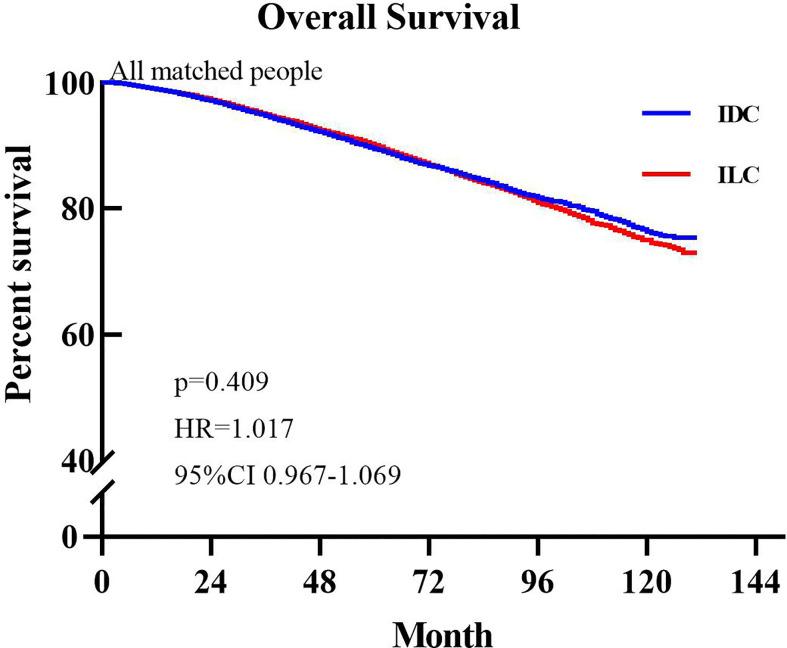
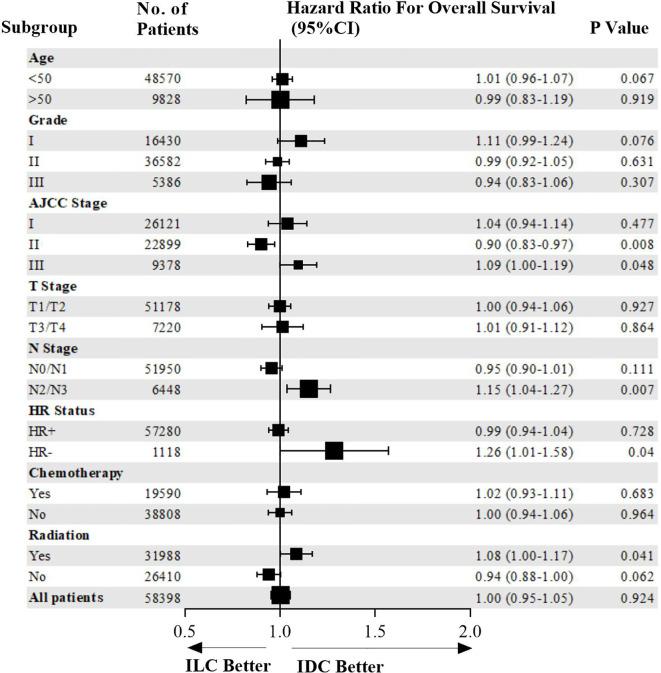
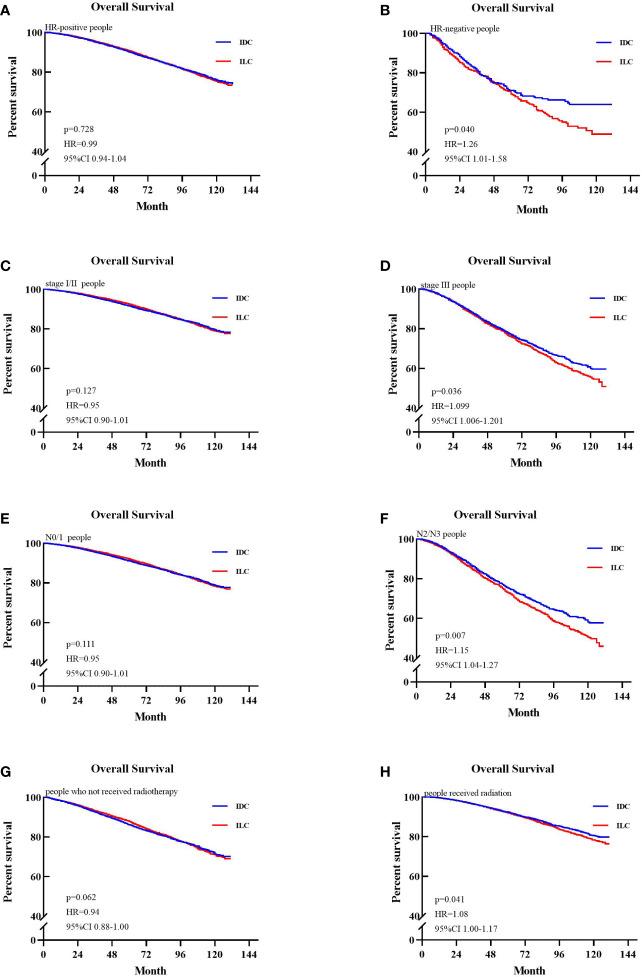
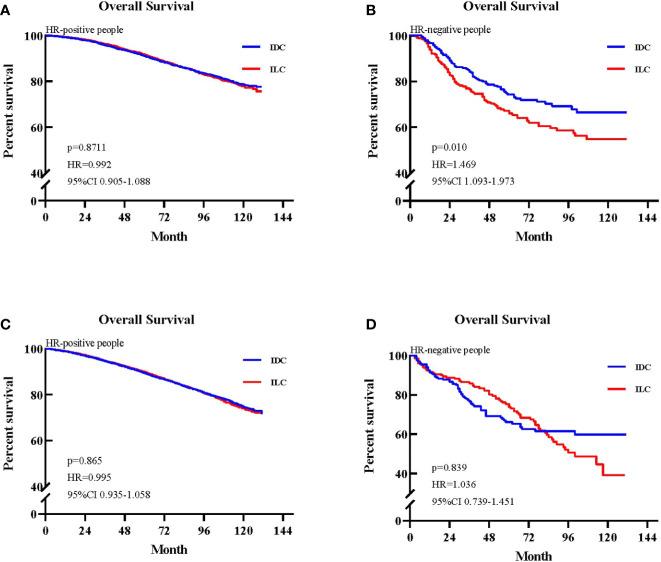
Compared to IDC patients, ILC patients were diagnosed later in life with poorly differentiated and larger lesions, as well as increased expression of estrogen receptors (ERs) and/or progesterone receptors (PRs). A lower rate of radiation therapy and chemotherapy was observed in ILC. After PSM, ILC, and IDC patients exhibited similar OS (HR=1.017, p=0.409, 95% CI: 0.967-1.069). In subgroup analysis of HR-negative, AJCC stage III, N2/N3 stage patients, or those who received radiotherapy, ILC patients exhibited worse OS compared to IDC patients. Furthermore, multivariate analysis revealed a 47% survival benefit for IDC compared to ILC in HR-negative patients who received chemotherapy (HR=1.47, p=0.01, 95% CI: 1.09-1.97).
CONCLUSIONS
Our results demonstrated that ILC and IDC patients had similar OS after PSM. However, ILC patients with high risk indicators had worse OS compared to IDC patients by subgroup analysis.
目的
浸润性小叶癌(ILC)和浸润性导管癌(IDC)占大多数乳腺癌病例。然而,ILC和IDC之间的总生存期(OS)差异仍存在争议。本研究旨在比较非转移性ILC和IDC的生存率及ILC的预后因素。
方法
这项回顾性队列研究使用了监测、流行病学和最终结果(SEER)癌症数据库(www.seer.cancer.gov)中的数据。纳入2006年至2016年间诊断为非转移性ILC和IDC的女性。我们在分析中采用倾向评分匹配(PSM)方法以减少临床病理特征和生存结果的基线差异。采用Kaplan-Meier曲线和对数秩检验进行生存分析。
结果
与IDC患者相比,ILC患者确诊时年龄更大,肿瘤分化差、体积大,雌激素受体(ER)和/或孕激素受体(PR)表达增加。ILC患者接受放疗和化疗的比例较低。PSM后,ILC和IDC患者的OS相似(HR = 1.017,p = 0.409,95%CI:0.967 - 1.069)。在HR阴性、美国癌症联合委员会(AJCC)III期、N2/N3期患者或接受放疗的患者亚组分析中,ILC患者的OS比IDC患者更差。此外,多变量分析显示,在接受化疗的HR阴性患者中,与ILC相比,IDC的生存获益为47%(HR = 1.47,p = 0.01,95%CI:1.09 - 1.97)。
结论
我们的结果表明,PSM后ILC和IDC患者的OS相似。然而,通过亚组分析,具有高风险指标的ILC患者的OS比IDC患者更差。
 Zotero 插件