Israel Defense Force Medical Corps, Tel Hashomer, Ramat Gan, Israel.
Israel Defense Force Medical Corps, Tel Hashomer, Ramat Gan, Israel; Heller Institute of Medical Research, Sheba Medical Center, Tel-Hashomer, Israel.
Clin Microbiol Infect. 2021 Apr;27(4):618-623. doi: 10.1016/j.cmi.2020.12.028. Epub 2021 Jan 6.
To assess the utility of self-reported symptoms in identifying positive coronavirus disease 2019 (COVID-19) cases among predominantly healthy young adults in a military setting.
A questionnaire regarding COVID-19 symptoms and exposure history was administered to all individuals contacting the Israeli Defence Forces Corona call-centre, before PCR testing. Surveyed symptoms included cough, fever, sore throat, rhinorrhoea, loss of taste or smell, chest pain and gastrointestinal symptoms. Factors were compared between positive and negative cases based on confirmatory test results, and positive likelihood ratios (LR) were calculated. Results were stratified by sex, body mass index, previous medical history and dates of questioning, and a multivariable analysis for association with positive test was conducted.
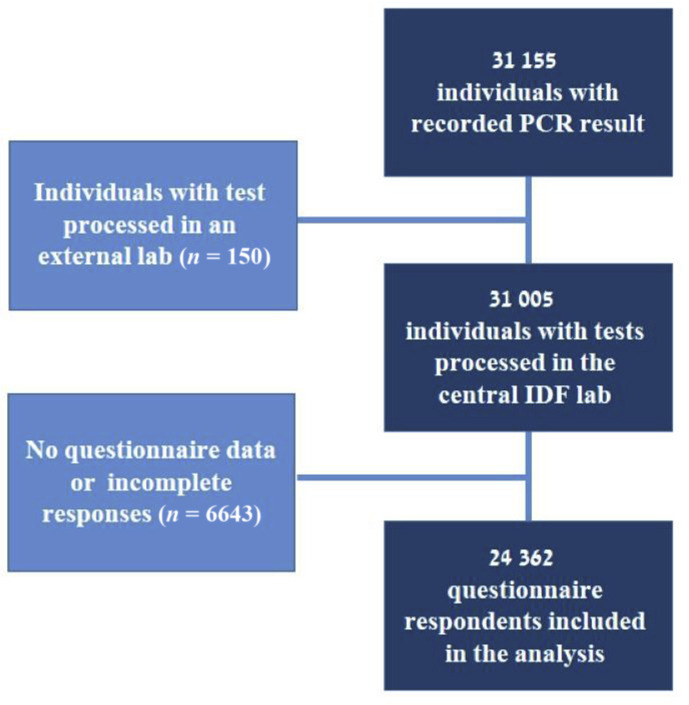
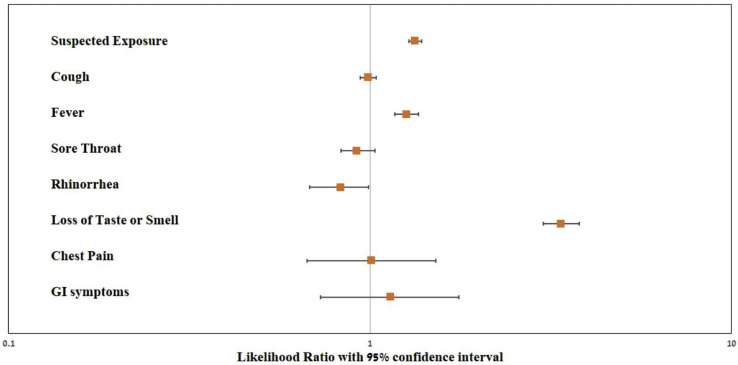
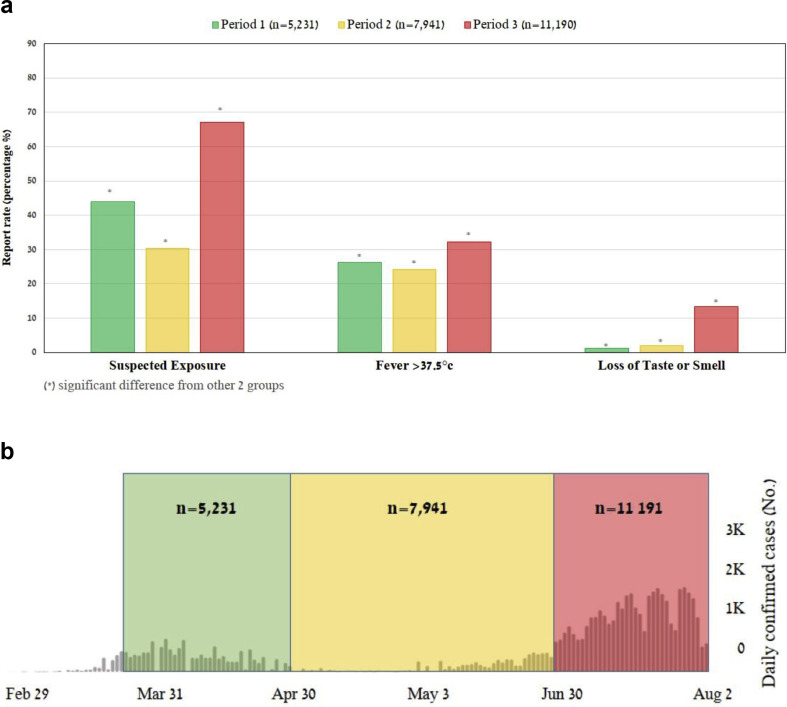
Of 24 362 respondents, 59.1% were men with a median age of 20.5 years (interquartile range 19.6-22.4 years). Significant positive LRs were associated with loss of taste or smell (LR 3.38, 95% CI 3.01-3.79), suspected exposure (LR 1.33, 95% CI 1.28-1.39) and fever (LR 1.26, 95% CI 1.17-1.36). Those factors were also associated with positive PCR result in a multivariable analysis (OR 3.51, 95% CI 3.04-4.06; OR 1.86, 95% CI 1.65-2.09; and OR 1.34, 95% CI 1.19-1.51, respectively). Reports of loss of taste or smell increased gradually over time and were significantly more frequent during the late period of the study (63/5231, 1.21%; 156/7941, 1.96%; and 1505/11 190, 13.45%: p < 0.001).
Loss of taste or smell, report of a suspicious exposure and fever (>37.5°C) were consistently associated with positive LRs for a positive SARS-CoV-2 PCR test result, in a population of predominantly young and healthy adults.
评估在以年轻健康成年人为主的军事环境中,自我报告的症状在识别新型冠状病毒病 2019(COVID-19)阳性病例中的作用。
在对所有联系以色列国防军新冠咨询中心的个体进行聚合酶链反应(PCR)检测之前,采用问卷形式询问 COVID-19 症状和接触史。调查的症状包括咳嗽、发热、咽痛、流涕、味觉或嗅觉丧失、胸痛和胃肠道症状。根据确诊试验结果比较阳性和阴性病例的因素,并计算阳性似然比(LR)。结果按性别、体重指数、既往病史和询问日期分层,并进行多变量分析以确定与阳性检测结果的关联。
在 24362 名应答者中,59.1%为男性,中位年龄为 20.5 岁(四分位间距 19.6-22.4 岁)。味觉或嗅觉丧失(LR 3.38,95%CI 3.01-3.79)、疑似接触史(LR 1.33,95%CI 1.28-1.39)和发热(LR 1.26,95%CI 1.17-1.36)与显著的阳性 LR 相关。在多变量分析中,这些因素也与阳性 PCR 结果相关(OR 3.51,95%CI 3.04-4.06;OR 1.86,95%CI 1.65-2.09;OR 1.34,95%CI 1.19-1.51)。味觉或嗅觉丧失的报告随时间逐渐增加,在研究后期明显更为频繁(5231 例中 63 例[1.21%];7941 例中 156 例[1.96%];11 190 例中 1505 例[13.45%]:p<0.001)。
在以年轻和健康成年人为主的人群中,味觉或嗅觉丧失、可疑接触史和发热(>37.5°C)与 SARS-CoV-2 PCR 检测结果阳性的 LR 持续相关。