Navas Daniel, Ibañez Andrés, González Iván, Palma Juan Luis, Dreyse Paulina
Departamento de Química, Facultad de Ciencias Naturales, Matemática y del Medio Ambiente, Universidad Tecnológica Metropolitana, Las Palmeras 3360, Ñuñoa, Santiago, 7800003, Chile.
Departamento de Física, Facultad de Ciencias Físicas y Matemáticas, Universidad de Chile, Av. Beauchef 850, Casilla 653, Santiago, Chile.
Heliyon. 2020 Dec 29;6(12):e05821. doi: 10.1016/j.heliyon.2020.e05821. eCollection 2020 Dec.
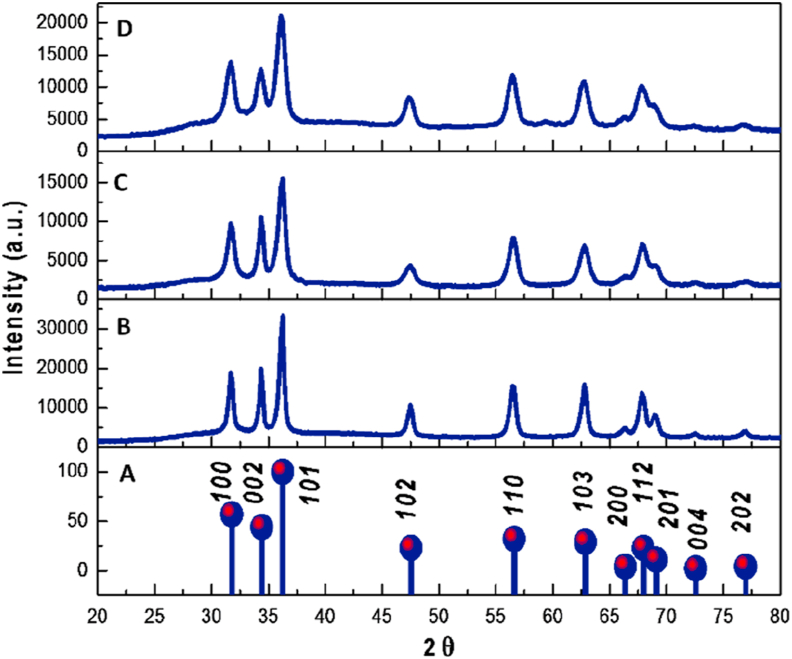
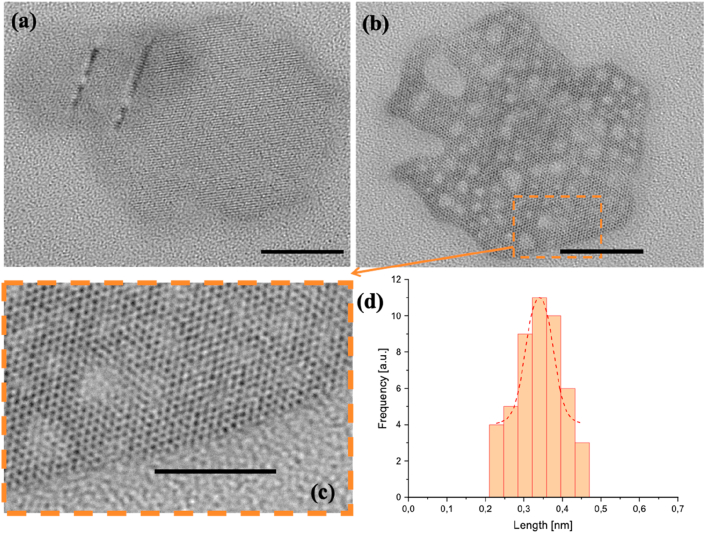
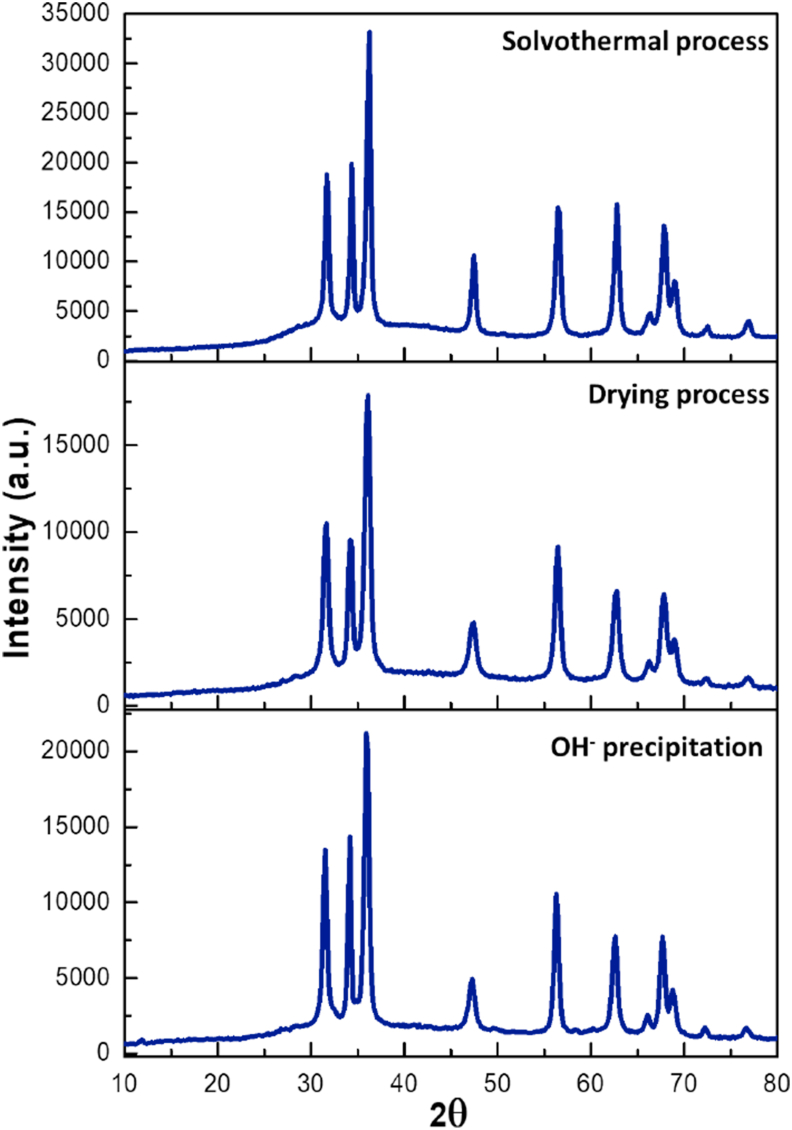
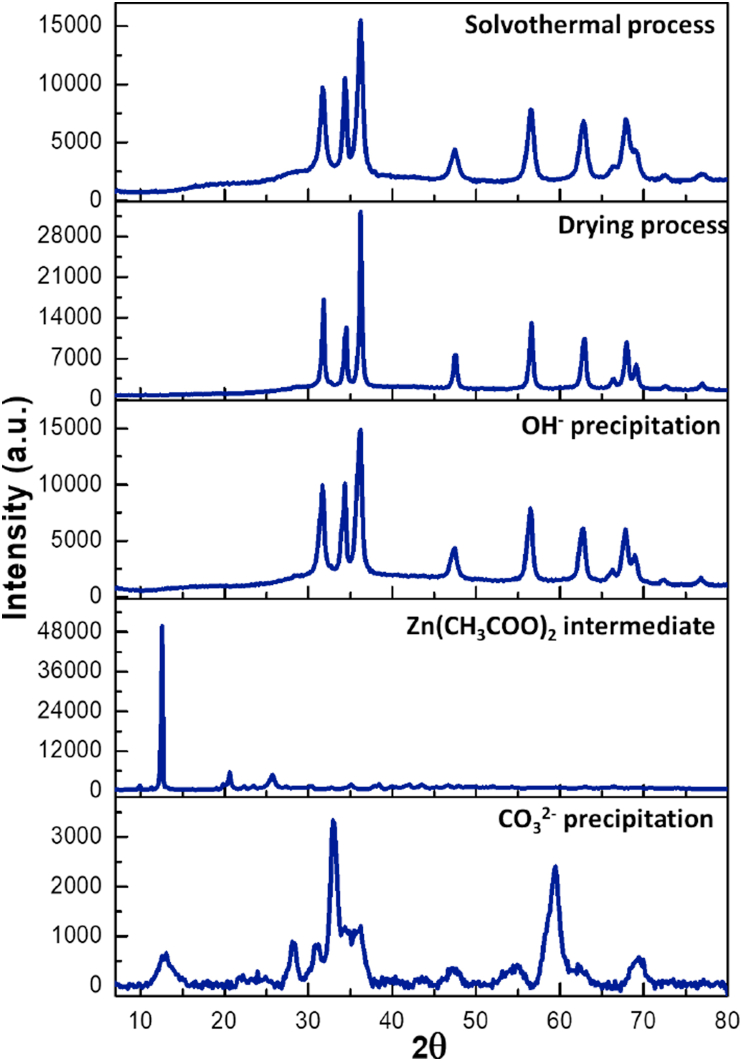
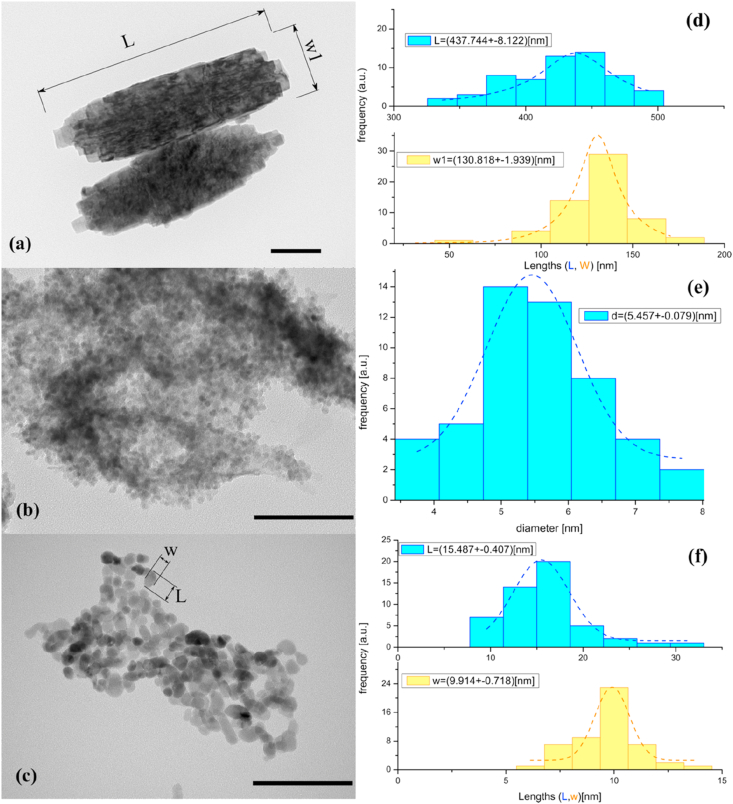
Zinc oxide nanoparticles were successfully synthesized under precipitation processes, using ZnSO·7HO as a Zn precursor and KCO used as a basic source, and hydrozincite was obtained as an intermediary, which was treated under two procedures; first procedure involved multiple stages to get final precipitated with NaOH, and in the second procedure the hydrozincite was straightforwardly dried at 220 °C. By both processes ZnO structures were obtained, which were turned into nanoparticles by a solvothermal treatment, for four hours in ethylene glycol at 200 °C. The final products for the first procedure was conglomerate of spherical nanoparticles with sizes ranged between 5-10 nm and dispersed ellipsoidal nanoparticles for the second procedure. Apart off the two procedures mentioned above, another synthesis was carried out with the same Zn precursor but now using NaOH, and the solvothermal treatment produced ZnO mixed micro-structures which under ultrasonic cavitation disaggregated on mesoporous ZnO nanoplates of hexagonal shapes with nanopore sizes of approximately 0.35 nm. All ZnOs synthesized were structurally characterized with XRD, TEM and FT-IR techniques, and electronically with UV-Vis absorption and diffuse reflectance spectroscopies.
在沉淀过程中成功合成了氧化锌纳米颗粒,使用ZnSO₄·7H₂O作为锌前驱体,K₂CO₃作为碱源,并得到了羟锌矿作为中间体,该中间体经过两种处理程序;第一种程序包括多个阶段,用NaOH得到最终沉淀,第二种程序是将羟锌矿在220℃直接干燥。通过这两种方法都得到了ZnO结构,通过在200℃的乙二醇中进行4小时的溶剂热处理将其转化为纳米颗粒。第一种程序的最终产物是尺寸在5-10nm之间的球形纳米颗粒聚集体,第二种程序的产物是分散的椭圆形纳米颗粒。除了上述两种程序外,还用相同的锌前驱体进行了另一种合成,但现在使用NaOH,溶剂热处理产生了ZnO混合微结构,该结构在超声空化作用下分解为六边形介孔ZnO纳米板,纳米孔尺寸约为0.35nm。所有合成的ZnO都用XRD、TEM和FT-IR技术进行了结构表征,并用UV-Vis吸收和漫反射光谱进行了电子表征。