Department of Radiology, Friedrich-Schiller-University, Jena University Hospital, Am Klinikum 1, 07747, Jena, Germany.
Department of Internal Medicine, Friedrich-Schiller-University, Jena University Hospital, Am Klinikum 1, 07747, Jena, Germany.
Respir Res. 2021 Jan 12;22(1):13. doi: 10.1186/s12931-020-01611-w.
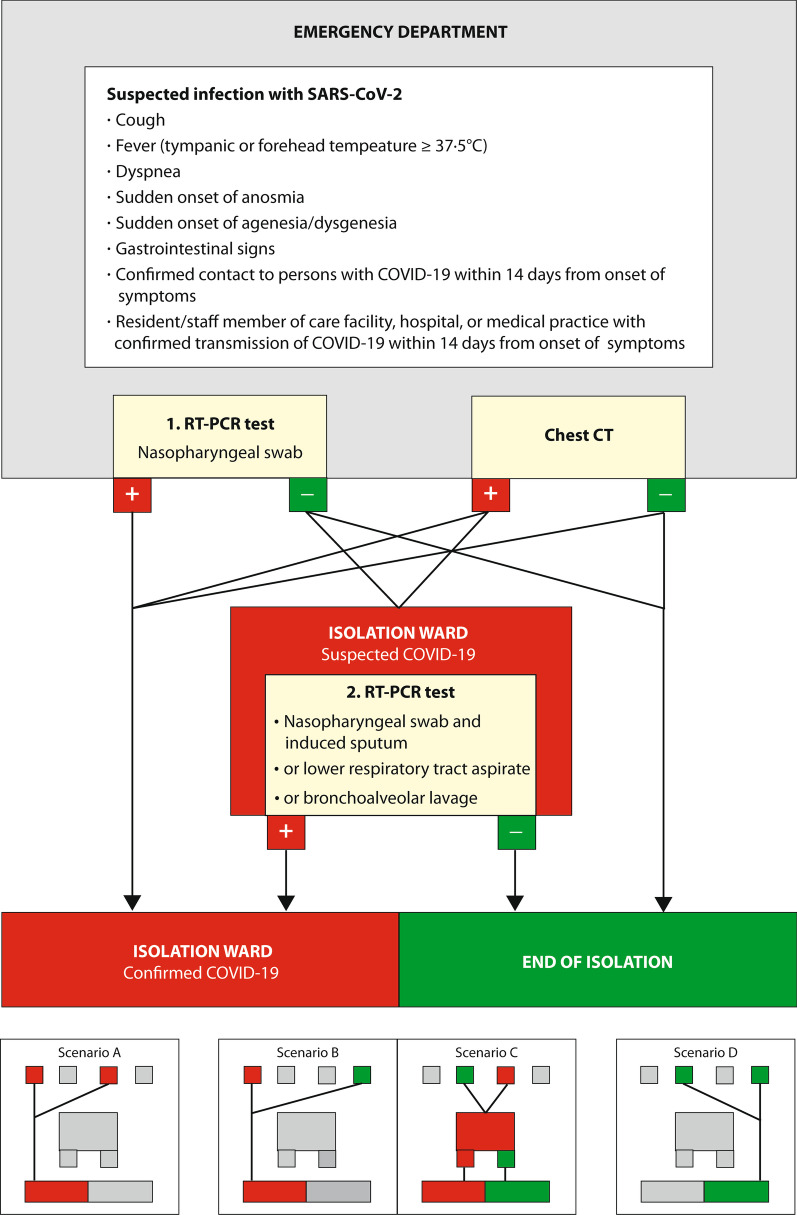
It is essential to avoid admission of patients with undetected corona virus disease 2019 (COVID-19) to hospitals' general wards. Even repeated negative reverse transcription polymerase chain reaction (RT-PCR) results do not rule-out COVID-19 with certainty. The study aimed to evaluate a rule-out strategy for COVID-19 using chest computed tomography (CT) in adults being admitted to the emergency department and suspected of COVID-19.
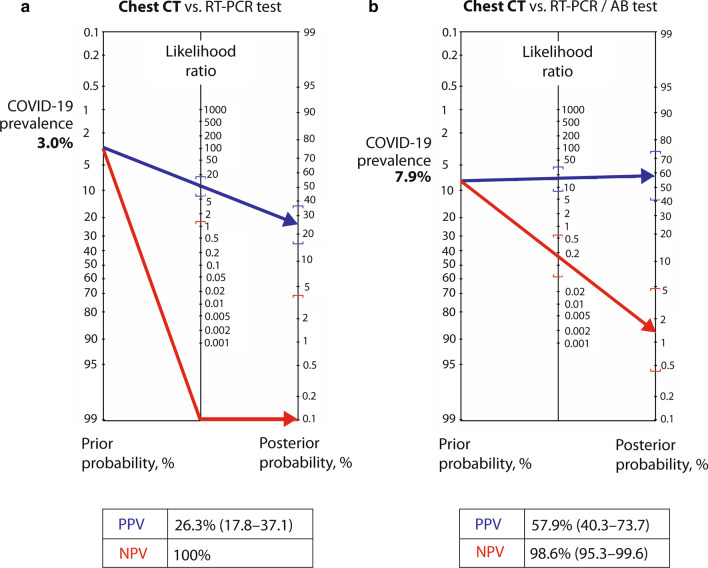
In this prospective, single centre, diagnostic accuracy cohort study, consecutive adults (≥ 18 years) presenting with symptoms consistent with COVID-19 or previous contact to infected individuals, admitted to the emergency department and supposed to be referred to general ward were included in March and April 2020. All participants underwent low-dose chest CT. RT-PCR- and specific antibody tests were used as reference standard. Main outcome measures were sensitivity and specificity of chest CT. Predictive values were calculated based on the theorem of Bayes using Fagan's nomogram.
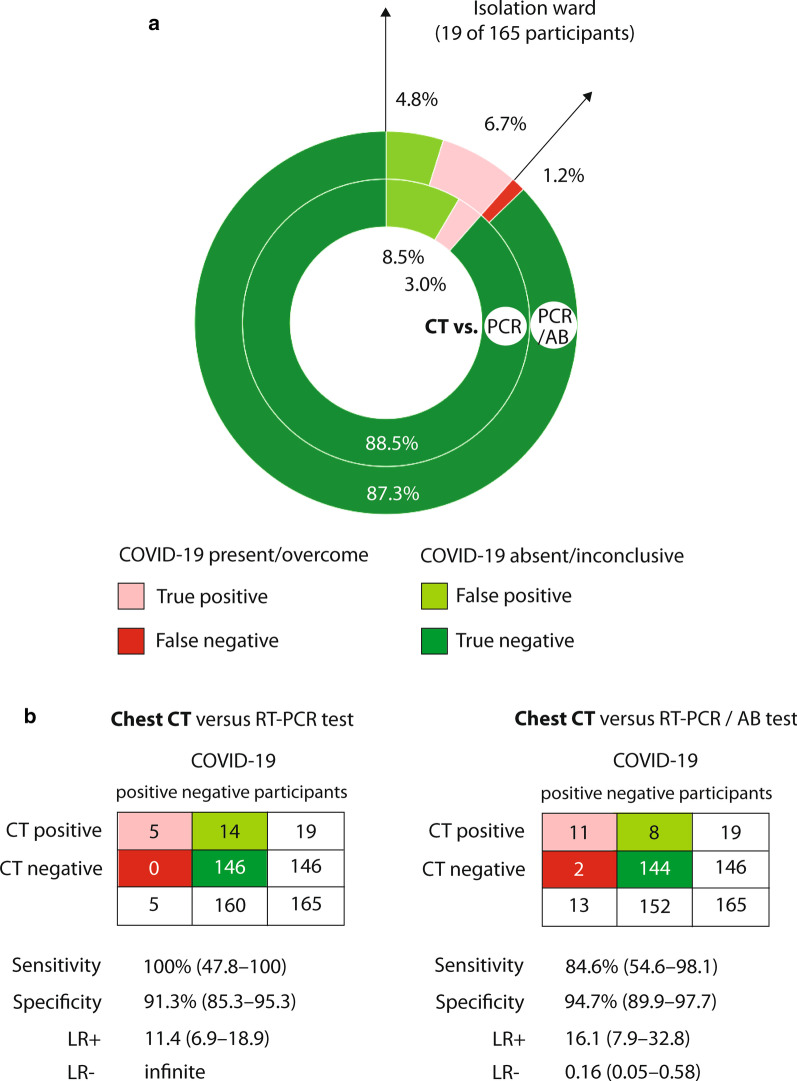
Of 165 participants (56.4% male, 71 ± 16 years) included in the study, the diagnosis of COVID-19 was confirmed with RT-PCR and AB tests in 13 participants (prevalence 7.9%). Sensitivity and specificity of chest CT were 84.6% (95% confidence interval [CI], 54.6-98.1) and 94.7% (95% CI, 89.9-97.7), respectively. Positive and negative likelihood ratio of chest CT were 16.1 (95% CI, 7.9-32.8) and 0.16 (95% CI, 0.05-0.58) and positive and negative predictive value were 57.9% (95% CI, 40.3-73.7) and 98.6% (95% CI, 95.3-99.6), respectively.
At a low prevalence of COVID-19, chest CT could be used as a complement to repeated RT-PCR testing for early COVID-19 exclusion in adults with suspected infection before referral to hospital's general wards. Trial registration ClinicalTrials.gov: NCT04357938 April 22, 2020.
避免将未检出的 2019 年冠状病毒病(COVID-19)患者收入医院普通病房至关重要。即使重复进行反转录聚合酶链反应(RT-PCR)检测结果阴性也不能完全排除 COVID-19。本研究旨在评估一种用于排除疑似 COVID-19 成年患者的策略,即使用胸部计算机断层扫描(CT)。
这是一项前瞻性、单中心、诊断准确性队列研究,连续纳入 2020 年 3 月至 4 月期间因符合 COVID-19 症状或与感染患者有过接触而收入急诊科、疑似 COVID-19 的成年患者(≥18 岁)。所有患者均接受低剂量胸部 CT 检查。RT-PCR 和特定抗体检测被用作参考标准。主要结局指标为胸部 CT 的敏感性和特异性。预测值基于贝叶斯定理,使用 Fagan 列线图计算。
在纳入的 165 名患者(56.4%为男性,71±16 岁)中,有 13 名患者(7.9%)通过 RT-PCR 和 AB 试验确诊 COVID-19。胸部 CT 的敏感性和特异性分别为 84.6%(95%可信区间[CI],54.6-98.1)和 94.7%(95%CI,89.9-97.7)。胸部 CT 的阳性和阴性似然比分别为 16.1(95%CI,7.9-32.8)和 0.16(95%CI,0.05-0.58),阳性和阴性预测值分别为 57.9%(95%CI,40.3-73.7)和 98.6%(95%CI,95.3-99.6)。
在 COVID-19 低流行率的情况下,胸部 CT 可作为对疑似感染成人在收入医院普通病房之前进行重复 RT-PCR 检测的补充,以早期排除 COVID-19。
ClinicalTrials.gov:NCT04357938,于 2020 年 4 月 22 日注册。