Department of Geological Sciences, University of North Carolina, Chapel Hill, NC, 27599, USA.
Department of Earth and Planetary Sciences, University of Tennessee, Knoxville, TN, 37996, USA.
Nat Commun. 2021 Jan 13;12(1):351. doi: 10.1038/s41467-020-20484-7.
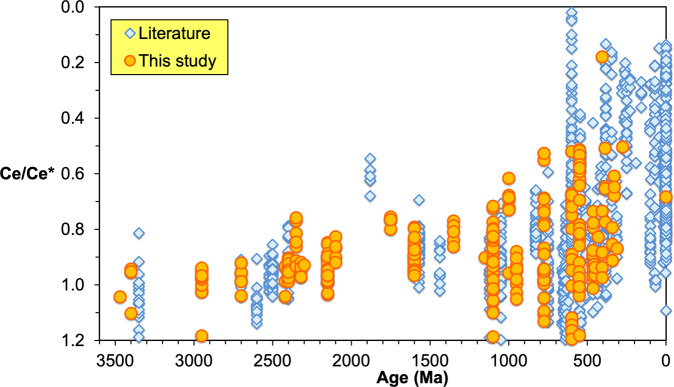
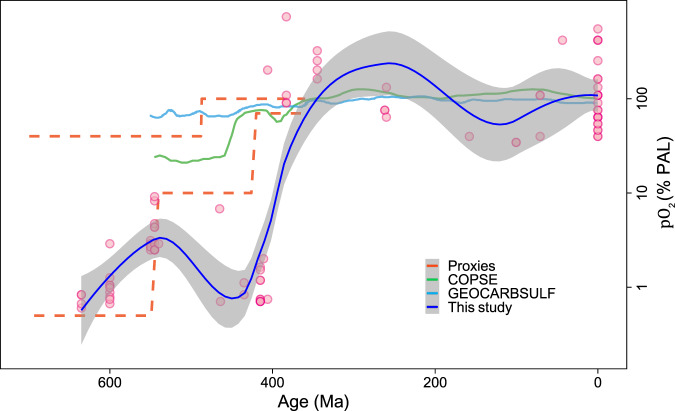
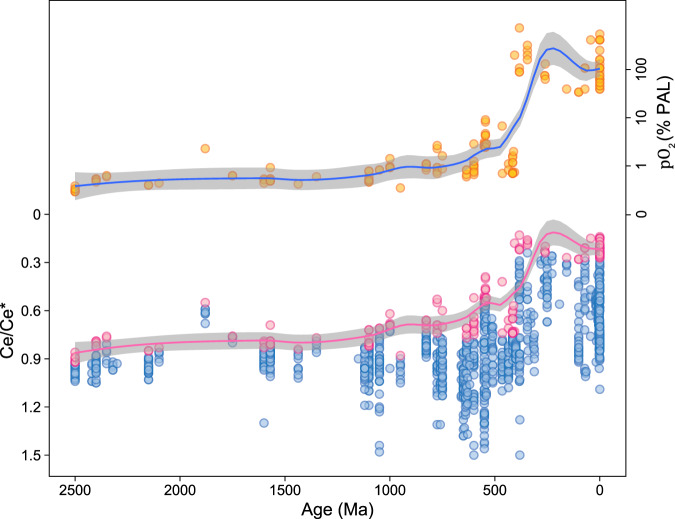
Resolving how Earth surface redox conditions evolved through the Proterozoic Eon is fundamental to understanding how biogeochemical cycles have changed through time. The redox sensitivity of cerium relative to other rare earth elements and its uptake in carbonate minerals make the Ce anomaly (Ce/Ce*) a particularly useful proxy for capturing redox conditions in the local marine environment. Here, we report Ce/Ce* data in marine carbonate rocks through 3.5 billion years of Earth's history, focusing in particular on the mid-Proterozoic Eon (i.e., 1.8 - 0.8 Ga). To better understand the role of atmospheric oxygenation, we use Ce/Ce* data to estimate the partial pressure of atmospheric oxygen (pO) through this time. Our thermodynamics-based modeling supports a major rise in atmospheric oxygen level in the aftermath of the Great Oxidation Event (~ 2.4 Ga), followed by invariant pO of about 1% of present atmospheric level through most of the Proterozoic Eon (2.4 to 0.65 Ga).
解决地球表面氧化还原条件如何在元古代演化的问题,对于理解生物地球化学循环随时间的变化至关重要。铈相对于其他稀土元素的氧化还原敏感性及其在碳酸盐矿物中的吸收,使得铈异常(Ce/Ce*)成为捕捉当地海洋环境氧化还原条件的特别有用的示踪剂。在这里,我们报告了地球历史上 35 亿年的海洋碳酸盐岩石中的 Ce/Ce数据,特别关注中元古代(即 18 亿至 8 亿年前)。为了更好地了解大气增氧的作用,我们使用 Ce/Ce数据来估算这一时期的大气氧气分压(pO)。我们基于热力学的建模支持在大氧化事件(约 24 亿年前)之后,大气氧气水平出现了大幅上升,随后在大部分元古代(24 亿至 6.5 亿年前),大气氧气分压保持在约为现代大气水平的 1%不变。