Department of Urology, Seoul National University Bundang Hospital, Seongnam, 13620, Korea.
Department of Convergence Software, Hallym University, Chuncheon, 24252, Korea.
Sci Rep. 2021 Jan 13;11(1):1242. doi: 10.1038/s41598-020-80262-9.
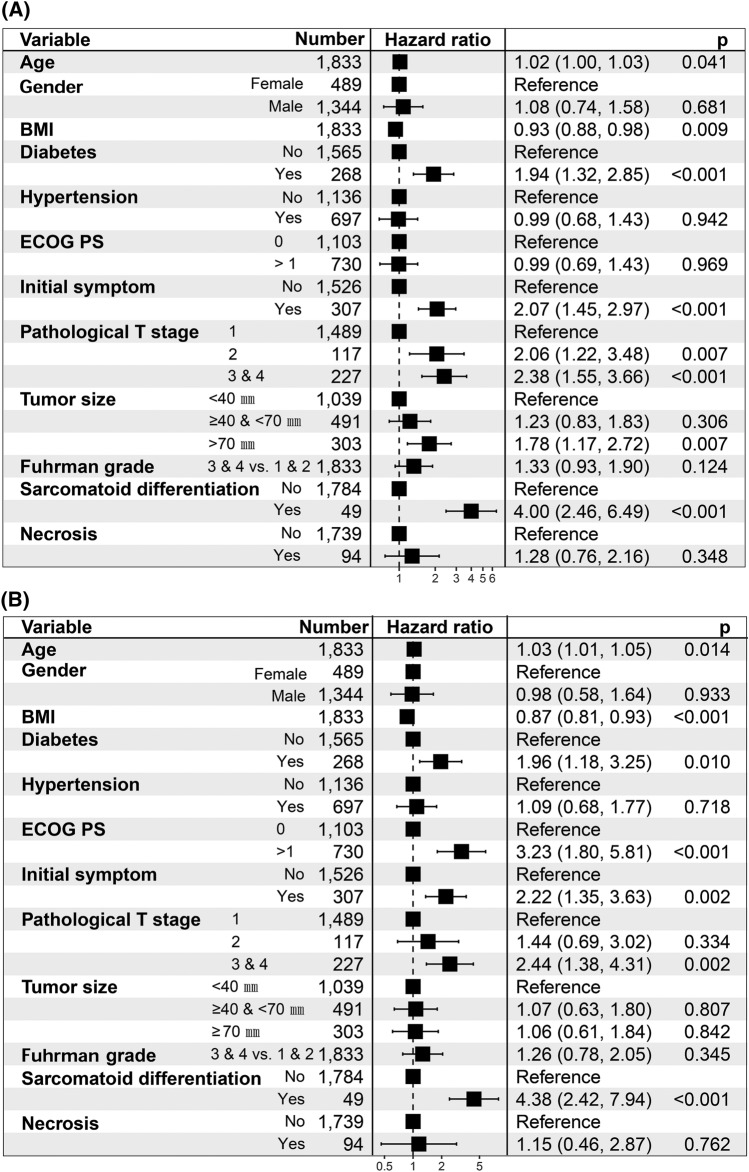
Survival analyses for malignancies, including renal cell carcinoma (RCC), have primarily been conducted using the Cox proportional hazards (CPH) model. We compared the random survival forest (RSF) and DeepSurv models with the CPH model to predict recurrence-free survival (RFS) and cancer-specific survival (CSS) in non-metastatic clear cell RCC (nm-cRCC) patients. Our cohort included 2139 nm-cRCC patients who underwent curative-intent surgery at six Korean institutions between 2000 and 2014. The data of two largest hospitals' patients were assigned into the training and validation dataset, and the data of the remaining hospitals were assigned into the external validation dataset. The performance of the RSF and DeepSurv models was compared with that of CPH using Harrel's C-index. During the follow-up, recurrence and cancer-specific deaths were recorded in 190 (12.7%) and 108 (7.0%) patients, respectively, in the training-dataset. Harrel's C-indices for RFS in the test-dataset were 0.794, 0.789, and 0.802 for CPH, RSF, and DeepSurv, respectively. Harrel's C-indices for CSS in the test-dataset were 0.831, 0.790, and 0.834 for CPH, RSF, and DeepSurv, respectively. In predicting RFS and CSS in nm-cRCC patients, the performance of DeepSurv was superior to that of CPH and RSF. In no distant time, deep learning-based survival predictions may be useful in RCC patients.
生存分析在恶性肿瘤中得到了广泛应用,包括肾细胞癌(RCC)。这些分析主要使用Cox 比例风险(CPH)模型进行。我们比较了随机生存森林(RSF)和 DeepSurv 模型与 CPH 模型在预测无复发生存(RFS)和癌症特异性生存(CSS)方面的性能,用于非转移性透明细胞 RCC(nm-cRCC)患者。我们的队列包括 2139 例在 2000 年至 2014 年间在六家韩国机构接受根治性手术的 nm-cRCC 患者。两所最大医院患者的数据被分配到训练和验证数据集,其余医院的数据被分配到外部验证数据集。使用 Harrell 的 C 指数比较了 RSF 和 DeepSurv 模型与 CPH 的性能。在随访期间,在训练数据集中分别有 190 例(12.7%)和 108 例(7.0%)患者出现复发和癌症特异性死亡。CPH、RSF 和 DeepSurv 在测试数据集中的 RFS 的 Harrell C 指数分别为 0.794、0.789 和 0.802。CPH、RSF 和 DeepSurv 在测试数据集中的 CSS 的 Harrell C 指数分别为 0.831、0.790 和 0.834。在预测 nm-cRCC 患者的 RFS 和 CSS 方面,DeepSurv 的性能优于 CPH 和 RSF。在不远的将来,基于深度学习的生存预测可能对 RCC 患者有用。