Department of Economics, University of Konstanz, D-78457 Konstanz, Germany;
Thurgau Institute of Economics, CH-8280, Kreuzlingen, Switzerland.
Proc Natl Acad Sci U S A. 2021 Jan 5;118(1). doi: 10.1073/pnas.2016385118.
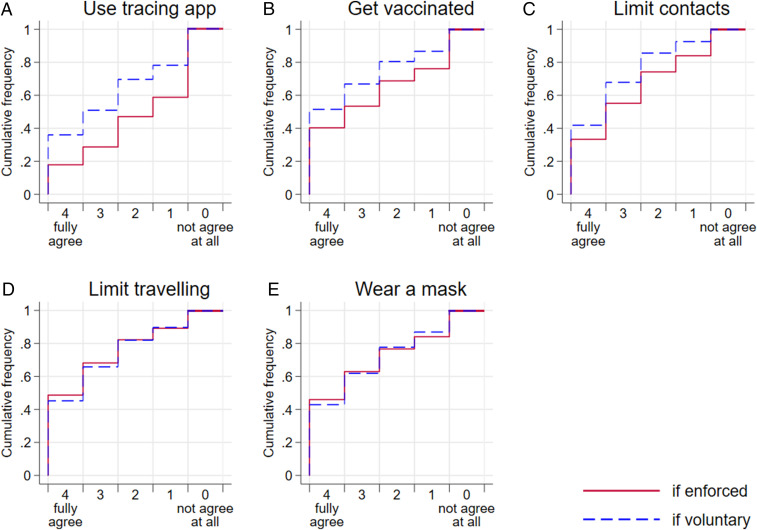
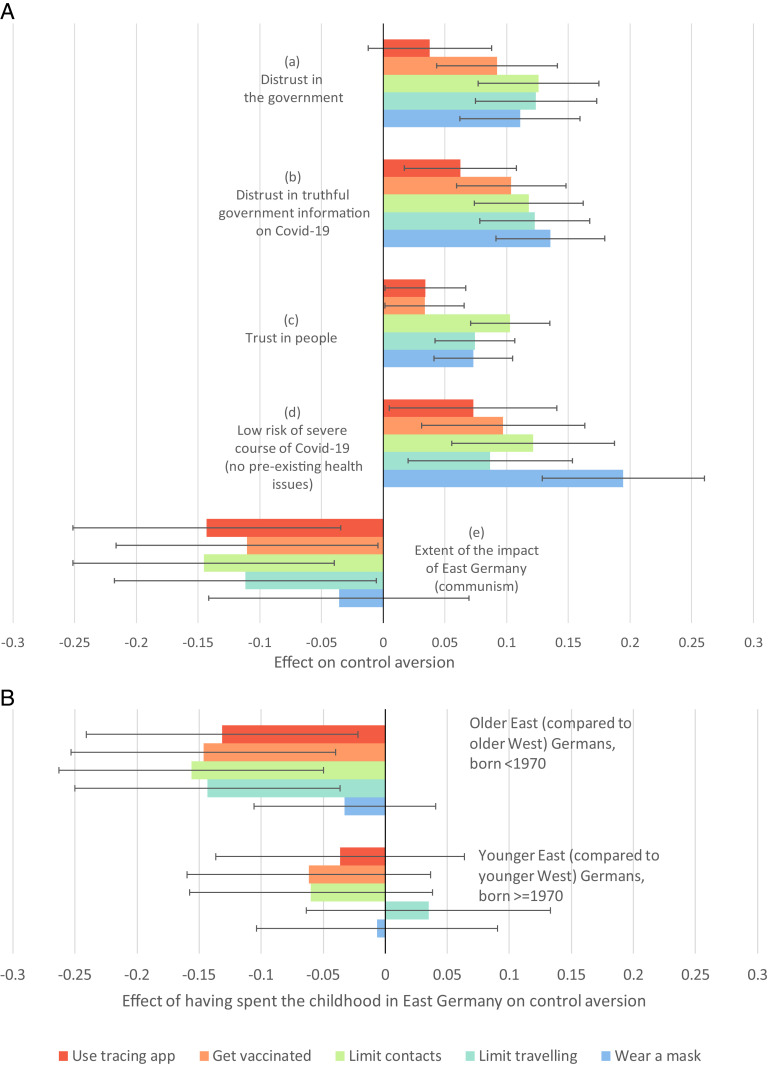
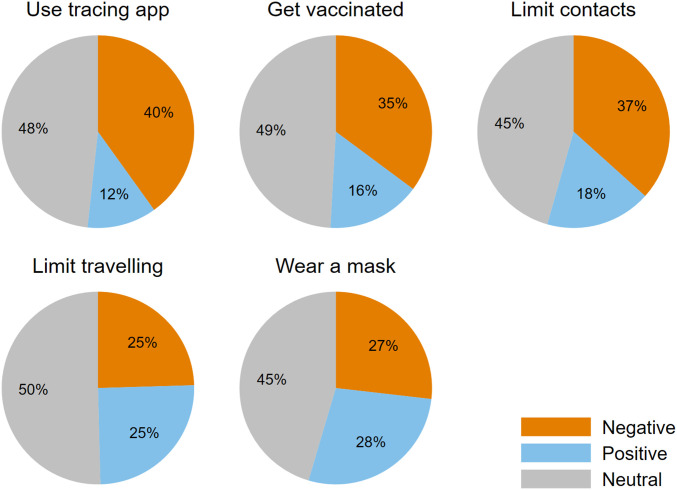
Effective states govern by some combination of enforcement and voluntary compliance. To contain the COVID-19 pandemic, a critical decision is the extent to which policy makers rely on voluntary as opposed to enforced compliance, and nations vary along this dimension. While enforcement may secure higher compliance, there is experimental and other evidence that it may also crowd out voluntary motivation. How does enforcement affect citizens' support for anti-COVID-19 policies? A survey conducted with 4,799 respondents toward the end of the first lockdown in Germany suggests that a substantial share of the population will support measures more under voluntary than under enforced implementation. Negative responses to enforcement-termed control aversion-vary across the nature of the policy intervention (e.g., they are rare for masks and frequent for vaccination and a cell-phone tracing app). Control aversion is less common among those with greater trust in the government and the information it provides, and among those who were brought up under the coercive regime of East Germany. Taking account of the likely effectiveness of enforcement and the extent to which near-universal compliance is crucial, the differing degrees of opposition to enforcement across policies suggest that for some anti-COVID-19 policies an enforced mandate would be unwise, while for others it would be essential. Similar reasoning may also be relevant for policies to address future pandemics and other societal challenges like climate change.
有效的治理模式是执法与自愿遵守的结合。为了控制 COVID-19 大流行,一个关键决策是政策制定者在多大程度上依赖自愿遵守而非强制遵守,各国在这一方面存在差异。虽然执法可以确保更高的合规性,但有实验和其他证据表明,它也可能挤出自愿遵守的动机。执法如何影响公民对反 COVID-19 政策的支持?在德国第一次封锁接近尾声时,对 4799 名受访者进行的一项调查表明,相当一部分人口将在自愿实施的情况下比在强制实施的情况下更支持这些措施。对执法的负面反应(称为控制回避)因政策干预的性质而异(例如,对口罩的控制回避很少,而对疫苗接种和手机追踪应用程序的控制回避则很常见)。控制回避在对政府及其提供的信息更信任的人群中较少见,在东德强制性政权下长大的人群中也较少见。考虑到执法的可能效果以及普遍遵守的重要性,不同政策之间对执法的不同程度的反对表明,对于一些反 COVID-19 政策,强制命令将是不明智的,而对于其他政策,强制命令将是必要的。类似的推理也可能适用于应对未来大流行和气候变化等其他社会挑战的政策。