London School of Hygiene and Tropical Medicine, United Kingdom.
University of Gothenburg, Sweden.
Child Abuse Negl. 2021 Jun;116(Pt 2):104897. doi: 10.1016/j.chiabu.2020.104897. Epub 2020 Dec 22.
The COVID-19 pandemic could increase violence against children at home. However, collecting empirical data on violence is challenging due to ethical, safety, and data quality concerns.
This study estimated the anticipated effect of COVID-19 on violent discipline at home using multivariable predictive regression models.
Children aged 1-14 years and household members from the Multiple Indicator Cluster Surveys (MICS) conducted in Nigeria, Mongolia, and Suriname before the COVID-19 pandemic were included.
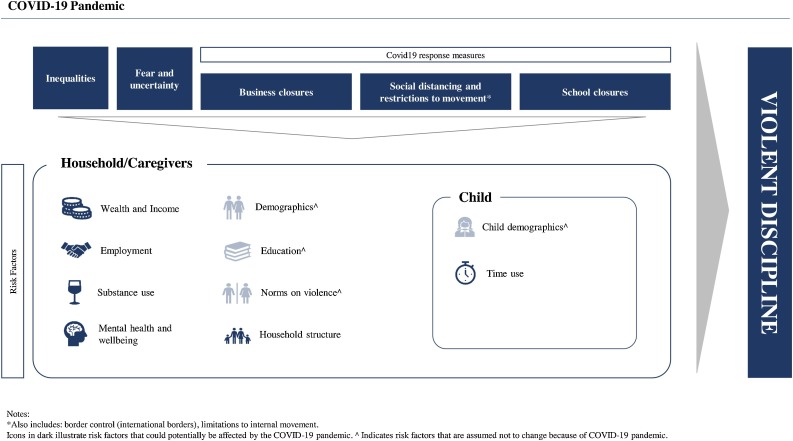
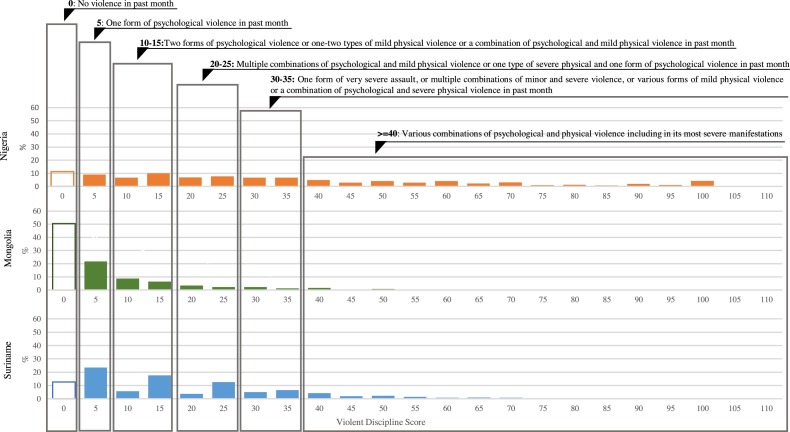
A conceptual model of how the COVID-19 pandemic could affect risk factors for violent discipline was developed. Country specific multivariable linear models were used to estimate the association between selected variables from MICS and a violent discipline score which captured the average combination of violent disciplinary methods used in the home. A review of the literature informed the development of quantitative assumptions about how COVID-19 would impact the selected variables under a "high restrictions" pandemic scenario, approximating conditions expected during a period of intense response measures, and a "lower restrictions" scenario with easing of COVID-19 restrictions but with sustained economic impacts. These assumptions were used to estimate changes in violent discipline scores.
Under a "high restrictions" scenario there would be a 35%-46% increase in violent discipline scores in Nigeria, Mongolia and Suriname, and under a "lower restrictions" scenario there would be between a 4%-6% increase in violent discipline scores in these countries.
Policy makers need to plan for increases in violent discipline during successive waves of lockdowns.
新冠疫情大流行可能会增加家庭内针对儿童的暴力行为。然而,由于伦理、安全和数据质量方面的考虑,收集有关暴力行为的实证数据具有挑战性。
本研究使用多变量预测回归模型,估计新冠疫情对家庭内暴力管教的预期影响。
本研究纳入了在新冠疫情大流行之前,于尼日利亚、蒙古和苏里南开展的多指标类集调查(MICS)中 1-14 岁的儿童及其家庭成员。
我们构建了一个概念模型,用以说明新冠疫情大流行如何影响暴力管教风险因素。我们使用国家特定的多变量线性模型,估计来自 MICS 的选定变量与暴力管教得分之间的关联,该得分捕捉了家庭中使用的各种暴力管教方法的平均组合。文献综述为如何根据新冠疫情对选定变量的影响做出定量假设提供了信息,这些假设反映了在严格限制疫情传播的“高限制”大流行情景下以及在限制措施放宽但经济持续受到影响的“低限制”情景下的预期情况。这些假设被用于估计暴力管教得分的变化。
在“高限制”情景下,尼日利亚、蒙古和苏里南的暴力管教得分预计会增加 35%-46%,而在“低限制”情景下,这些国家的暴力管教得分预计会增加 4%-6%。
决策者需要为连续封锁期间暴力管教的增加做好规划。