Azizi-Soleiman Fatemeh, Sharifi Hamid, Zamanian Maryam
Department of Nutrition, School of Health, Arak University of Medical Sciences, Arak, Iran.
HIV/STI Surveillance Research Center, and WHO Collaborating Center for HIV Surveillance, Institute for Futures Studies in Health, Kerman University of Medical Sciences, Kerman, Iran.
Int J Prev Med. 2020 Nov 26;11:182. doi: 10.4103/ijpvm.IJPVM_18_19. eCollection 2020.
To plan for decreasing the prevalence of malnutrition among children, reliable data of current status are required. The aim of the present cross-sectional study was to estimate the prevalence and trend of malnutrition among Iranian children.
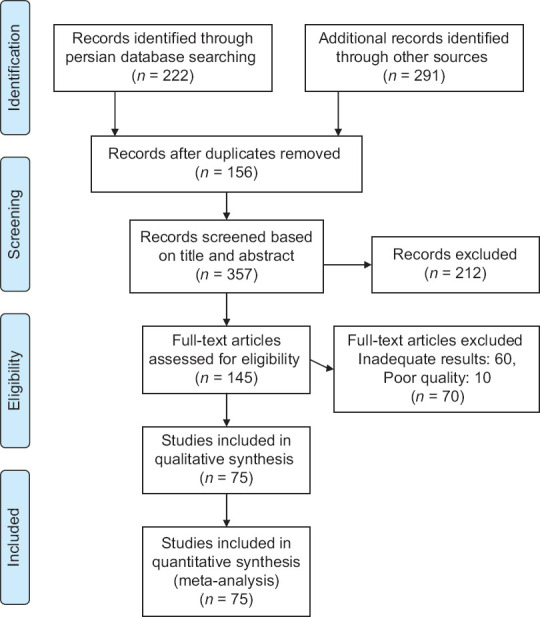
PubMed, ISI Web of Science, Scopus, Google Scholar, and Iranian databases including SID and Magiran were searched for studies published prior to October 2017 with MeSH terms of Malnutrition, Nutrition Disorders, Wasting, Stunting, Underweight, Undernutrition, Nutrition, Anthropometry, Weight, and Children and Iran. Three random effect models were applied to estimate the pooled prevalence of underweight, stunting, and wasting. Meta-regression and cumulative meta-analysis were performed. All analyses were also conducted separately for two different age groups including 0-6 years old (preschool) and 7-11 years old (primary school). Seventy-five studies (information of 1,069,815 individuals) were included in the final meta-analysis.
The overall prevalence of underweight, stunting, and wasting was estimated to be 8.4% [95% confidence interval (CI): 7.6-9.1], 14.5% (95% CI: 13.1-15.9) and 5.6% (95% CI: 5-6.2) in children age 0-6 years, and 6.6% (95% CI: 4.8-8.4), 7.3% (95% CI: 5.6-9.1), and 8.3% (95% CI: 6-10.7) in children age 7-11 years, respectively.
The cumulative meta-analysis showed a decrease in the general trend of malnutrition in both preschool and primary school children of Iran. Stunting and wasting were the most common form of malnutrition in Iranian preschool and primary school children, respectively. The decreasing trend of malnutrition was much more noticeable about stunting.
为规划降低儿童营养不良患病率,需要当前状况的可靠数据。本横断面研究的目的是估计伊朗儿童营养不良的患病率和趋势。
检索了PubMed、ISI科学网、Scopus、谷歌学术以及包括SID和Magiran在内的伊朗数据库,查找2017年10月之前发表的研究,其医学主题词为营养不良、营养障碍、消瘦、发育迟缓、体重不足、营养不足、营养、人体测量学、体重以及儿童和伊朗。应用三种随机效应模型来估计体重不足、发育迟缓和消瘦的合并患病率。进行了Meta回归和累积Meta分析。所有分析也分别针对两个不同年龄组进行,即0至6岁(学龄前)和7至11岁(小学)。最终的Meta分析纳入了75项研究(1,069,815人的信息)。
0至6岁儿童体重不足、发育迟缓和消瘦的总体患病率估计分别为8.4%[95%置信区间(CI):7.6 - 9.1]、14.5%(95%CI:13.1 - 15.9)和5.6%(95%CI:5 - 6.2),7至11岁儿童分别为6.6%(95%CI:4.8 - 8.4)、7.3%(95%CI:5.6 - 9.1)和8.3%(95%CI:6 - 10.7)。
累积Meta分析表明,伊朗学龄前和小学儿童营养不良的总体趋势有所下降。发育迟缓是伊朗学龄前儿童最常见的营养不良形式,消瘦是小学儿童最常见的营养不良形式。营养不良的下降趋势在发育迟缓方面更为明显。