• 文献检索
  • 文档翻译
  • 深度研究
  • 学术资讯
  • Suppr Zotero 插件Zotero 插件
  • 邀请有礼
  • 套餐&价格
  • 历史记录
应用&插件
Suppr Zotero 插件Zotero 插件浏览器插件Mac 客户端Windows 客户端微信小程序
定价
高级版会员购买积分包购买API积分包
服务
文献检索文档翻译深度研究API 文档MCP 服务
关于我们
关于 Suppr公司介绍联系我们用户协议隐私条款
关注我们

Suppr 超能文献

核心技术专利:CN118964589B侵权必究
粤ICP备2023148730 号-1Suppr @ 2026

文献检索

告别复杂PubMed语法,用中文像聊天一样搜索,搜遍4000万医学文献。AI智能推荐,让科研检索更轻松。

立即免费搜索

文件翻译

保留排版,准确专业,支持PDF/Word/PPT等文件格式,支持 12+语言互译。

免费翻译文档

深度研究

AI帮你快速写综述,25分钟生成高质量综述,智能提取关键信息,辅助科研写作。

立即免费体验

基于网络的 COVID-19 阿拉伯文健康信息的质量和可读性:一项信息流行病学研究。

Quality and readability of web-based Arabic health information on COVID-19: an infodemiological study.

机构信息

Department of Maxillofacial Surgery and Diagnostic Sciences, College of Dentistry, Jazan University, Jazan, Kingdom of Saudi Arabia.

Department of Oral Medicine, Oral Pathology and Oral Radiology, Faculty of Dentistry, Sana'a University, Sana'a, Yemen.

出版信息

BMC Public Health. 2021 Jan 18;21(1):151. doi: 10.1186/s12889-021-10218-9.

DOI:10.1186/s12889-021-10218-9
PMID:33461516
原文链接:https://pmc.ncbi.nlm.nih.gov/articles/PMC7812558/
Abstract

BACKGROUND

This study sought to assess the quality and readability of web-based Arabic health information on COVID-19.

METHODS

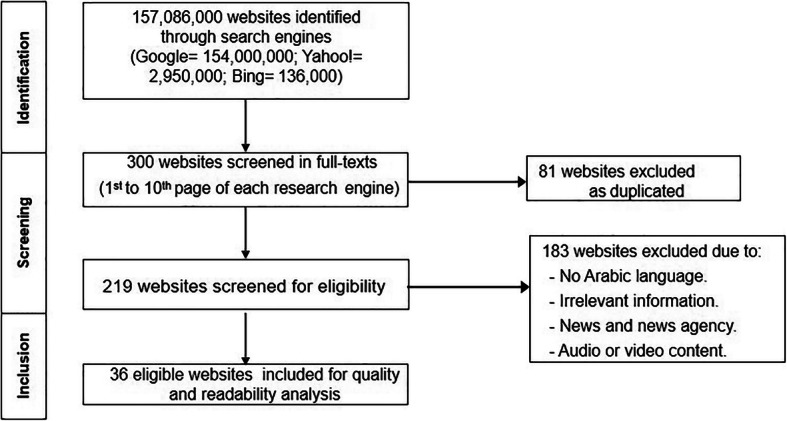
Three search engines were searched on 13 April 2020 for specific Arabic terms on COVID-19. The first 100 consecutive websites from each engine were analyzed for eligibility, which resulted in a sample of 36 websites. These websites were subjected to quality assessments using the Journal of the American Medical Association (JAMA) benchmarks tool, the DISCERN tool, and Health on the Net Foundation Code of Conduct (HONcode) certification. The readability of the websites was assessed using an online readability calculator.

RESULTS

Among the 36 eligible websites, only one (2.7%) was HONcode certified. No website attained a high score based on the criteria of the DISCERN tool; the mean score of all websites was 31.5 ± 12.55. As regards the JAMA benchmarks results, a mean score of 2.08 ± 1.05 was achieved by the websites; however, only four (11.1%) met all the JAMA criteria. The average grade levels for readability were 7.2 ± 7.5, 3.3 ± 0.6 and 93.5 ± 19.4 for the Flesch Kincaid Grade Level, Simple Measure of Gobbledygook, and Flesch Reading Ease scales, respectively.

CONCLUSION

Almost all of the most easily accessible web-based Arabic health information on COVID-19 does not meet recognized quality standards regardless of the level of readability and ability to be understood by the general population of Arabic speakers.

摘要

背景

本研究旨在评估 COVID-19 阿拉伯文在线健康信息的质量和可读性。

方法

2020 年 4 月 13 日,通过三个搜索引擎以特定的阿拉伯文术语搜索 COVID-19。从每个引擎中分析前 100 个连续的网站以确定其是否符合入选标准,最终纳入了 36 个网站。使用《美国医学会杂志》(JAMA)基准工具、DISCERN 工具和健康网络基金会行为准则(HONcode)认证对这些网站进行质量评估。使用在线可读性计算器评估网站的可读性。

结果

在 36 个合格的网站中,只有一个(2.7%)通过了 HONcode 认证。没有一个网站在 DISCERN 工具的标准下获得高分;所有网站的平均得分为 31.5±12.55。至于 JAMA 基准测试结果,网站平均得分为 2.08±1.05;然而,只有四个(11.1%)符合所有 JAMA 标准。可读性的平均年级水平分别为 Flesch Kincaid 年级水平的 7.2±7.5、简单的文字难度等级的 3.3±0.6 和 Flesch 阅读舒适度的 93.5±19.4。

结论

无论可读性和阿拉伯语母语人群的理解能力如何,大多数最容易获得的 COVID-19 阿拉伯文在线健康信息都不符合公认的质量标准。
https://cdn.ncbi.nlm.nih.gov/pmc/blobs/df07/7814450/888b1325817d/12889_2021_10218_Fig1_HTML.jpg

相似文献

1
Quality and readability of web-based Arabic health information on COVID-19: an infodemiological study.基于网络的 COVID-19 阿拉伯文健康信息的质量和可读性:一项信息流行病学研究。
BMC Public Health. 2021 Jan 18;21(1):151. doi: 10.1186/s12889-021-10218-9.
2
Assessment of the Quality and Readability of Web-Based Arabic Health Information on Halitosis: Infodemiological Study.基于网络的口臭阿拉伯文健康信息质量和可读性评估:信息流行病学研究。
J Med Internet Res. 2024 Aug 28;26:e54072. doi: 10.2196/54072.
3
Quality and readability of web-based information on dental caries in Arabic: an infodemiological study.基于网络的阿拉伯文龋齿信息的质量和可读性:一项信息流行病学研究。
BMC Oral Health. 2023 Oct 25;23(1):797. doi: 10.1186/s12903-023-03547-1.
4
Quality and readability of web-based Arabic health information on periodontal disease.基于网络的牙周病阿拉伯文健康信息的质量和可读性。
BMC Med Inform Decis Mak. 2021 Feb 4;21(1):41. doi: 10.1186/s12911-021-01413-0.
5
Quality and Readability of Web-based Arabic Health Information on Denture Hygiene: An Infodemiology Study.基于网络的阿拉伯语假牙卫生健康信息的质量与可读性:一项信息流行病学研究。
J Contemp Dent Pract. 2020 Sep 1;21(9):956-960.
6
Assessment of the Arabic patient-centered online information about orthodontic pain: A quality and readability assessment.评估阿拉伯语患者为中心的正畸疼痛在线信息:质量和可读性评估。
PLoS One. 2024 May 23;19(5):e0303308. doi: 10.1371/journal.pone.0303308. eCollection 2024.
7
Quality of web-based Arabic health information on dental implants: an infodemiological study.基于网络的阿拉伯文牙科植入物健康信息质量:一项信息流行病学研究。
BMC Oral Health. 2023 Apr 20;23(1):232. doi: 10.1186/s12903-023-02938-8.
8
Web-Based Health Information Following the Renewal of the Cervical Screening Program in Australia: Evaluation of Readability, Understandability, and Credibility.澳大利亚宫颈筛查计划更新后的基于网络的健康信息:可读性、可理解性和可信度评估
J Med Internet Res. 2020 Jun 26;22(6):e16701. doi: 10.2196/16701.
9
Evaluating the Quality, Content, and Readability of Online Resources for Failed Back Spinal Surgery.评估失败性脊柱手术后在线资源的质量、内容和可读性。
Spine (Phila Pa 1976). 2019 Apr 1;44(7):494-502. doi: 10.1097/BRS.0000000000002870.
10
Misinformation of COVID-19 on the Internet: Infodemiology Study.互联网上关于 COVID-19 的错误信息:信息流行病学研究。
JMIR Public Health Surveill. 2020 Apr 9;6(2):e18444. doi: 10.2196/18444.

引用本文的文献

1
An infodemiologic review of internet resources on dental hypersensitivity: A quality and readability assessment.关于牙齿过敏症互联网资源的信息流行病学综述:质量与可读性评估
PLoS One. 2025 Jan 24;20(1):e0312832. doi: 10.1371/journal.pone.0312832. eCollection 2025.
2
Web-Based Educational Resources for Patients with Sickle Cell Disease: Availability and Reliability.镰状细胞病患者基于网络的教育资源:可用性与可靠性
Int J Gen Med. 2024 Dec 27;17:6487-6493. doi: 10.2147/IJGM.S495248. eCollection 2024.
3
Exploring online health information quality criteria on social media: a mixed method approach.

本文引用的文献

1
Quality and Readability of Web-based Arabic Health Information on Denture Hygiene: An Infodemiology Study.基于网络的阿拉伯语假牙卫生健康信息的质量与可读性:一项信息流行病学研究。
J Contemp Dent Pract. 2020 Sep 1;21(9):956-960.
2
Social Media Use, eHealth Literacy, Disease Knowledge, and Preventive Behaviors in the COVID-19 Pandemic: Cross-Sectional Study on Chinese Netizens.新冠疫情期间社交媒体使用、电子健康素养、疾病知识及预防行为:针对中国网民的横断面研究
J Med Internet Res. 2020 Oct 9;22(10):e19684. doi: 10.2196/19684.
3
Quality of online information for the general public on COVID-19.
社交媒体上在线健康信息质量标准的探索:混合方法研究。
BMC Health Serv Res. 2024 Oct 30;24(1):1311. doi: 10.1186/s12913-024-11838-8.
4
Content Analysis of Arabic Websites As Patient Resources for Osteoporosis.作为骨质疏松症患者资源的阿拉伯语网站内容分析
Cureus. 2024 Jul 19;16(7):e64880. doi: 10.7759/cureus.64880. eCollection 2024 Jul.
5
Is Arabic online patient-centered information about dental extraction trustworthy? An infodemiological study.关于拔牙的以患者为中心的阿拉伯语在线信息是否可信?一项信息流行病学研究。
Digit Health. 2024 Jul 21;10:20552076241264390. doi: 10.1177/20552076241264390. eCollection 2024 Jan-Dec.
6
Assessment of the Arabic patient-centered online information about orthodontic pain: A quality and readability assessment.评估阿拉伯语患者为中心的正畸疼痛在线信息:质量和可读性评估。
PLoS One. 2024 May 23;19(5):e0303308. doi: 10.1371/journal.pone.0303308. eCollection 2024.
7
Arabic Web-Based Information on Oral Lichen Planus: Content Analysis.基于阿拉伯语网络的口腔扁平苔藓信息:内容分析
JMIR Form Res. 2024 Mar 19;8:e49198. doi: 10.2196/49198.
8
Arabic websites assessment of irritable bowel syndrome: How trustworthy are they? A cross-sectional study.阿拉伯语网站对肠易激综合征的评估:它们的可信度如何?一项横断面研究。
Health Sci Rep. 2024 Feb 6;7(2):e1819. doi: 10.1002/hsr2.1819. eCollection 2024 Feb.
9
Evaluating online health information quality using machine learning and deep learning: A systematic literature review.使用机器学习和深度学习评估在线健康信息质量:一项系统的文献综述。
Digit Health. 2023 Nov 20;9:20552076231212296. doi: 10.1177/20552076231212296. eCollection 2023 Jan-Dec.
10
COVID-19 vaccine-related misinformation identification among Chinese residents during a regional outbreak.中国居民在区域性疫情爆发期间对 COVID-19 疫苗相关错误信息的识别。
Front Public Health. 2023 Oct 6;11:1258466. doi: 10.3389/fpubh.2023.1258466. eCollection 2023.
面向公众的关于新冠病毒的在线信息质量。
Patient Educ Couns. 2020 Aug 7;103(12):2594-7. doi: 10.1016/j.pec.2020.08.001.
4
Impact of National Containment Measures on Decelerating the Increase in Daily New Cases of COVID-19 in 54 Countries and 4 Epicenters of the Pandemic: Comparative Observational Study.国家防控措施对54个国家和4个疫情中心减缓新型冠状病毒肺炎每日新增病例数增长的影响:比较性观察研究
J Med Internet Res. 2020 Jul 22;22(7):e19904. doi: 10.2196/19904.
5
Restructured society and environment: A review on potential technological strategies to control the COVID-19 pandemic.重构的社会和环境:控制 COVID-19 大流行的潜在技术策略综述。
Sci Total Environ. 2020 Jul 10;725:138858. doi: 10.1016/j.scitotenv.2020.138858. Epub 2020 Apr 23.
6
Quality Assessment of Information on Oral Cancer Provided at Arabic Speaking Websites.阿拉伯语网站提供的口腔癌信息质量评估。
Asian Pac J Cancer Prev. 2020 Apr 1;21(4):961-966. doi: 10.31557/APJCP.2020.21.4.961.
7
Association of the COVID-19 pandemic with Internet Search Volumes: A Google Trends Analysis.新冠疫情与互联网搜索量的关联:谷歌趋势分析
Int J Infect Dis. 2020 Jun;95:192-197. doi: 10.1016/j.ijid.2020.04.033. Epub 2020 Apr 17.
8
Misinformation of COVID-19 on the Internet: Infodemiology Study.互联网上关于 COVID-19 的错误信息:信息流行病学研究。
JMIR Public Health Surveill. 2020 Apr 9;6(2):e18444. doi: 10.2196/18444.
9
Assessment of Health Information About COVID-19 Prevention on the Internet: Infodemiological Study.评估互联网上关于 COVID-19 预防的健康信息:信息流行病学研究。
JMIR Public Health Surveill. 2020 Apr 1;6(2):e18717. doi: 10.2196/18717.
10
World Health Organization declares global emergency: A review of the 2019 novel coronavirus (COVID-19).世界卫生组织宣布全球紧急状态:对 2019 年新型冠状病毒(COVID-19)的回顾。
Int J Surg. 2020 Apr;76:71-76. doi: 10.1016/j.ijsu.2020.02.034. Epub 2020 Feb 26.